Sunday, April 01, 2007

Chocolate Sculpture of a Nude Jesus


Editors note: I included some of the comments from readers of this story.


He seeks new home for 'Jesus'

Choc-statue artist sez offers abound


BY CHRISTINA BOYLE and NICOLE LYN PESCE
DAILY NEWS WRITERS


Artist Cosimo Gavallero with his controversial chocolate Jesus sculpture.

The chocolate sculpture of a nude Jesus is being held in a secret location, but it could have a new home soon.

The artist who created "My Sweet Lord" said he's gotten offers from around the world to buy or exhibit the controversial figure booted from a Manhattan gallery.

"I've got thousands of e-mails of help and donations, people who want to support it, give money, even offer exhibition space, from Holland to Japan," Cosimo Cavallaro said yesterday.

"It's quite amazing."

While Cavallaro weighed the offers, the uproar over his work was causing problems for a fellow artist who also carves religious figures out of chocolate.

George Heslop displayed a chocolate Jesus on a crucifix in his native England last year and was hoping to reprise the show in the U.S.

"Now I'm having second thoughts," he said.

Cavallaro's 200-pound sculpture was supposed to be shown at the Lab Gallery in the Roger Smith Hotel on E. 47th St. during Holy Week.

But a Daily News story about the work - which presents Christ with his arms outstretched and without a loincloth - sparked complaints from some Catholics, and the hotel pulled the plug.

Now the dark chocolate figure is in a refrigerated truck in a secret location, living a "gypsy" existence "going around and trying to find a home," Cavallaro said.

"I don't want to disclose the location because of people, some people who are fanatics," he said, adding that he's received threats.

When Heslop exhibited his life-size Jesus last year, it also ignited a firestorm, but the show went on.

He now lives in Arizona and expected to submit applications to show the sculpture to U.S. galleries - a plan he is rethinking.

"I probably won't send it now," he said.

"Obviously the U.K. and America are very, very different," he said.

npesce@nydailynews.com
Related Articles

*
satan666
Apr 2, 2007 10:43:10 PM

When are we going to put a stop to the Catholic church and their threats. I am so sick and tired of them trying to stop whatever it is that they do not agree with this is a free country and we sending so many of our young people to die in yet another religious war. When are we going to see the stupidity in our lives and how it is slowly going to destroy us. The Catholic church let how many of its so called leaders rape and abuse young men and then they paid off their stupid parents and they have the gall to tell me that I cant look at a sculpture of jesus made of chocolate? What is wrong with you idiots? Dot you care about your children and you rights? This is a free country and that is what we are fighting for right now so you can have your stupid religion and and believe what ever is programed into what is left of your brain. I am working on putting a stop to this once and for all the number of Americans that are simply sick of this is growing by the numbers we will not seat and le
*
daber35
Apr 2, 2007 9:15:40 PM

You know what? I'm just going to start selling chocolate Mohammed and Moses...See if anyone would buy them. It's that simple.
*
ysmwph
Apr 2, 2007 7:59:13 PM

This message is for Island Hal who seems to have stored up quite a bit of hostility towards Christianity. Well, Hal, admit it. Much as you say you might like the idea, there is NO WAY a nude depiction of Moses would be put on display on Passover without hearing cries of "Nazi," anti-Semitism, and probably the whole of Borough Park filing a class action law suit for emotional distress. Also, Hal, take another look the rabbis who have been accused of child molestation. One of the latest fled to - guess where - Israel, which refuses to extradite him. As for freedom for artists - well I remember one man who tried to get into the Brooklyn Museum with a painting of Rabbi Schneerson with donkey's ears and he was arrested before he got to the door. Freedom? For whom? - And this hatred for St. Patrick's Cathedral! Hmmmm. My friend's husband, an Irish Catholic, went to his Jewish dentist the day after September 11, 2001, and the dentist made a wisecrack that the terrorists were really aiming at
*
donna salazar
Apr 2, 2007 5:39:46 PM

Are there no Tom Waits fans over at the Daily News? His Mule Variations album has a song entitled "Chocolate Jesus". The words: ( I ) don't go to church on Sunday Don't get on my knees to pray Don't memorize the books of the Bible I got my own special way But I know Jesus loves me maybe just a little bit more I fall down on my knees every Sunday At Zerelda Lee's candy store Well it's got to be a chocolate Jesus Make me feel good inside Got to be a chocolate Jesus Keep me satisfied Well I don't want no Abba Zabba Don't want no Almond Joy There ain't nothing better suitable for this boy Well it's the only thing that can pick me up Better than a cup of gold See only a chocolate Jesus can satisfy my soul When the weather gets rough and it's whiskey in the shade it's best to wrap your savior up in cellophane He flows like the big muddy but that's ok Pour him over ice cream for a nice parfait Well it's got to be a chocolate Jesus good enough for me
*

Saturday, March 31, 2007

'Bleeding' Jesus portraits draw crowds in India


'Bleeding' Jesus portraits draw crowds in India

PORT BLAIR: Thousands of people are flocking to a policeman's house in India's remote Andaman Islands to pray in front of two portraits of Jesus Christ, which are said to have been "bleeding" for the past two weeks, police and witnesses said.

Eric Nathaniel, a police radio operator, found red fluid trickling down a portrait of Jesus in his house two weeks ago which he believed was blood.

"We lit candles and prayed all night and a little later the blood dried but it soon started trickling down from the hands and heart of another portrait in the house," Nathaniel said in the islands' capital Port Blair on Wednesday.

Officials said red paint used in the portraits could be melting in the extreme humidity, but islanders and priests were coming in boats from remote parts of the Andaman and Nicobar archipelago to pray.

"This is indeed a miracle and shows that Jesus was in pain because of our sins," said John Chrysostom, a priest at the Anglican Church of Port Blair.

One portrait was temporarily moved to the local bishop's house for public viewing after police found it difficult to control swelling crowds

Tuesday, March 27, 2007

Self Portraits: Andrew Sloan


Me & My Ideas.
Acrylic on Canvas.
Painted during a massive pre-solo-show studio session. This is me and all that was coming out of my head (and going in) at that time. Seemed appropriate then and works for now as well. Good to have your arms out - not just for balance, but to receive all that the world has to offer.
All the best,
Andrew

Andrew Sloan
Providence Rhode Island
andrew@newsheriff.com

Friday, March 09, 2007

Gwenn Seemel :: Self Portraits


"The gaze of a self-portrait is a curiously intimate one: it is the
gaze of a person that scrutinizes her-him self. Looking at an
artist's self-portrait is a most delicious intrusion on a private
moment."


Gwenn Seemel

www.onefaceatatime.com


Gwen paints portraits one face at a time. Her web site chronicles her work. Not just portraits for portrait sake (which she does do) but also what she considers to conceptual projects:"When do you become a woman? Is it through puberty or after marriage? Maybe when you become a mother? How do modern gender surgeries affect what it means to be a woman? Can a breast enlargement surgery make you more of a woman? Or a male-to-female sex reassignment surgery? Is menopause the end of womanhood? Or is a woman always someone older than you? Are you a woman?

My next series questions whether physical changes have anything at all to do with becoming a woman. Each of my subjects has undergone some kind of physical change in 2006, transitions that are traditionally--as well as not so traditionally--associated with becoming a woman. I am capturing this year of change with two portraits of each subject, one "before" image and one "after."

Also, I am currently gathering subjects around the question "what does it mean to be an American?" Most of the subjects are immigrants or children of immigrants, because I tend to think that first and second generation Americans are more American than people whose families have been in the U.S. for many generations. What do you think?"
Please email her if you are interested in participating in this series or if you would like to be added to her mailing list: gwenn.seemel@gmail.com.

Chris Ellis :: Self Portraits

"Self Portrait" age 21 ( Graphite )
graphite self portrait created during
my student years.


"Self Portrait with Skull" age 35 ( photograph )
eye patch resulted from a severe shingles
attack to the optic nerve.


************
*Chris Ellis*
***Artist***
United States
*************

Wednesday, March 07, 2007

Lisa Scrivner :: Self Portraits


These stylized self-portraits depict very different views of self-perception. In trying to capture the 'essence of me', if you will- there is no one moment that can describe it all. The same goes for you...from every angle is a new view, a new idea, a new you. Embrace them all.
-Lisa Scrivner

Charlie Alan Kraft :: Self Portrait


Thoughts on the picture of self portraits: ( self portraits in general )

How very rare to find a self portrait that contains the very music of the artist themselves. Too often do I find myself looking at Hollywood reproductions of what a person is not instead of what a person is, using the self as a way to express entertainment instead of sacrifice. Self portraits should reflect the rawness of the core inside of ourselves. The empty that no one else can see or hear. When I see painting after painting of eyes and smile or smug lips and casual hair I am reminded of nothing and no piece of the painter has been given to me.
Charlie Alan Kraft

You can see more of Charlie Alan Kraft's work at his website. Cool Stuff.

http://www.charliealankraft.com/index02.html#

keith farris :: Selp Portrait


this portrait is several years old now. i was in the classroom and the lighting was such and from a mirror i imagined myself emerging, bourbon soaked, from the magnolia bar and grille at closing time; all lit up with neon and brimming with nihilism.

keith farris
portland


You can visit him at his MYSPACE place: existing in space

http://www.myspace.com/grinchly_schleprock

Tuesday, March 06, 2007

Call for Submissions - self portraits with links to artist sites


Self portraits

A focus on fifty artist self portraits- Could be you

What we are looking for-

1. Self portraits by artist -(physically sent via email- link below )

2. Your comments or thoughts about the picture of the subject of self portraits

What we will Do

1. Make a blog entry on Art Talk titled: (Your name) Self portrait.

You may send up to four pictures.

2. We will include a link to your website (or blog or myspace)- if you want

Why?

Because we thought it would be cool

Are you willing to expose your view of yourself?

Send entries HERE


;

Wednesday, February 28, 2007

Two Picasso paintings stolen


Two Picasso paintings stolen from his granddaughter Diana Widmaier-Picasso's house in Paris,police said Wednesday. The paintings are Maya and the Doll and Portrait of Jacqueline.

Though police only mentioned the two paintings, the director of the Picasso Museum, Anne Baldassari, said several paintings and drawings were stolen.

Picasso family lawyer, Céline Astolfe said in a telephone interview that Ms. Widmaier-Picasso and her mother, Maya, the daughter of Picasso’s longtime mistress Marie-Thérèse Walter, were asleep in the house when the theft occurred.

“They heard a noise, went downstairs and saw nothing,” Ms. Astolfe said. “They went to bed and the following morning they saw that two paintings were missing.”

The lawyer said the theft appeared to be the work of professionals because the home’s alarms were neutralized and there were no signs of a break-in. “They blocked the alarm, and they had either the code or keys,” she said.

"It was a very large theft," she said, without giving details.

The value of the two paintings is estimated to be about $66 million

The Pictures:

The burglars cut the edges of "Maya and the Doll," to take it out of its frame.

"Maya and the Doll" is a colorful portrait of a young blonde girl in pigtails, eyes askew in a Cubist perspective. Another version of the painting hangs in the Picasso Museum. It portrays Maya Widmaier, the daughter of Picasso and Marie-Therese Walter, his companion from 1924-1944.

The painting had sentimental value for Widmaier-Picasso: It shows her mother, Maya, as a young girl in pigtails, eyes askew in an off-kilter Cubist perspective. A similar version of the painting hangs in the Picasso Museum in Paris.

Maya was the artist's daughter with Marie-Therese Walter, whom he met when she was a fresh-faced, blonde teenage girl. Their affair did not last.

Four years after Picasso died in 1973, Walter committed suicide by hanging herself.

Maya married Pierre Widmaier had three children, Olivier, Richard and Diana Widmaier-Picasso, an art historian and author of a book called Art Can Only be Erotic.

The other missing painting was "Portrait of Jacqueline," and the burglars took the frame with it, police said. That painting showed Picasso's second wife Jacqueline.

Neither Diana Widmaier-Picasso nor her mother could be reached on Wednesday.

Other missing Picaso's


The Art Loss Register, which maintains the world's largest database on stolen, missing and looted art, currently lists 444 missing Picasso pieces, including paintings, lithographs, drawings and ceramics.

Among recent missing Picasso's reported to the register was the theft of an abstract watercolor stolen in Mexico, said staff member Antonia Kimbell.

The number of missing Picasso's is so high simply because Picasso was so prolific, Kimbell said. She said the Paris theft was "definitely quite significant."

Picasso's treasured paintings

After Picasso died of a heart attack in 1973, his heirs divided up the paintings that he treasured over the years - which might explain why Widmaier-Picasso ended up with a painting of a woman who was not her mother.

The stolen paintings were important because they were works Picasso chose to keep, said Pepe Karmel, an associate professor at New York University and the author of "Picasso and the Invention of Cubism."

"They were meaningful to him, so he didn't sell them," he said.

The artist’s descendants have had artworks stolen before. One famous theft involved pieces worth about $17 million, taken from the Cannes home of Marina Picasso, another of his granddaughters, in 1989. Those were later recovered.

-------------------------------------
Books mentioned in article:


Friday, February 23, 2007

A nice little video tour of the Art Institute of Chicago

The Art Institute, for its extensive collections of 19th-century French painting (Impressionist works and the work of Claude Monet in particular) and 20th-century European and American painting. Among its best-known works are Georges Seurat's A Sunday Afternoon on La Grand Jatte — 1884 (1884--86), Grant Wood's American Gothic (1930), and Edward Hopper's Nighthawks (1942)

posted by ghaile123 on YouTube

Wednesday, February 07, 2007

Seven works of John Brewster A Deaf Artist in Early America


A travelling exhibit- now showing in Portland Maine. January 25, 2007 - March 25, 2007

A Deaf Artist in Early America: The Worlds of John Brewster, Jr.


The first comprehensive exhibition on the important American painter John Brewster, Jr. (1766-1854), this show features 50 outstanding paintings illustrating the full range of Brewster’s long and successful career. Brewster was not an artist who incidentally was Deaf but rather a Deaf artist, one in a long tradition that owes many of its features and achievements to the fact that Deaf people are, as scholars have noted, visual people. The exhibition and companion book provide a major assessment of Brewster’s life and art within his four worlds: his artistic influences, his distinctive painting style and techniques, his elite clientele, and the world of the Deaf in early America. He is particularly noted for his portraits of children, who are depicted with an angelic innocence rarely achieved in portrait painting.

John Brewster Jr. (1766-1854), born a deaf-mute in rural Connecticut, was an itinerant portrait artist who created images of American life during the formative period of the nation, images of haunting beauty. He was a key formulator of a style of American folk portraiture that came to dominate rural New England, a striking adaptation of the English Grand Manner filtered through the works of Connecticut portraitist Ralph Earl. The Grand Manner style entailed a romanticized view of the sitter, with rich colors and an exploration of detail in the sitter’s features, costume and setting. Working in a folk art style that emphasized simpler settings, broad, flat areas of color, and soft, expressive facial features, Brewster achieved a directness and intensity of vision rarely equaled.

The exhibition was organized by the Fenimore Art Museum, Cooperstown, New York, and is funded in part by the Institute of Museum and Library Services, the American Folk Art Society, Robert and Katharine Booth, and Jon and Rebecca Zoler. This exhibition has been made possible through a grant from the National Endowment for the Arts as part of the American Masterpieces program.


Monday, January 15, 2007

James Allen: Love of trains leads to career in art


As a child James Allen had a fascination for the railroad. He was 6 years old when he began sketching trains. Now, at 23, he is still absorbed by that passion

"The mechanical complexity, things like the wheels to the air conditioning parts of the train those are just very intriguing," said James Allen, artist.

Allen has never had an art lesson.

"I was drawing because it was just an everyday hobby for me. I started to recognize it the moment that people would acknowledge and say you be very grateful for what you have," said James Allen.

Allen is a participant in Project Onward, a 3 year old program for artists with special needs based at the cultural center.

Rob Lentz is cofounder and program director of the project.

"James is an incredible talent. I think he has a lot of natural ability for someone his age. I think what distinguishes him is that he's really got a lot of passion and drive for what he's doing," said Rob Lentz, co-founder.

A high school drop out, he was homeless for time and slept in the subway.

"You'd see various rare maintenance vehicles you'd see these workers cleaning at the wee hours of the morning occasionally you would see really very large rats it was an experience. Its something I wouldn't want to go back through," said James Allen.

He has become self sufficient as his reputation as an artist grows. About his first sale?

"I couldn't believe it. I thought it was just one of my farfetched dreams that I'd actually be an artist. But it actually came to life," said James Allen.

To learn about James Allen's work and Project Onward, visit projectonward.org


Legendary Chicago newsman Harry Porterfield profiled Allen for his segment "Someone You Should Know" on ABC7 News, broadcast January 11, 2007

sparking curious mind: Advertising: 5 rules of creativity

Advertising: 5 rules of creativity

Wieden+Kennedy's five rules of creativity:


1. Act Stupid.

"Our philosophy is to come in ignorant every day. The idea of retaining ignorance is sort of counterintuitive, but it subverts a lot of [problems] that come from absolute mastery. if you think you know the answer better than somebody else does, you become closed to being fresh." states Jelly Helm, creative director.

2. Shut up.
"The first thing we do when we meet with clients is listen. We try to figure out what their problems are. Then we come back with questions, not solutions. We write these out and put them on the wall. And then we circle the ones that we think are interesting. More often than not, the questions hold the answer."

3. Always say yes.
"What I've learned from improvisation is to let go of outcome and just say yes to what4ever the situation is. If you say an idea is bad, you're creating conflict--you're breaking an improv rule. You want an energy flow that moves you forward, as opposed to a creative stasis."

4. Chase Talent.
"Find people who make you better. It's best to be the least talented person in the room. It's reciprocal. It challenges you to keep up."

5. Be Fearless.
"Do anything, say anything. In the worlds of our president, Dan Wieden, 'You're not useful to me until you've made three momentous mistakes.' He knows that if you try not to make mistakes, you miss out on the value of learning from them."

Sunday, January 07, 2007

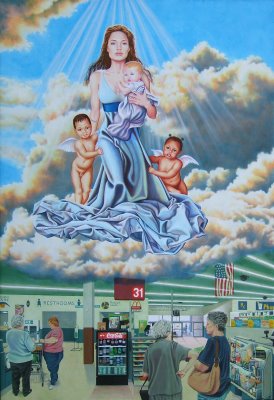
Painting of Jolie as the Virgin Mary hovering over a Wal-Mart check-out line draws notice


By MARTHA WAGGONER, Associated Press Writer Fri Jan 5, 6:57 PM ET

RALEIGH, N.C. - A North Carolina artist intrigued by the public obsession with celebrity has found herself feeding that obsession with a painting of actress Angelina Jolie as the Virgin Mary hovering over a Wal-Mart check-out line.


Kate Kretz has painted for 20 years but none of her previous work has garnered the attention given "Blessed Art Thou," showing this weekend at Art Miami, an annual exposition of modern and contemporary art.

The painting has gotten much attention from celebrity web sites and blogs. Since the buzz started, the number of daily unique visitors to Kretz's own blog has jumped from an average of 30 to 15,000 on Wednesday.

"My intention was to ask a question and get people to think," Kretz said in a telephone interview Friday from Miami. "I had no idea so many people would be asking a question and thinking."

The painting — acrylic and oil on linen — depicts an angelic Jolie in the clouds, holding her newborn daughter, Shiloh, with children Maddox and Zahara at her legs. Below them is a Wal-Mart checkout line. The painting is for sale for $50,000 through Chelsea Galleria in Miami, which represents Kretz.

On her blog, Kretz, 43, said the painting addresses "the celebrity worship cycle." She said she chose Jolie for the subject "because of her unavoidable presence in the media, the worldwide anticipation of her child, her 'unattainable' beauty and the good that she is doing in the world through her example, which adds another layer to the already complicated questions surrounding her status."

Washington Post art critic Blake Gopnik, asked to comment about "Blessed Art Thou" on a Post blog, was unimpressed. "Once you've deciphered it, there's not much chance of giving it a second look," Gopnik wrote.
On the Net:

The artist web site: http://www.katekretz.com

The artist Blog :http://katekretz.blogspot.com/ In her blog she talks about her amazement at the publicity that this one picture recieved.

To give you another example of this artist work:

Putting Moonlight to Sleep
acrylic/oil/collage
38 x 42”
1999

Thursday, December 28, 2006

National Palace Museum - Taipei, Taiwan - Design - New York Times


The National Palace Museum in Taipei is celebrating its rarest works. More Photos >

*
E-Mail
* Print
* Reprints
* Save
* Share
o Digg
o Facebook
o Newsvine
o Permalink

Article Tools Sponsored By
By KEITH BRADSHER
Published: December 28, 2006

TAIPEI, Taiwan, Dec. 27 — After four years of renovations that closed two-thirds of the building, the museum housing the world’s most famous collection of Chinese art is reopening this winter and holding a three-month exhibition of its rarest works.

The National Palace Museum, home to the best of the 1,000-year-old art collection of China’s emperors, is often compared to leading Western institutions like the Louvre, the Prado and the Metropolitan Museum of Art. But while this museum’s holdings are magnificent, the institution has been known for being a highly politicized place where priceless porcelain sat in poorly lit display cases and where invaluable paintings were kept in a damp manmade cave for fear of Communist attack from mainland China.

That has now changed. Heroic statues of Chiang Kai-shek, Taiwan’s former leader, and of Sun Yat-sen, the founder of modern China, have been banished. New lighting, air-conditioning, climate-controlled storage vaults and other features rival the newest museums in the West. Even the wall labels attached to the artwork are now written in clear and specific Chinese, English and Japanese.

And after many years of hiding its most valuable and most fragile artworks — those from the Northern and Southern Sung dynasties that ruled China from 960 to 1279 — the museum has brought them out for a “Grand View” exhibition that opened on Christmas. Four of the best known Northern Sung dynasty paintings — one of them on loan from the Metropolitan Museum in New York — are being shown together for the first time, along with other rare paintings, scrolls and some of the world’s earliest printed books.

The four paintings are magnificent landscapes that tower over visitors but still have the exquisite detail of miniatures. The Chinese characters of the name of one artist are so subtly hidden in the trees of one painting that they went unnoticed until this century. A deputy director of the museum is credited with discovering them, although rumor says that a janitor was really the first to find them, said Ho Chuan-hsing, a museum specialist in early paintings and calligraphy.

Many of the pieces are so fragile that they are never lent to museums elsewhere. Some will only be on display here for half the exhibition: either from Christmas to Feb. 7 or from Feb. 8 to March 25. Museum policy allows these works to be shown only for 40 days, after which they are loosely rolled and placed in a vault to rest for at least three years; the exhibition here will not go on tour.

Art scholars describe the “Grand View” as unique.

“To see all of these paintings come out at one time again is just not going to happen,” said Marc F. Wilson, a Chinese-art specialist who is the director and chief executive of the Nelson-Atkins Museum of Art in Kansas City, Mo., which lent two rare scrolls to the exhibition here. “These are the foundations of modern Chinese pictorial sensibility.”

Also on temporary display this winter in a single case are 50 of the 70 known examples of Ju Ware, one of the world’s rarest and most valuable kinds of porcelain. Manufactured for imperial use at a single kiln in central China for just two decades at the end of the 11th century, Ju (pronounced rue) Ware is glazed with a lustrous, green-tinged shade of blue that has a faint, rose sparkle.

Craftsmen ground up agate, a semiprecious quartz, to make the glaze, using a technique that was soon lost and has never been rediscovered. The 50 pieces on exhibit here include the museum’s own 21 examples and 29 borrowed from other collections around the world.

The presentation of the Ju Ware is raising eyebrows at a museum so conservative that many of the curators wore the traditional blue silk robes of Chinese scholars into the 1970s. The vases and dishes sit on a 100-foot-long, waist-high white surface that is an imitation of the runways on which models promenade at fashion shows.

Jimmy Yang, a 33-year-old Taiwan-born but Australian-educated architect and designer who showed up at the opening on Christmas in a black T-shirt and blue jeans, arranged the exhibition.

“We wanted it to be a little more up-to-date, a little humorous even,” he said as visitors began ogling the spotlighted vases.

Chi Jo-hsin, the chief curator of the museum’s antiquities department, acknowledged that the presentation had been controversial within the museum’s staff. “Some think it is good, and some think it should be different,” she said.

The Imperial Palace in Beijing, better known as the Forbidden City, became a museum in 1925 as part of a republican bid to prevent the restoration of the last emperor, Pu Yi. When Chiang Kai-shek’s Nationalists became worried in 1933 about a possible Japanese attack, they secretly sent the collection in wheelbarrows to Beijing’s train station to be transported south, the start of the collection’s 16-year odyssey during war with Japan and China’s civil war.

The Nationalists ended up shipping the most valuable art to Taiwan, where it has remained ever since. The mainland government has since gathered at museums in Beijing and Shanghai a large number of the works that were left behind, together with the fruits of archaeological excavations as well as the purchase or confiscation of mainland collections and gifts from tycoons in Hong Kong and elsewhere.

The exhibition here is taking place in rooms that have been heavily renovated as part of an extensive overhaul of the museum. Elevators and other features have also been added to make the building completely accessible to the elderly and the disabled, and the building has been strengthened to improve protection against earthquakes, including one that shook Taiwan on Tuesday evening but did not damage the museum or its collection.

Tu Cheng-sheng, who started the renovation as the museum’s director in 2002, said then that it would be too controversial to remove the memorial hall dedicated to Sun Yat-sen, a symbol of Taiwan’s ties to the mainland. But the hall and its giant bronze statue are gone now, a disappearance that Ms. Lin and Mr. Tu, now Taiwan’s education minister, declined in separate interviews to discuss.

The building’s exterior still has jade-green tile roofs and yellow walls designed to evoke the Forbidden City. But the museum’s celebrated tearoom has been transformed as part of an effort by Ms. Lin, the director, to address a problem facing art museum directors all over the world: how to draw the young and trendy.

While the museum’s collection has an international reputation among art connoisseurs, it has been distinctly less popular in Taiwan, and especially among young Taiwanese who feel little connection to the mainland. Slightly more than half the museum’s two million visitors a year come from outside Taiwan, mainly from Japan, Korea and other countries in Asia.

The tearoom, on the museum’s top floor with lovely views of the surrounding mountain valley, used to be a reproduction of the Three Treasures room at the Forbidden City, complete with an elaborately carved and flamboyantly painted ceiling. The ceiling has now been covered with gray-brown paint and the room turned into a very contemporary Taiwanese tearoom with sturdy furniture made of oak, not traditional sandalwood.

The “Grand View” this winter may also represent the last chance for visitors from the United States and elsewhere to see the best of China’s art without having to push through throngs of mainland Chinese tourists.

Taiwan is negotiating with Beijing officials to allow mainland tourists to start visiting here this spring. While the number of tourists is supposed to be limited to 1,000 a day at first, the tourism industry is expected to press for quick increases in that cap.

Jason Kuo, a Taiwan-born professor of Chinese art history at the University of Maryland who studied at the National Palace Museum from 1971 to 1973, said the museum faced a difficult balance as it prepares to handle more visitors, appeal to young Taiwanese and protect the art collection.

“They want to be open to the West,” he said, “but they want to maintain their heritage.”

Thursday, December 21, 2006

John Berger: Here Is Where We Meet, season of events in London, April - May 2005

I can't tell you what art does and how it does it, but I know that art has often judged the judges, pleaded revenge to the innocent and shown to the future what the past has suffered, so that it has never been forgotten.

I know too that the powerful fear art, whatever its form, when it does this, and that amongst the people such art sometimes runs like a rumour and a legend because it makes sense of what life's brutalities cannot, a sense that unites us, for it is inseparable from a justice at last. Art, when it functions like this, becomes a meeting-place of the invisible, the irreducible, the enduring, guts and honour.
John Berger

Wednesday, December 20, 2006

De Kooning


I cant stand this artist works. I can somewhat understand his emotional demeanor behind the picture, but it is a demeanor I do not like. People are often afraid to say they don't like artist that have been accepted by society, often using the `I don't understand' comment. There , for me is nothing loving or positive about this work, and for me it cannot be considered beautiful and holds no referential value ( as being a portrait of a known person.) -Paul Grant (follower of Basho)


Willem de Kooning, American, 1904-1997, b. The Netherlands
Woman IV, 1952-1953


Oil, enamel, and charcoal on canvas
59 x 46 1/4 inches (149.86 x 117.48 cm)

Gift of William Inge, 56-128

Location: Gallery L2

In Woman IV a figural form, frontal and iconic, fills the surface of the canvas. The woman has enormous arms and breasts, bulging eyes and appears to either grin or grimace. Painted in intense and garish colors, she shifts, disassembles, reassembles and merges into a field of painterly brush strokes. Dramatic brushwork, over painting, scrapes and scumbles create a myriad of layered effects that set the canvas in motion and record the dynamic painting process.

De Kooning identified the complex fusion of references present in Woman IV: Venus, the nude, ancient fertility goddesses, Mesopotamian idols, contemporary women, the pin-up of the early 1950s and even the abstract forces of nature.

Fully aware of the ambiguity of form and content in his paintings, he observed: "Content is a glimpse of something, an encounter like a flash." De Kooning's Women are never definitively interpreted. Instead, they remain open, inviting speculation, while suggesting the artist's intense engagement with the concept of woman.

Video - Picasso

picasso

Anew video on YouTube by ghaile123.

"Everyone wants to understand art. Why don't we try to understand the song of a bird? Why do we love the night, the flowers, everything around us, without trying to understand them? But in the case of a painting, people think they have to understand. If only they would realize above all that an artist works of necessity, that he himself is only an insignificant partjavascript:void(0)
Publish of the world, and that no more importance should be attached to him than to plenty of other things which please us in the world though we can't explain them; people who try to explain pictures are usually barking up the wrong tree."
-- Picasso

Monday, December 11, 2006

the Plain English Campaign

Germaine Greer, the British-based Australian academic and writer, won the campaign's Golden Bull award, which recognises the "worst examples of written tripe".

She wrote in her arts column in The Guardian on October 23: "The first attribute of the art object is that it creates a discontinuity between itself and the unsynthesised manifold."

Sunday, December 10, 2006

Aminah Brenda Lynn Robinson Symphonic Poem


Symphonic Poem

Fragment of Aminah Brenda Lynn Robinson's Symphonic Poem Exhibit at the Brooklyn Museum

AMINAH BRENDA LYNN ROBINSON

Columbus native Aminah Brenda Lynn Robinson has created over 20,000 works, including cloth paintings, sculptures, drawings, prints, book illustrations, and quilts. Her work is based on extensive research, oral history, and first-hand observation, but all of it is primarily concerned with documenting the lives and history of her family, friends, and community.

Robinson often works for many years on a fabric piece, incorporating buttons, shells, twigs, and fabric to create richly textured works that weave a memory into a colorful and grand collage. Her work is in the collections of, among others, the Columbus Museum of Art and the Wexner Center for the Arts.


My work is about people, historical data, traditions, lost communities. For me, there is no distinction between life and art. The button work is the core. It is important because of long traditions in my family, especially from my mother. These traditions are still being passed on today, not only through me but through the younger generation. It takes time to produce work. It takes everything you have because it takes your life to leave something for those who are coming after


African American artist Aminah Robinson (b. 1940) works her magic in a stunning array of richly textured, wildly colorful multimedia works. Grand collages on fabric, sculptures, drawings, paintings, carvings, quilts, and books weave memory into a moving and unique art that documents her own and her community's history. Symphonic Poem--the catalogue for a major traveling exhibition celebrating her work--brings together more than 100 of Robinson's works with essays exploring her life, African influences and spirituality in her art, and her work in relation to that of other contemporary African-American artists.


About the book


Throughout this book Robinson herself speaks about her life, her family, her travels, and her work, and provides a view of The Dollhouse, the workspace she has built in her backyard. This strikingly designed, oversized volume, complete with three gatefolds, is a lush and inviting look at the work of an exceptional artist.

About the Author


Carole Genshaft is Co-curator of the accompanying exhibition of Aminah Robinson's art. Leslie King-Hammond is Dean of Graduate Studies at the Maryland Institute College of Art. Romana Austin is Director of the Hampton University Museum of Virginia. Annagreth Nil, Curator of the Columbus Museum of Art, is Co-curator of the exhibition.

Friday, November 24, 2006

Scotsman.com News - Latest News - Artists track every stuffed polar bear in UK

Artists track every stuffed polar bear in UK

By Paul Majendie

LONDON, Nov 24 (Reuters Life!) - Two artists prowled the country in search of stuffed polar bears -- and uncovered 34 of the proud Arctic icons discarded in stockrooms or languishing in stately homes.

The result is "Great White Bear" -- a new photo exhibition that explores mankind's fascination with the magnificent creatures and underlines the fragility of their future.

Mark Wilson and his Icelandic partner Bryndis Snaebjornsdottir -- her name means Snow Bear's Daughter --- spent three years tracking down and photographing their elusive quarry everywhere from dusty museum basements to a hotel's glass showcase.

Depending on the whim of the taxidermist, some stand proud, reared up to their full height, snarling in fury. One poses with a seal pup between his paws, another even gets used as a lampstand.

They were brought to Britain by aristocratic explorers, mapping expeditions and whalers who had no compunction about killing up to 50 bears on a hunt.

Today the Polar Bear faces an even more perilous future in a melting sea that is being inexorably diminished by global warming across the Arctic, with environmentalists petitioning the U.S. Fish and Wildlife Service to classify the bears as threatened because of the new difficulties they face.

"They are used to swimming 60 miles a day. Now they have to swim so much further to find sea ice from which they are able to hunt. So, as a result, many of them drown," Wilson said.

"We felt as many responses photographing the bears as viewers feel looking at the pictures," he told Reuters in an interview to mark the exhibition at London's Horniman Museum.

"There is very real pathos when you think how many were shot on a single expedition. Some were just shot and left there," he said.

"The settings for the stuffed bears are cluttered and decrepit, sometimes farcical. They set off uncomfortable little triggers when you look at the photos."

But are there any more stuffed polar bears languishing out there in some forgotten corner of a musty attic?

"The show has had a massive amount of publicity in the newspapers and we have had a couple of contacts by e-mail. Two more have come to light," Wilson said.

The photos lining two walls of the Horniman certainly do stir strong emotions -- and above all a poignant sense of regret over the cavalier way mankind can treat marvels of nature.

The Times, reviewing the exhibition, said: "The images send a chilling premonitory frisson down the spine. This is a species in the process of being junked."

And Wilson agreed: "The Polar Bear is in dire danger. There is no doubt of that. It is very iconic and acts as a kind of barometer for the Arctic itself."

(c) Reuters 2006

Saturday, November 18, 2006

Top Indian artist bemoans "exile" over nude painting


Top Indian artist bemoans "exile" over nude painting
Nov 17 7:38 AM US/Eastern

India's most celebrated artist M.F. Husain says he is very homesick in London where he lives in voluntary exile to escape prosecution over his paintings of nude Hindu gods and goddesses.

"I am extremely homesick," the 91-year-old told The Hindustan Times, adding that he is yearning for Mumbai.

"I long to walk through the streets of Grand Road and Byculla where I have spent some of the best years of my life," he said.

"As far as I know there are at least 900 cases registered against me (in India). Matters are so legally complicated that I have been advised not return home.

"I have become an international gypsy. It is no secret that I am wandering around the world with only my art for company." His paintings fetch tens of thousands of dollars.

Last May, the Indian government alerted the police fearing Hindu-Muslim riots over a nude painting by Husain, a Muslim.

The work depicts a nude "Mother India" and raised the hackles of Hindu groups, one of which this year offered an 11.5 million dollars for Husain's murder.

One of the cases pending against Husain is for hurting the sentiments of Hindus.

The law ministry has examined half-a-dozen works by Husain and told the government that prosecutors would have a strong case against him if they sued him for deliberately hurting religious feelings.

Tuesday, October 31, 2006

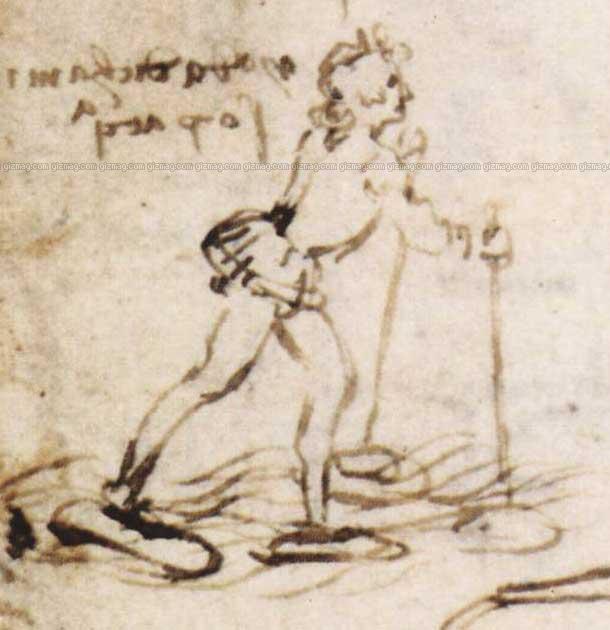
Leonardo da Vinci's sketch becomes a reality : walking on water


gizmag Article: Patent granted for walking on water invention: "

October 31, 2006 History suggests humans have always been captivated with the possibility of walking on water with references to it in Christianity, Hinduism and Buddhism. In Egyptian mythology the god Horus walked on water, and in Greek mythology Orion, the son of the gods walked on water. Indeed, Leonardo da Vinci even conceived a set of shoes and stocks which would enable this highly improbable act.

Now, thanks to an invention by Massachusetts inventor Yoav Rosen, it seems we may be in need of a new colloquialism for the impossible. Rosen’s Da Vinci-like pontoon shoes have just been granted a patent by the United States Patent and Trademark Office (USPTO) for an “Upright Human Floatation Apparatus And Propulsion Mechanism” and enable him to do just that (video here). Rosen’s company wishes to focus its business activities on its equally remarkable standing kayaks, and is seeking to license or sell its water-walking technology. We spoke with Rosen about his invention.

The new water-walking patent (patent number 7,121,910) is a continuation to a previous patent (patent number 6,764,363) with an identical name that was published in August 2004.

Rosen’s company, Wavewalk makes kayaks that people can paddle while standing and is a firm proponent of offering people the alternative of standing instead of sitting in their recreational boating.

“Snow skiing and snowboarding are more popular than snow sledding, and surfboards are more popular than surf skis, and most people prefer to ride a cycle upright rather than recumbent, so why shouldn’t people do their boating standing up,” says Rosen. That was the standing rather than sitting imperative that motivated Rosen to begin work on his pontoon shoes for walking on water and subsequently to develop the WaveWalk.

“I was a teenager then, and I just couldn't accept the fact that walking on water wasn't possible. After all, people have been surfing standing for hundreds, maybe thousands of years!”
“Humans are bipedal, and we like using our legs,” he continues. “We're also very good in doing that, if and when we're given a chance."

We asked Rosen if he had seen Leonardo da Vinci's sketches before or after he had the idea? “I saw it recently, but if you look at Leonardo's sketch it's clear he wasn't thinking about walking on water at all but rather about human powered water skiing.”

“In the "prior art" section of my patents, I'm quoting some 70 patents and inventions, starting with ancient catamarans, Leonardo Da Vinci and the first known patent in the field of water-walking dating 1858, that was granted to a Bostonian named H. R. Rowlands. The problems with all prior water-walking inventions were mainly in the areas of effective propulsion and sufficient stability.


“Think about it this way. You load and unload a tiny "canoe" with your entire weight at a rate of once per second ... in this short period of time you also have to generate maximum water-resistance from one leg, while you minimize the water-resistance from your other leg that's making a full, long step forward.

“And you also have to be able to make turns without using a rudder or a paddle, and you should be able to keep a maximal distance between your "shoes" because if your legs spread you'll lose balance and fall ... and you need to be able to enter the equipment on firm land and then access the water since you definitely don't want to struggle with getting your feet into it while you're already in the water.

“It is no wonder it took so long for this apparently simple "technology" to mature,” he smiles. Why are you selling or licensing the walking on water patents rather than developing them yourself, we asked Rosen. His response: “I'm offering the patent for sale since my company doesn't have the resources to develop the potential markets for both Wavewalk and water-walking products.”

125th birth anniversary of Pablo Picasso


Madrid - As Spain celebrates the 125th birth anniversary of Pablo Picasso (1881-1973) on October 25, nobody questions that he was one of the greatest artists of all time and perhaps the greatest of the 20th century.

In his lifetime, Picasso took such adulation for granted. The artist's last wife Jacqueline even used to kiss his hands and call him 'my God.'

Few people remember today that Picasso's works continued sparking scandals almost until his death.

Many of the people queueing to anniversary exhibitions in Spain, France, the United States, Austria or Germany this year would no doubt be reluctant to admit that often, in fact, they do not understand the master's Cubist paintings.

There is, in any case, no question that the painter born in the southern Spanish city of Malaga revolutionized the world of art. He may later be remembered as 'the great grave-digger of art or as its great fertilizer,' Peruvian author Mario Vargas Llosa writes.

Picasso's prodigious talent was evident from the beginning. His art teacher father soon had nothing more to impart to his young son.

When Pablo was 14, the family moved to artistically vibrant Barcelona where the boy began art studies. In 1897, Picasso was admitted to Madrid's Academy of Fine Arts at the young age of 16 years.

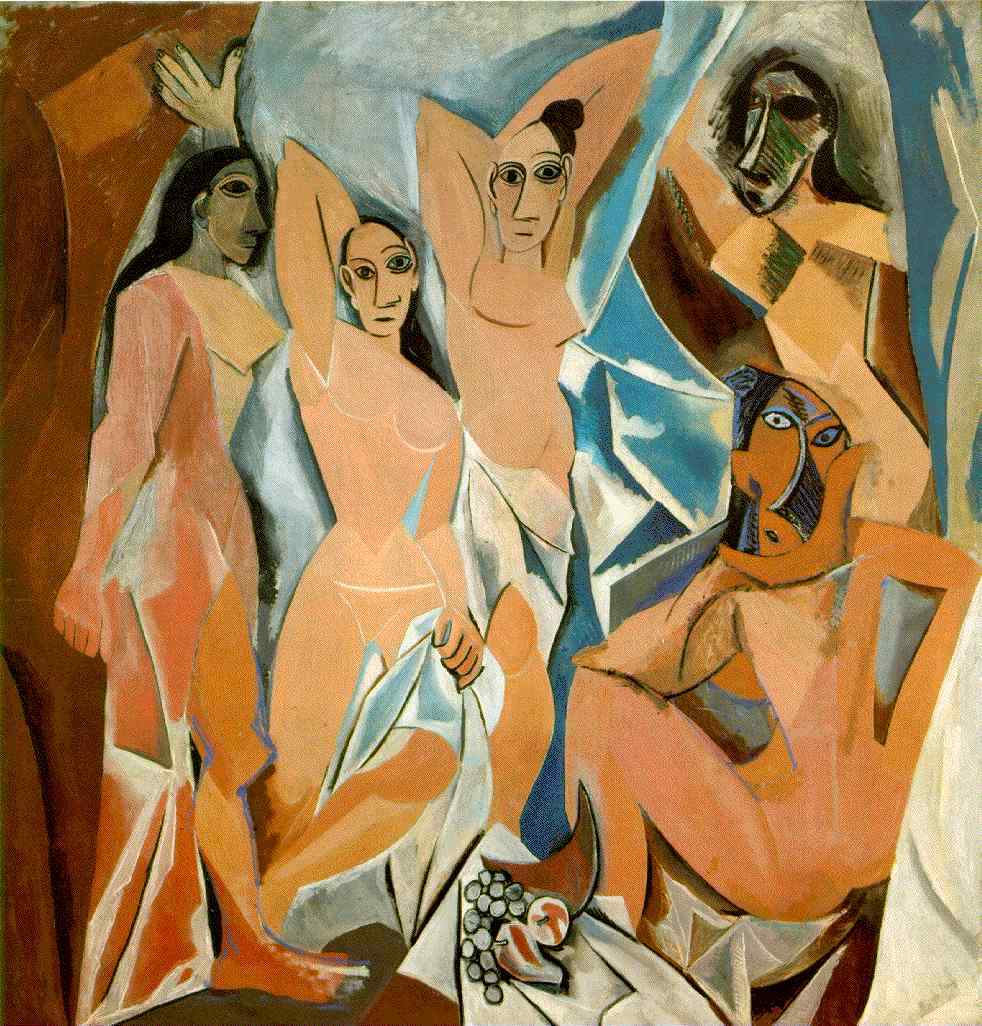
In 1904, he moved to Paris where, three years later, he painted Les Demoiselles d'Avignon, a key work in the development of Cubism.

For Picasso, life was an endless source of inspiration and experimentation, where he picked the women, harlequins, minotaurs, bullfighters, animals and children who populate his paintings.

He left behind no less than some 1,900 paintings, 3,200 pieces of ceramics, 7,000 drawings, 1,200 sculptures and 30,000 graphic works.

'The soul of beings does not interest him much,' the US writer Gertrude Stein once said. Picasso liked to keep his models at a distance and under control, deconstructing them in his Cubist fashion rather than studying them psychologically.

He displayed something of the same attitude towards his two wives, numerous lovers and four children.

Books by Picasso's lover Francoise Gilot and his niece Marina Picasso irritated many of the artist's admirers by describing his egoistic and callous treatment of those close to him.

After Picasso's death, his grandson Pablo, his former lover Marie-Therese Walter and his last wife Jacqueline Roque all committed suicide.

Jacqueline Roque

Portrait of Jacqueline Roque with Flowers


Portrait of Jacqueline Roque with Flowers


Giclee Print
Picasso, Pablo 13 in. x 20 in.
Buy at AllPosters.com Framed Mounted


For the world of art, however, Picasso's contribution was invaluable. 'He represents a revolution of forms, a break with all that was before, but he also builds a bridge towards tradition,' Vargas Llosa writes.

Picasso, who experimented with art forms ranging from his 'blue period' to surrealism, was a chameleon who could make any style his own.

However, he claimed that there could be nothing new in art. 'Art does not have a past or a future, evolution or progress,' said the artist who integrated ancient African influences into his work.

Refusing to return to a Spain governed by General Francisco Franco, Picasso protested against the dictatorship by creating Guernica, his probably most famous work, for the Paris World Exhibition in 1937.

Guernica, 1937


Guernica, 1937 Art Print Picasso, Pablo 28 in. x 22 in.
Buy at AllPosters.com Framed Mounted


The huge canvas depicting the bombardment of the Basque town of Guernica by Nazi Germany in support of Franco during the Spanish Civil War - brought to Spain from the United States in 1981 after the dictator's death - remains a powerful anti-war symbol.

Painting obsessively as if in a race against time, Picasso was still creating heavily erotic images shortly before his death in Mougins, southern France, at age 92.

© 2006 dpa - Deutsche Presse-Agentur

Tuesday, October 24, 2006

Vietnamese-born artist Binh Danh

Binh Danh's chlorophyll prints

Vietnamese-born artist Binh Danh prints photographs onto living leaves. Seen here, The Leaf Effect: Study for Metamorphosis #2, 2006, 11.5 x 9.5 x 2 inches, chlorophyll print, butterfly specimen and resin. From Danh's artist page at the Haines Gallery:
 Images Bdan.8649.Lg Danh has invented a technique for printing found photographs (digitally rendered into negatives) onto the surface of leaves by exploiting the natural process of photosynthesis. The leaves, still living, are pressed between glass plates with the negative and exposed to sunlight from a week to several months. Coined "chlorophyll prints" by the artist, the fragile works are encapsulated and made permanent through casting them in solid blocks of resin. By conjoining his process into his conceptual ideas so completely, Danh is also able to reference the history and technical developments of photography.

He says of his work, "Throughout my education, I have always been very attracted to Art, History, and Science. The histories I search for are the hidden stories embedded in the landscape around me. The processes used in my work represent my interest in the sciences and photographic techniques."
Link to Haines Gallery, Link to an Examiner.com article about Danh's last exhibition, Link to NPR "Talking Plants" program about Danh from 2003 (Thanks, Jennifer Lum!)

UPDATE: Thanks to all the readers who pointed out that Grand Illusions has a page showing how to make your own chlorophyll prints using a similar technique. Link

Wednesday, October 18, 2006

Picasso in the Vatican?

More ART TALK on Picasso:


Earlier this week there was a story of a guy putting his elbow through a Picasso, and a short while earlier there was a story about the Vatican wanting modern art to add to thier collection. I retitled the story - Whose going to pay for it? That little editorial barb was to call attention to the choice of where Roman Catholic Church funds were being spent. Should they spend one hundred million on a Picasso, or maybe spend the money instead on building homes for the homeless - or inproving the Church's own schools? This is just one take on the subject.


I found an interesting artical on the subject, a different view, from the Art Critic Elizabeth Lez


Picasso in the Vatican? A Possible Short List

By Elizabeth Lev

ROME, AUG. 31, 2006 (Zenit.org).- This summer, Francesco Buranelli, director of the Vatican Museums, was interviewed by the Italian newspaper La Stampa, revealing his ambition to add a Picasso to the Vatican collection.

This struck me as somewhat strange. While Picasso was undeniably a great artist, why would the Vatican Museums want to display the work of a man who undermined the Christian message for seventy years?

Of course from a purely technical angle, Buranelli's aspiration makes good sense. What museum director, after all, wouldn't want a work by the most celebrated name in 20th century art?

But perhaps I am missing something. After all, there are so many styles and periods in Picasso's work, maybe one would indeed complement the art collection of the Catholic Church?

So I did a little research and compiled a short list of possible contenders for a place alongside Michelangelo, Raphael and other great Christian artists represented in the Vatican Museums.

"The Crucifixion"

This would be perhaps the most obvious choice, as this is the only religiously themed work by Picasso from 1897, until his death in 1973.

Pablo Picasso was born in 1881 into a Spanish Catholic family. He rejected his Catholic upbringing in his early 20s, mostly because he saw religious morals as an obstacle to the burgeoning sexual freedom of his age.

More prodigious than prodigal, Picasso never publicly returned to the church, although a priest was present at the artist's funeral.

Picasso sidelined Christ in the painting the way he had sidelined him in his own life. Picasso's "Crucifixion" features a small Christ at the top center. The crucified Jesus seems overwhelmed by what appears to be weeping women superimposed on him.

It is difficult to tell friend from foe in the work, and the clearest image of all is the soldier playing dice in the lower left.

Done in crayon colors, the painting seems more like a self-pitying tribute to Picasso's personal troubles (his wife and mistress were not getting along) than any real exploration of the meaning of Christ's suffering.

"Man with Sheep"

This bronze sculpture, representing a man holding a sheep, was created in 1944 at the end of World War II. This piece could be displayed next to "The Good Shepherd" statue in the Pio Christian Museum.

Viewers could contrast the youthful gentle face of the good shepherd, one of the earliest Christian symbols for Jesus, next to Picasso's stark, distorted man with the bulging eyes and fierce expression.

In the Christian version of the subject, a tranquil lamb curls gently around the shepherd's shoulders, but in the modern vision, although the shepherd clasps the sheep in one arm like an infant, the animal twists its head away, open-mouthed and protesting. Unlike the good shepherd, the savior who has found a lost sheep, Picasso's figure seems like a butcher bringing a lamb to the slaughter.

Picasso sculpted this work at the same time he joined the Communist party, so the distortion of one of the oldest symbols of man's salvation makes an apt metaphor for the artist's new ideology.

"The Demoiselles of Avignon"

This work, painted in 1904, of course refers to Avignon, home of the Papacy for over 70 years in the 14th century, so it bears a nice papal point of reference.

The painting has all the hallmarks of a masterpiece; employing the techniques of the old masters, Picasso made 106 preparatory sketches for it, which resulted in an innovative, gripping effect.

Unlike Michelangelo's Mary in the Pieta, who renders the sublime beauty of God's grace and her exemplary obedience to divine will, Picasso's five female figures are imbued with a very different kind of "feminine genius." The demoiselles pose, strut and squat in a brothel.

Like Renaissance artists, Picasso explored the sacred in this work, except his "holy" inspiration was drawn from the tribal African masks. Speaking of the "Demoiselles," the Spanish painter said that the African masks "were intercessors … against everything," adding that the painting was his "first canvas of exorcism!"

True, this work is a watershed in the history of art and most curators would allow themselves to be contorted into one of Picasso's misshapen figures to own it, furthermore, they would be completely justified given the nature and function of their secular museums.

The Vatican Museums, however, were not intended to be just another general exhibition in the history of art.

Michelangelo and Bernini and Fra Angelico created works that incite devotion, glorify God and stir viewers to transcend themselves. Secular museums do not have to reckon with two thousand years of propagating the Christian message.

My real question became: What do these works have to offer to the Christian audience looking for signs of God's sublime presence in our troubled modern times?

One of Picasso's early works might offer a solution to the selection dilemma.

"Science and Charity" was painted in 1897 by a 17-year-old Picasso.

This academic painting shows a woman on her deathbed, a doctor on her right and a nun on her left. The doctor looks away from the patient as he takes her pulse and goes about his science. The religious sister holds the woman's soon-to-be-orphaned child, proffering a glass toward the woman offering comfort.

Both the nun and the doctor wear the same colors of black and white, and appear as two sides of a scale. But the balance is tipped slightly toward the sister as the light shines on her while the doctor is cast in shadow. At the moment of death his science is useless, but the charitable care of the sister can offer solace.

Given that Picasso was to reject religion and embrace science as his guide -- from optics in cubism to psychology in his surrealist phase -- if nothing else, this painting would serve as a reminder of how God's gifts of talent, vision and genius can be used for both good and ill.

Is there a place in the history of art for Pablo Picasso? Most assuredly. I doubt very much, however, that it is in the Vatican Museums.

Tuesday, October 17, 2006

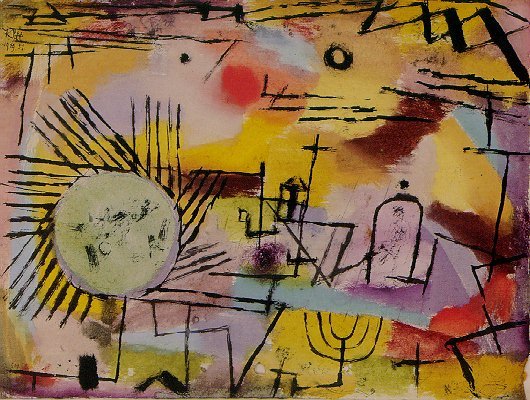
Paul Klee - a missed exhibit

Opening Eyes, Belatedly, to Paul Klee

By Jessica Dawson
Special to The Washington Post
Sunday, June 18, 2006; N01


A Paul Klee exhibition in the United States is bound to prompt a question:

What, exactly, does a Paul Klee painting look like?

We Americans aren't likely to know. Although the Swiss-born artist's fame came easily enough in Europe -- where his career flowered in the decades before his death in 1940 from scleroderma -- those on this side of the Atlantic missed the memo itemizing Klee's talent and influence.

Perhaps that's because the artist never traveled stateside and never really wanted to. Perhaps Americans didn't cotton to Klee's jittery lines, off-note color schemes and childlike surrealism. Or maybe his reputation as a fringe-dwelling visionary turned people off.

"Klee and America," on view at the Phillips Collection, offers alternate explanations for our country's slow warming to the idiosyncratic painter. This nation, after all, did accept him, although the embrace was warmest after his death.


The artist's American market witnessed its first uptick toward the end of his career, when his reputation in Europe soured due to Nazi interference. In the early 1930s, he benefited from the efforts of a strong cohort of expatriate American dealers who pushed his work stateside -- and by the middle of that decade, his work found Americans sympathetic to his talent and his persecution.

Later in the 20th century his impact was clear, but it's been 20 years since Americans saw a major Klee show. If we struggle to conjure a Klee in our minds, perhaps we can be forgiven our fuzzy-headedness.


The nearly 80 works in "Klee and America," organized by Houston's Menil Collection, serve as a barometer of the artist's rise in this nation's consciousness during his lifetime. Only those paintings and works on paper that landed on U.S. soil are on view.

Tracing Klee's relationship to the United States through the pictures Americans bought is an unusual curatorial tack, one that scholars might delight in viewing. For the everyday museum visitor, though, the exhibition performs a more urgent task: It shows us what Klee's pictures look like.

"Klee and America," it should be noted, is no survey. Only 10 percent of Klee's output is held by Americans, so this show registers the tastes of a discrete collecting population. The accompanying catalogue, a 315-page behemoth that's richly illustrated and thoroughly researched, parses the details of transatlantic Klee transactions and the early-20th-century tastemakers who brought his work here.


We learn about Katherine S. Dreier, who in the 1920s founded Societe Anonyme in collaboration with Marcel Duchamp and Man Ray and organized Klee's first one-man show in the United States, in 1924. We learn that six years after that, Alfred Barr -- a man whose reputation requires no further gilding -- mounted the largest solo show of Klee's work outside Europe, at the Museum of Modern Art; Klee was the first living European artist to receive a solo show there. Also found in the catalogue's pages: The notion that Klee didn't gain traction here until his fortunes fell in Nazi Germany.

You'll have to crack the catalogue to get the details. The Phillips exhibition is mercifully free of didacticism. "Klee and America" asks us, quite simply, to look. And we've got some excellent pictures from the 1920s and '30s to feast on.

Many of Klee's pictures were made in Germany, where he spent most of his life. After moving to Munich at the turn of the century and abandoning a career as a concert violinist (he would continue to play all his life), he began painting lessons. Klee and Wassily Kandinsky, himself fresh from a career change, shared painting instructor Franz von Stuck, an artist specializing in the macabre themes of late symbolism and art nouveau.

Although Kandinsky and Klee shared a belief in the spiritual nature of art and its eruption from deep human drives, their work took very different forms.

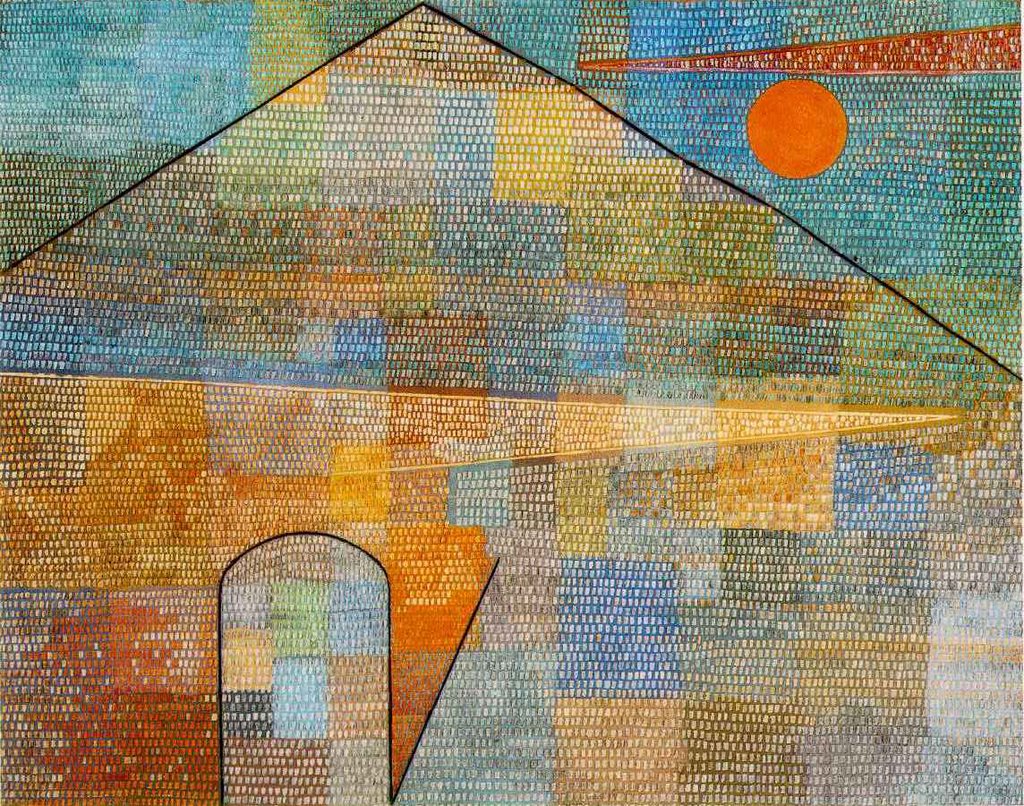
When Klee worked in abstraction, as he did in "Gradation, Red-Green (Vermilion)," a 1921 watercolor on view at the Phillips, he never approached Kandinsky's bravado of color and scale. Klee's exercise in color and composition is much more intimate and subdued than any Kandinsky. Most of the Klees here are the size of postcards or notebook paper. (A few get larger as he approaches his final years. Most suffer a little for it.)

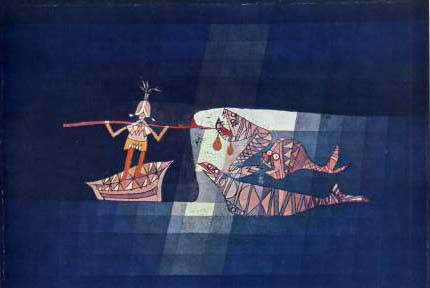
Although Klee lived in Germany, a strong strain of French surrealism ran through his pictures. The twitchy lines and oddball creatures of Klee's works from the 1920s show why the French considered him one of the fathers of dada. At the Phillips, the Duchampian "Twittering Machine" is on view, as is the anxiously Freudian "Girl With Doll's Pram," where the little girl's breasts are the size of Hindenburgs.

For most of the 1920s, Klee taught at the Bauhaus and later at the Dusseldorf Academy. But his time in Germany ended badly. His teaching emphasized individualism, and the Nazis found his lessons suspect, dismissing him from the Dusseldorf position in 1933. Several years later, Germany exhibited some of his most childlike work in its degenerate-art exhibition. Klee spent his final years in exile in Switzerland.

Klee's waning European fortunes offered more opportunities for Americans to acquire him. In "Klee and America," wall labels detailing provenance read like small-scale society rags. That the picture called "Plan of a Castle" (a spatial exercise in floating polygons) belonged to Philip Johnson in the years 1948 to 1961 comes as no surprise, given the architect's taste for geometry. That Johnson also owned the childlike ink drawing "Not Without Heart" (1928) -- in which Klee renders a dachshund out of a parallelogram with charming naivete -- seems rather out of Johnson's character. (A few years later, the collecting stars realigned when the piece turned up in gimlet-penned draftsman Andy Warhol's cache.)

Among the Important People who acquired Klees was Duncan Phillips. Visitors to this leg of "Klee and America" get a special treat: a re-creation of the Klee room that Phillips maintained for nearly 40 years, beginning in 1948. In a former sewing room on the second floor of the museum mansion, 13 tiny Klees hung shoulder-to-shoulder for the enjoyment of thousands of visitors, Kenneth Noland and Mark Rothko among them.

That little group, perhaps the strongest subset of "Klee and America," reminds us what fun Klee is, and what peculiar attraction his works offer.

Although the museum plans to rehang the Klee room after "Klee and America" ends, the when and where of that arrangement remain uncertain. For the time being, at least, our chance is now.

Klee and America at the Phillips Collection, 1600 21st St. NW, Tuesday-Saturday 10 a.m.-5 p.m., Thursday 10 a.m.-8:30 p.m., Sunday noon-5 p.m., through Sept. 10. $12 adults, $10 age 62 and older and students. Free to those 18 and younger and museum members. Call 202-387-2151 or visit http://www.phillipscollection.org/ .

posted by follower of basho
 
*/ /* Use this with templates/template-twocol.html */