Showing posts with label Leonardo da Vinci. Show all posts

Monday, December 13, 2010

New Clue found on Leonardo da Vinci's Mona Lisa


Mona Lisa's eyes may reveal model's identity, expert claims

Silvano Vinceti claims initials – possibly the model's – are discernible in the left eye of the iconic Da Vinci painting

Mona Lisa by Leonardo da Vinci
Leonardo da Vinci's painting of Mona Lisa contains several clues as to the model's identity, Vinceti claims. Photograph: Gianni Dagli Orti/Corbis

An Italian researcher has sparked new controversy over the world's most famous painting by claiming Leonardo da Vinci painted tiny letters into the eyes of the Mona Lisa which may finally reveal the disputed identity of his model.
To arrive at a theory worthy of The Da Vinci Code, Dan Brown's 2003 bestseller, researcher Silvano Vinceti avoided the Mona Lisa's enigmatic smile and instead gazed deep into her eyes with the help of high-resolution images.
"Invisible to the naked eye and painted in black on green-brown are the letters LV in her right pupil, obviously Leonardo's initials, but it is what is in her left pupil that is far more interesting," said Vinceti, the chairman of the Italian national committee for cultural heritage.
Vinceti said that the letters B or S, or possibly the initials CE, were discernible, a vital clue to identifying the model who sat for the Renaissance artist. She has often been named as Lisa Gherardini, the wife of a Florentine merchant, but Vinceti disagreed, claiming Leonardo painted the Mona Lisa in Milan. He said he would announce his conclusions next month.
"On the back of the painting are the numbers '149', with a fourth number erased, suggesting he painted it when he was in Milan in the 1490s, using as a model a woman from the court of Ludovico Sforza, the Duke of Milan," said Vinceti, who claimed earlier this year that he had identified the lost remains of the painter Michelangelo da Caravaggio.
In The Da Vinci Code, Brown suggests Mona Lisa is an anagram for Amon l'Isa, referring to ancient Egyptian deities.
"Leonardo was keen on symbols and codes to get messages across, and he wanted us to know the identity of the model using the eyes, which he believed were the door to the soul and a means for communication," said Vinceti.
He said that while researching the model's identity he had been inspired by a 1960s book by a French art historian, which mentions the letters in her eyes.
"Under the right-hand arch of the bridge seen in the background, Leonardo also painted 72, or L2, another possible clue," he added. "Two expert painters we consulted on this tell us that all these marks, painted using a tiny brush and a magnifying glass, cannot be an error."

Tuesday, October 31, 2006

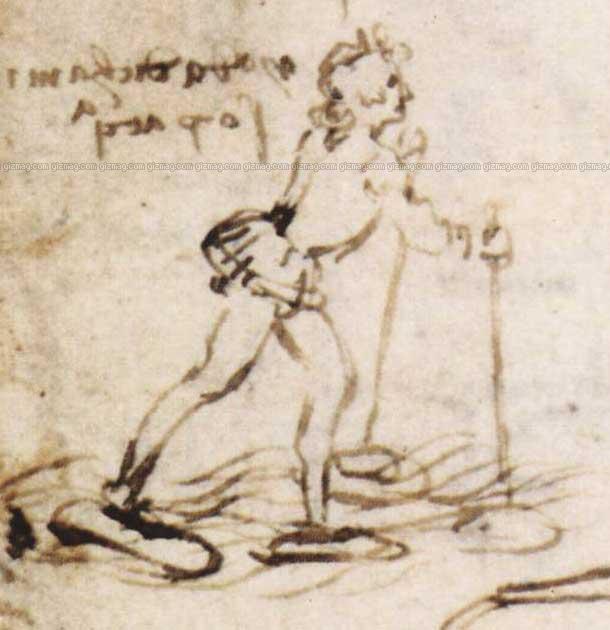
Leonardo da Vinci's sketch becomes a reality : walking on water


gizmag Article: Patent granted for walking on water invention: "

October 31, 2006 History suggests humans have always been captivated with the possibility of walking on water with references to it in Christianity, Hinduism and Buddhism. In Egyptian mythology the god Horus walked on water, and in Greek mythology Orion, the son of the gods walked on water. Indeed, Leonardo da Vinci even conceived a set of shoes and stocks which would enable this highly improbable act.

Now, thanks to an invention by Massachusetts inventor Yoav Rosen, it seems we may be in need of a new colloquialism for the impossible. Rosen’s Da Vinci-like pontoon shoes have just been granted a patent by the United States Patent and Trademark Office (USPTO) for an “Upright Human Floatation Apparatus And Propulsion Mechanism” and enable him to do just that (video here). Rosen’s company wishes to focus its business activities on its equally remarkable standing kayaks, and is seeking to license or sell its water-walking technology. We spoke with Rosen about his invention.

The new water-walking patent (patent number 7,121,910) is a continuation to a previous patent (patent number 6,764,363) with an identical name that was published in August 2004.

Rosen’s company, Wavewalk makes kayaks that people can paddle while standing and is a firm proponent of offering people the alternative of standing instead of sitting in their recreational boating.

“Snow skiing and snowboarding are more popular than snow sledding, and surfboards are more popular than surf skis, and most people prefer to ride a cycle upright rather than recumbent, so why shouldn’t people do their boating standing up,” says Rosen. That was the standing rather than sitting imperative that motivated Rosen to begin work on his pontoon shoes for walking on water and subsequently to develop the WaveWalk.

“I was a teenager then, and I just couldn't accept the fact that walking on water wasn't possible. After all, people have been surfing standing for hundreds, maybe thousands of years!”
“Humans are bipedal, and we like using our legs,” he continues. “We're also very good in doing that, if and when we're given a chance."

We asked Rosen if he had seen Leonardo da Vinci's sketches before or after he had the idea? “I saw it recently, but if you look at Leonardo's sketch it's clear he wasn't thinking about walking on water at all but rather about human powered water skiing.”

“In the "prior art" section of my patents, I'm quoting some 70 patents and inventions, starting with ancient catamarans, Leonardo Da Vinci and the first known patent in the field of water-walking dating 1858, that was granted to a Bostonian named H. R. Rowlands. The problems with all prior water-walking inventions were mainly in the areas of effective propulsion and sufficient stability.


“Think about it this way. You load and unload a tiny "canoe" with your entire weight at a rate of once per second ... in this short period of time you also have to generate maximum water-resistance from one leg, while you minimize the water-resistance from your other leg that's making a full, long step forward.

“And you also have to be able to make turns without using a rudder or a paddle, and you should be able to keep a maximal distance between your "shoes" because if your legs spread you'll lose balance and fall ... and you need to be able to enter the equipment on firm land and then access the water since you definitely don't want to struggle with getting your feet into it while you're already in the water.

“It is no wonder it took so long for this apparently simple "technology" to mature,” he smiles. Why are you selling or licensing the walking on water patents rather than developing them yourself, we asked Rosen. His response: “I'm offering the patent for sale since my company doesn't have the resources to develop the potential markets for both Wavewalk and water-walking products.”
 
*/ /* Use this with templates/template-twocol.html */