
The Harry Potter star, 19, made his stage debut in London on February 27 2007 in the revival of Peter Shaffer's play, in which he does a full frontal scene.
And Radcliffe was so scared about the performance that he suffered from "Michelangelo's David effect".

Daniel tells the New York Times, "He [David] wasn't very well endowed, because he was fighting Goliath.
"There was very much of that effect. You tighten up like a hamster.
Shrivelled from the fear of mortal danger ... Michelangelo's David.
One of the most intriguing, if least openly discussed, mysteries in art has been resolved.
Michelangelo's David is meant to be a representation in marble of the perfect male form. So why did his creator not make him - how would one say - a little better endowed?
As every visitor to Florence will know, the modest dimensions of David's "pisello" are a running joke with Italians, and the stuff of irreverent postcards.
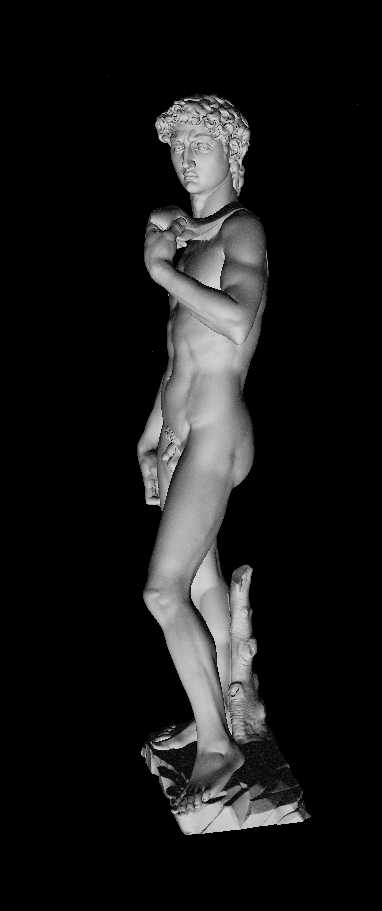
But, in a paper to be published at the end of this month, two Florentine doctors offer a scientific explanation: the poor chap was shrivelled by the threat of mortal danger. Michelangelo's intention was to depict David as he confronted Goliath.
What the new study shows is that every anatomical detail - right down to the shaping of the muscles in his forehead - is consistent with the combined effects of fear, tension and aggression.
One of the authors of the paper, Pietro Antonio Bernabei, of the Careggi hospital in Florence, said one such effect would be "a contraction of the reproductive organs".
Last autumn he and his collaborator, Professor Massimo Gulisano, of Florence University, conducted a computer-assisted study of the 4.34 metre-high statue, in the Galleria dell'Accademia. They emerged, in Prof Gulisano's words, "stupefied" by Michelangelo's physiological accuracy.
The only mistake is at a point in the centre of David's back that is hollow and ought to be rounded. Michelangelo was aware of the error. But, as he wrote at the time: "Mi manco matera" ("I lacked [enough] material").
Dr Bernabei said allowance had to be made for the conventions of high Renaissance art, which depicted activity in a "much more composed and elegant fashion than today". But, anatomically, everything about Michelangelo's David was consistent with a young man "at the moment immediately preceding the slinging of a stone".
His right leg is tensed while the left one juts forward "like that of a fencer, or even a boxer". Tension is written all over his face. His eyes are wide open. His nostrils are flared. And the muscles between his eyebrows stand out, exactly as they would if they were tightened by concentration and aggression.
"You see the same thing on Japanese opera masks depicting anger," said Dr Bernabei.
David is holding something in his right hand, and it has conventionally been assumed that it is a stone. But Dr Gulisano said their studies suggested otherwise.
"He is holding the handle of the sling. The arrangement of the muscles in his right arm is consistent with someone making, or about to make, a rotary movement, but not with someone about to throw a stone," he said.
Their full findings are to be given in a paper written for the Dutch Institute for Art History in Florence. A summary was published in the latest edition of the Italian journal Il Giornale dell'Arte.
The two experts' examination of one of the world's most famous statues was carried out using a specially constructed scaffold that was wheeled into place when the gallery closed its doors to visitors in the evening and on public holidays. Michelangelo's masterpiece, completed in 1504, was put back on display last May after cleaning which allowed its anatomical details to be studied much more easily than before.
Now we all know why he is rather less substantial in one area than might have been expected, just one great puzzle remains: why, since David was Jewish, did Michelangelo sculpt him uncircumcised?
| ||||

Michelangelo's famous statue of David could collapse because of its exposure to mass tourism, Italian experts say. They say the massive statue of the naked boy-warrior is in danger because of its size, shape and the weakness of the marble from which it was carved. But they warn that the greatest risk comes from the footfall of many visitors who troop past it each day at Florence's Galleria dell'Accademia. The experts want to protect the statue by insulating it from the vibrations. This would cost about 1m euros (£785,000). Otherwise David could topple over, engineers from the University of Perugia say. Iconic status The warning follows a detailed study of the statue which showed that the cracks filled  during major restoration works four years ago - on the occasion of its 500th anniversary - have already reopened. That restoration was itself controversial because it involved using distilled water to clean the statue - which critics argued could damage it. Michelangelo's David has had iconic status almost since its completion at the height of the Renaissance. At the time it was seen as a powerful symbol of Florence's republican political ideals: David being the youthful warrior who felled the mighty Goliath in the Biblical Old Testament story. Since then it has enjoyed mixed fortunes: attacked by crowds when it was first displayed, then hacked by a deranged painter in 1991. The statue has also acquired kitsch status - its copies adorn everything from casinos in Las Vegas to tacky Mediterranean beach bars. | ||||


