Tuesday, April 28, 2009

Michelle Obama, Hillary Clinton, other prominent women unveil bust of Sojourner Truth

Sojourner_Truth photo by Paul Grant (follower of Basho)

- It's Equal Pay Day -- designed to call attention to women's lower earning power -- and Secretary of State Hillary Rodham Clinton and first lady Michelle Obama will mark it by speaking in succession at an the unveiling of a Capitol Visitor Center bust of women's rights crusader Sojourner Truth.

The $3.2 million bust makes history as the first memorial bust of a black woman to be placed in the Capitol. The project was spearheaded by the National Congress of Black Women, Inc., and took nearly 10 years to complete.

Sojourner Truth (1797 – November 26, 1883) was the self-given name, from 1843, of Isabella Baumfree, an American slave, abolitionist, and women's rights activist. Truth was born into slavery in Swartekill, New York. Her best-known speech, Ain't I a Woman?, was delivered in 1851 at the Ohio Women's Rights Convention in Akron, Ohio.

Wednesday, April 22, 2009

Damien Hirst : Requiem, major retrospective in Kiev

Notorious British provocateur Damien Hirst is opening the largest single show of his career at the Pinchuk Art Center in downtown Kiev. Damien Hirst

"I always thought museums were for dead artists and I was afraid of that," said Hirst, who decided to mount his exhibit in the Ukraine because he believes audiences there are new to contemporary art. "I hope it will make people think."

Hirst, perhaps the most famous current living artist, sold his work at auction last year at Sotheby's for nearly US$200-million. Whatever it is that attracts art buyers to his fish skeletons, dead sharks and bewjeweled skulls will soon be making its way to Kiev.


The PinchukArtCentre (Kyiv, Ukraine) is pleased to announce Requiem, a major retrospective of over 100 works dating from 1990 to 2008, by Damien Hirst. Requiem opens on 25th April and continues through 20th September 2009.

"Art's about invention and we are all desperately trying to invent a better future, and to learn from the past." (Damien Hirst, in conversation with Eckhard Schneider)

In his work over the last two decades, Hirst has continually produced paintings, sculptures and drawings that radically and directly address our shared quest for life in the face of inevitable death. Through an exploration of beauty and decay, love and desire, science and religion, history and art, Hirst has created some of the most conceptually profound and challenging artworks of our time.

 Hirst “Charity.” 2002-2003

“Charity.” 2002-2003

Requiem brings together many of the artist's most celebrated works. Ranging from early iconic sculptures such as A Thousand Years, 1990 and Away from the Flock, 1994 to more recent works like the monumental butterfly triptych, Doorways to the Kingdom of Heaven, 2007 as well as Death Explained, 2007, a sculpture of a shark cut in half in formaldehyde, the exhibition shows the extraordinary breadth of Hirst's artistic enterprise.


Since the start of his career, Hirst has pushed the boundaries of art and what it means to be an artist. Requiem bears witness to a bold new direction in his work by showing for the first time a series of skull paintings he created between 2006 and 2008. In works such as Floating Skull, 2006, The Meek Shall Inherit the Earth, 2008 and Men Shall Know Nothing, 2008, Hirst returns to the solitary practice of painting and confronts, in very personal terms, the darkness that lies at the heart of human nature and experience.

The impulses driving Damien Hirst’s work stem from dilemmas inherent in human life: ‘I am aware of mental contradictions in everything, like: I am going to die and I want to live for ever. I can’t escape the fact and I can’t let go of the desire’. The materials he uses often shock, but he says he ‘uses shock almost as a formal element . not so much to thrust his work in the public eye . but rather to make aspects of life and death visible’. (Tate Britain.)“The Physical Impossibility of Death in the Mind of Someone Living.” 1991

“The Physical Impossibility of Death in the Mind of Someone Living.” 1991


Victor Pinchuk: "This exhibition is of great significance but what is most important for me is that the opportunity to see Hirst's new body of work occurs first in Kyiv. Damien's exhibition in Kyiv symbolises the reciprocal and mutually beneficial relationship between contemporary Ukrainian culture and that of the rest of the world. They share a common ground."

Eckhard Schneider, General Manager of the PinchukArtCentre: "With this fundamental retrospective including a cycle of new paintings the PinchukArtCentre gives an important international contribution to the debate surrounding one of the leading artists of our time."

Requiem is made possible by the loaning of key works from private collections. The exhibition was curated by Eckhard Schneider and developed in close cooperation with Damien Hirst and Victor Pinchuk. In hosting a major retrospective of one of the most important artists working today, the PinchukArtCentre is testament to the Ukraine's ongoing cultural development. -- www.gagosian.com

Tuesday, April 21, 2009

Amedeo Modigliani Comprehensive Retrospective Exhibition (with video)

Amedeo Modigliani
The `last bohemian of Paris' Amedeo Modigliani shows up in a major show in Bonn Germany 17 April – 30 August 2009.


Amedeo Modigliani was one of the most important artists of the 20th century. His works have long since gained iconic status in our collective pictorial memory. The Art and Exhibition Hall is holding a comprehensive retrospective exhibition to pay tribute to this outstanding artist, who died tragically young at the age of only 35. Born in Italy in 1884, Modigliani was a painter, draughtsman and sculptor. With the exception of a handful of landscapes, his creative energy was entirely devoted to portraits and nudes.

Modigliani_seated_nude Leon_Bakst_by_Amadeo_Modigliani Modigliani_girl_in_Apron

Modigliani's paintings are deeply rooted in Italian art history, drawing particularly on the formal languages of the Renaissance and Mannerism. These he combined with elements from Expressionism, Cubism and Symbolism as well as African sculpture, whose perceived primitivism and iconic presence equally fascinated many other avant-garde artists of his day. While Modigliani's work cannot be easily classified as belonging to any contemporary styles such as Cubism or Fauvism, it bears eloquent testimony to the restlessness and exuberance of an artist only too aware of his own vulnerability and mortality, and who needed the euphoria of intoxication to live and work. Even today, Modigliani’s idiosyncratic, at times melancholy portraits have lost none of their power to captivate the viewer. The exhibition is structured biographically, reflecting the decisive turning points of his life. The Art and Exhibition Hall hopes to present a representative selection of paintings,drawings and sculptures from 1900 to 1919, giving a vivid impression of the oeuvre of this exceptional artist


Sad: Artist and art-car sculptor Tom Kennedy Drowned


Artist and activist Tom Kennedy, known internationally for his work in "art car sculpturing" drowned about 2 p.m. Sunday April 19th, 2009 at Ocean Beach California.

The Bay Area artist was a pioneer in the art-car movement who built the Topsy-Turvy Bus for ice cream czar Ben Cohen and Ripper the Friendly Shark for himself.

Mr. Kennedy, who was 48, was pulled from the surf just south of the Cliff House.

The cause of death was not released Monday, but friends wrote on Laughingsquid.com that he had been body surfing and was hit by a large wave, and a companion pulled him to shore.

Rescue crews rushed him to a local hospital, where he was pronounced dead on arrival, according to officials at the Golden Gate National Recreation Area.

Mr. Kennedy's art cars were vehicles that have been turned into rolling works of original art - they look a lot different from ordinary, factory-designed cars.

Harrod Blank, a veteran of the art-car movement, said Mr. Kennedy's works "were, ironically, inspired by the sea - his famous art-car, Ripper the Friendly Shark, was one, and there was Fishbait, an angelfish bicycle, the Sharkbite bicycle, the Dolphin Car and the Whale."

Cobbling up cars that looked like sharks and upside-down buses was hardly in the offing 20 years ago, when Mr. Kennedy was living in Houston and plying the corporate trade.

"Tom worked at the Houston Chronicle" in circulation sales, Blank said, "and he did the typical things - buy a house, get married, get a good job, the whole traditional lifestyle. Then he went to a Houston drowned about 2 p.m. Sunday at Ocean Beach parade. After seeing the effect these rolling sculptures had on people, he decided he wanted to make an art car and join that group of people. He made Ripper the Friendly Shark.

"It suspends your disbelief. It's a car, but all you see on the highway is a giant shark. It's something you're not used to seeing on a highway."

Mr. Kennedy left the Houston Chronicle and began devoting every waking hour to his new and different life as an art-car sculptor, aided by his wife and collaborator, Haideen Anderson.

Mr. Kennedy did art cars for public exhibits and also for individual clients, such as Cohen of Ben & Jerry's ice cream. The Cohen bus was a rolling protest against military spending. Mr. Kennedy built more than 30 art cars in all, and his art-car career and life can be seen at his Web site: www.tomkennedyart.com.

Mr. Kennedy also did special cars, like the Whale, for the annual Burning Man festival in the Nevada desert, a place where he felt there was enough room to stretch.

"I told him about Burning Man," Blank said, "and that opened the doors to his creativity. It was a venue where he could make large-scale sculptures and blow fire.

"He was kind of a renegade," Blank added. "He would drive Ripper like a shark, zigzagging around. He celebrated that a lot - he wanted to live, and he lived by that principle."

He received his bachelor's degree in marketing from the University of Houston and then spent a couple of years studying at the university's School of Sculpture.

He will have a part in an upcoming documentary see www.artispatriotic.com )“He hit the road hard,” said California car artist and filmmaker Harrold Blank. “He called himself an ambassador of good will.”

Blank’s documentary, Automorphisis, which features Kennedy, will be screened this weekend at WorldFest-Houston International Film Festival.

“We thought this would be a celebration,” Blank said. “Now I guess it will be a memorialization.”


Among Kennedy’s early creations were the eye-shaped vehicle that shot Twinkies from a cannon and the Mack the Fin Mobile.

The Topsy Turvy bus — a school bus with a second upside down bus welded to its top — alluded to military expenditures made at the expense of education and health programs.

A truck bearing a large missile and accompanied by a bevy of female attendants made numerous appearances during the past presidential election.


Mr. Kennedy is survived by his wife.

Sad: Vandals deface historical and sacred site

rock art at UbirrThis is a picture of the rock art at Ubirr

Sacred Aboriginal sites, including rock art at Uluru and rock faces in Kakadu have been defaced by acts of graffiti in several locations.
In the heritage-listed Kakadu National Park two rock faces were damaged with graffiti.

No rock art in the park –among the oldest in the world- had been impacted, according to Shannon Murray from the Kakadu visitor services team.

There have been three graffiti incidents but none had defaced the rock art.
However, vandals had left scratchings of graffiti on Ubirr lookout, which is one of the most sacred sites in the national park.

The Aboriginal rock art at Ubirr is tens of thousands of years old, Ms Murray said. A Parks Australia spokeswoman was unable to confirm reports that traditional owners were incensed about the vandals’ acts. Ms Murray said that local Aboriginal people expect visitors to treat their land with respect.

Earlier this year vandals also damaged rock art at Uluru in central Australia, causing thousands of dollars worth of repairs.

People who deface any surface in a commonwealth park face fines of up to $2,500.

Berlin Wall renovation -Artist re-painting

Berlin Wall
"The concrete has been scrubbed, the graffiti removed, the metal de-rusted and now Thierry Noir, the first artist to paint on the Berlin Wall, is set to start all over again.

"We need to restore it to protect it for future generations," Noir said. "The wall will never be a thing of beauty, and nor should it. Too many people died because of it. It is there to remind a future generation of what happened."

Noir, who says he personally painted about three miles of the wall with his trademark figures, has devoted years to tracking down lumps taken by people as mementos or sold by dealers. "I found two big blocks being used as urinals in a Las Vegas casino. It's disgusting. The wall is a work of art and a historical monument."

The artists - from 21 different countries - who painted the wall 20 years ago have been painstakingly traced and paid to return to Berlin to re-create their works once the wall, badly damaged by years of vandalism, exhaust fumes, harsh weather and souvenir hunters, has been resurfaced."

Thursday, April 09, 2009

Outsider Art Show opening in April in Chicago

Culprits, Innocents and Outsiders
Heartland Visions


April 29- August 29, 2009

Opening Reception: Wednesday, April 29, 5-8pm

Self-taught and outsider art is a worldwide phenomenon, and America’s Heartland boasts some of the most distinct, recognized and collected artists in this genre, as well as some whose talents are not so known. This exhibition will feature art by the venerable William Hawkins (1895-1990) and Elijah Pierce (1892-1984), plus works by lesser-known artists Mary Borkowski (1916-2008), Mary Frances Merrill (1920-1999), David Pond (1940-2001), Ernest “Popeye” Reed (1919-1985) and Morris Ben Newman (1883-1980).

Kissing Couple by Elijah Pierce
Inspired by his own Ohio roots and accounts of the 1986 exhibition, 1 + 3 from Ohio, curator Kevin Cole culled several stellar Midwest public and private collections to produce an exhibition worthy of an audience. Self-taught art, although a global phenomenon, embodies the Midwestern and American attitude of self-reliance and the “go your own way” mentality. Culprits, Innocents and Outsiders: Heartland Visions highlights Self-Taught Midwesterners, including Merrill, Borkowski, Newman and Pond whose work has never been exhibited in Illinois.

Notable or newly exhibited, the work of these artist reflect a creative spirit and expression that is very often moving and poignant, impressive and worldly, sometimes humorous and always personal. Revealed are values such as: love, self reliance, independence, self awareness, and a strong work ethic, expressed through such subjects as family, religion, personal tragedy, current and political events, America’s heritage, and nature. Simply put, they present the Midwestern and American experience without a filter. It is the raw presentation of people compelled to create using whatever means and materials necessary and the independent spirit of a region exemplified by the artists who call it home.

Sunday, November 30, 2008

Hitler wamted to castrate Picaso

Balls to Picasso's masculinity


Pablo Picasso on a beach in 1937.

I found this essay on Picasso dealing with Picasso's sexual imagery of himself as a Bull man, and Hitlers assertion that artist who paint` unusually' should be castrated so as not to pass down the genes. Interesting.

Hitler's resolve to castrate modern artists only strengthened Picasso's obsession with the bullish minotaur, writes Robert Nelson.
.

Picasso did paint one direct commentary on war, his mural-sized Guernica from 1936; but this famous picture is the exception that proves the rule.

For the rest, Picasso's pictorial agonies seem to lack a moral or political frame and, instead, you get a great sense of an artist proud of his masculinity.

I've always felt that the image of the weeping woman in Picasso proceeds straight from the artist's ego. The spectacle of female pain and vulnerability flatters the artist's power and boastful privileges - at the expense of female gratification - of exercising an imaginary superhuman potency.

For years, Picasso identifies with the image of the minotaur and once went so far as to describe the bull-man archetype as analogous to himself. This mythical creature is conveniently revived from ancient Greece as a grandiose pretext for showing off; for it allows Picasso to hang upon the human frame the formidable head and testicles of a bull.

What kind of courage did it really take Picasso to advertise his randy instincts? How can his manifest indulgence - supported by an establishment of collectors and museums - be construed as an act of resistance?

Never was ancient myth so prostituted in the service of an artist's delusion, and never were such fantasies turned so successfully to the marketing of conceit and the pomposity of genius. How can we celebrate all that big-headedness, especially when transacted in an age of mass extermination?

The Picasso exhibition at the NGV has made me rethink some of those claims to which previously I'd given no credence. It is a serious study of the relationship between Picasso and his volatile lover and model of the war years, Dora Maar, an interesting artist in her own right.

Anna Baldassari is more than the curator of the current exhibition; she's also the author of a learned monograph accompanying it. Among many fascinating historical explorations, this eloquent book introduces some chilling facts concerning the culture of the German occupation in which Picasso was domiciled.

In Picasso's library, Baldassari found a volume of a magazine (Lit tout) summarising Hitler's policy on art. It described a strategy so unsettling that I decided to check to see if the report on Hitler's plans was really true. So I hunted down the 'Urtext' to find a loathsome document that is predictably painful to read. This awful exercise proves the truth of the account that Picasso would have read in Lit tout.

In 1937, Hitler gave the inaugural address at the opening of the "Haus der deutschen Kunst". This was a defining moment in Nazi cultural history, launching not only the severe neo-classical building by the architect Paul Ludwig Troost, but announcing what kind of art should go into it. The only profession for which Hitler had any training was art; he had a special interest in controlling it and approached it with a vengeance.

Hitler's philosophy of art is much as you would expect. He hates modern fads and fashions; he wants to see eternal greatness and absolute beauty, as of the Greeks, beyond time and transcending the happenstance and contingencies of the epoch. Art should aspire to universal virtues and beauty.

These tenets, structurally speaking, are the same kind of essentialist aesthetic still pursued by some writers today who denounce the relativism of critical theory in contemporary art. But Hitler's diatribe against modern art isn't just an expression of scorn and contempt, such as conservatives rehearse still today.

By 1937, Hitler was not merely venting his frustration but redesigning the world to his plan. Just as he was determined to eliminate Jewry and homosexuality from Aryan dominion, so he was prepared to stamp out, by whatever means, the congenital sickness that expressed itself in modern art.

Towards the end of his somewhat reasoned speech, Hitler comes to the crunch. In regard to the distortions and perversions of modern art, he declares:

"There are only two possibilities: either these so-called 'artists' really see things in that way and believe in the (appearance of) things that they represent, in which case it would only remain to investigate whether their ocular failure has arisen in a mechanical way or through inheritance ('Vererbung').

"In the one case, it is deeply sad for these unfortunate ones, in the second, important for the Ministry for the Interior, which would then have to concern itself with the question of how, at the very least, to prevent ('unterbinden') further inheritance of such a ghastly disturbance of vision."

In other words, the most conservative or minimal treatment of the degenerate artists is to ensure that they don't have children, lest their congenital shortcomings are transmitted to another generation. Sooner or later, Hitler was going to have the balls of the avant garde; and Picasso's would have been close to the top of the list.

An artist facing the threat of sterilisation would have no recourse to excuses along theoretical lines to do with illusion and perspectival experiments. Hitler's next sentence excludes this appeal: "Or, however, they do not themselves believe the reality of such impressions, but are motivated by other grounds, to annoy the nation with this humbug, whence such a process falls into the area of the criminal justice system (Strafrechtspflege)."

The artist would be tried in court, I imagine, for subversion, the punishment for which would probably be the death penalty. Nazi culture was not compassionate and ultimately saw all forms of cultural difference in congenital terms. No artist could assume that these guys were joking. They were serious about deleting unwanted lines of defective progeny. You wouldn't have imagined that you could somehow laugh it off. If you were deemed degenerate, you feared the worst.

The report in Picasso's possession explains that Hermann Goering had given "instructions for carrying out artistic cleansing to the civil servants of Germany's fine arts institutions" with "the order to act without pity against all the partisans of modernism". Indeed, pity and Goering had no overlap and resisting compliance with his edicts would have been nigh suicidal.

Quite what it felt like in those years to be a modern artist in the occupied territory (1940-44) is hard to imagine. The urge to make radical pictures would not have been encouraged with the triumphal jubilation that it enjoys in hindsight, and the terror of cultural oppression would have weighed heavily on the brush. There's no doubt that painting in a non-illusionistic way would have required a brave spirit.

The circumstances covered in Picasso: Love & War 1935-1945 are exceptional and horrendous. But apart from inspiring some humility among us postmoderns in relation to Picasso's creative torment, the dark recesses of history help connect two qualities in tension within the pictures: one, a kind of ballsy swagger and the other cry for freedom, especially using the female model.

The case shouldn't be overstretched. After all, Picasso was painting somewhat similar pictures before and after the period of the Vichy government; and the Nazi threat of castration would have had no influence. So it would be unhistorical to see Hitler as somehow conditioning the imagery or the intention behind any of Picasso's pictorial innovations, subject matter or expressive habits.

The audacity that made Picasso archetypical is a condition all to do with art and personality; it isn't primarily directed against the fascists in Spain or Germany. But the authoritarian mood in Europe that grew explosively with Franco, Mussolini and Hitler had a much longer lead-time than just the later 1930s, and modern art adopted an unmistakably anti-authoritarian posture in relation to mass conformity and agreed symbols.

The period was also obsessed with origins, the racial origins of people and their psychology, their assumed character, culture and even physical traits. As well as totalising the diversity of people, the fascination in cultural origins followed a master-narrative of racial purity. Picasso, though not necessarily chauvinistic in this regard, somewhat shared the disposition.

In the cubist period (early 20th century), Picasso was interested in space and composition, using motifs such as jugs, mandolins and figures. But from the 1930s, the intellectual concerns of the cubist years receded in favour - certain sentiments more closely identified with the Latin patrimony. Picasso turned to the dark mythical strata that might propose some kind of explanation for the enduring rituals and psychology of the Mediterranean.

The bull, which is still a fetish in Spain through bloody rituals, is explored in relation to Greek myth, likewise steeped in genealogies and procreative sacrifices. Baldassari sees the obsession as being primarily about art: "This symbol of the Minotaur, this man-bull Picasso chose as the emblem of his own persona, is moreover the very figure of myth, and thus an expression of the possible that is the condition of art."

But I think this return to the archaic is more about a common stock of culture. Specifically, the figure of the minotaur is also about "kinds of men". Heroes. Men of original nature who are imagined with enormous bollocks and, consequently, all the metaphors of courage and sexual vigour that go with them.

And so it seems that in this epoch, the bollocks go full circle. As the seat of male genetic material, they're at once tossed to the audience as a trophy of the artist/lover and solicited by the fascist dictator who wants to control them and snuff their wanton sprog. Gratefully, I guess, there is another phase, where the genetic resources swing gleefully back into boastfulness and produce more modern progeny that recuperates the same ancient animal vim.

In our more modest epoch, this bizarre emphasis on manly prowess strikes us as repugnant in greatly different measures, but on all sides a bit disgusting.

It has also contributed to the persistent cultural conceit that it takes balls to make modern art. In this economy, you'd have to ask: what chance did Dora Maar have?

robert.nelson@artdes.monash.edu.au
Picasso Love & War, is on at the NGV International, 180 St Kilda Rd, until October 8.

Friday, September 19, 2008

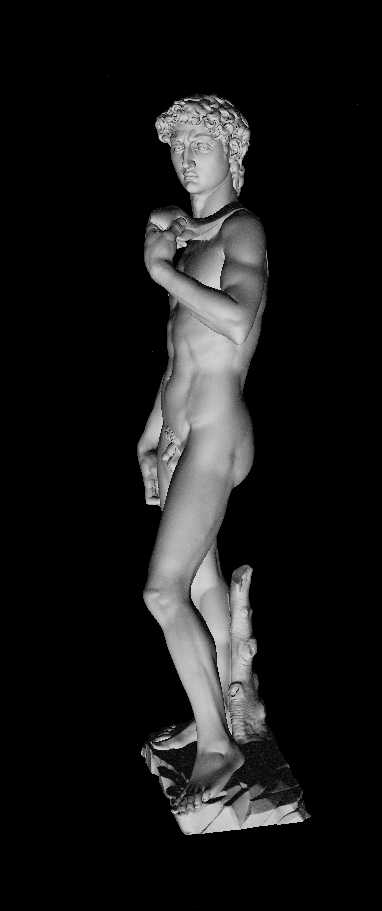
Under Pressure :: Michalangelos David


Under pressure from viewers Michalangelos David is Cracking:

In a single day the news brougt up Michalangelos David, the first was about fears that the historic statue in Florence was cracking from the vibrations of the viewers walking around it.

The second was  the concept of the "David Effect" (another explaination of that term here) about famed Harry Potter actor Danial  Radcliffe enbaresment at first preforming nude.

"Daniel Radcliffe was so nervous about getting naked on stage -- his penis shrank when he first stripped off in Equus.

The Harry Potter star, 19, made his stage debut in London on February 27 2007 in the revival of Peter Shaffer's play, in which he does a full frontal scene.

And Radcliffe was so scared about the performance that he suffered from "Michelangelo's David effect".


Daniel tells the New York Times, "He [David] wasn't very well endowed, because he was fighting Goliath.

"There was very much of that effect. You tighten up like a hamster.

http://www.showbizspy.com/showbiz/09152008/Daniel-Radcliffe-My-Willy-Shrank-When-I-Stripped-Off-On-Stage


He might have been refuring to a Gaurdian article:

Shrivelled from the fear of mortal danger ... Michelangelo's David.

One of the most intriguing, if least openly discussed, mysteries in art has been resolved.

Michelangelo's David is meant to be a representation in marble of the perfect male form. So why did his creator not make him - how would one say - a little better endowed?

As every visitor to Florence will know, the modest dimensions of David's "pisello" are a running joke with Italians, and the stuff of irreverent postcards.


But, in a paper to be published at the end of this month, two Florentine doctors offer a scientific explanation: the poor chap was shrivelled by the threat of mortal danger. Michelangelo's intention was to depict David as he confronted Goliath.

What the new study shows is that every anatomical detail - right down to the shaping of the muscles in his forehead - is consistent with the combined effects of fear, tension and aggression.

One of the authors of the paper, Pietro Antonio Bernabei, of the Careggi hospital in Florence, said one such effect would be "a contraction of the reproductive organs".

Last autumn he and his collaborator, Professor Massimo Gulisano, of Florence University, conducted a computer-assisted study of the 4.34 metre-high statue, in the Galleria dell'Accademia. They emerged, in Prof Gulisano's words, "stupefied" by Michelangelo's physiological accuracy.

The only mistake is at a point in the centre of David's back that is hollow and ought to be rounded. Michelangelo was aware of the error. But, as he wrote at the time: "Mi manco matera" ("I lacked [enough] material").

Dr Bernabei said allowance had to be made for the conventions of high Renaissance art, which depicted activity in a "much more composed and elegant fashion than today". But, anatomically, everything about Michelangelo's David was consistent with a young man "at the moment immediately preceding the slinging of a stone".

His right leg is tensed while the left one juts forward "like that of a fencer, or even a boxer". Tension is written all over his face. His eyes are wide open. His nostrils are flared. And the muscles between his eyebrows stand out, exactly as they would if they were tightened by concentration and aggression.

"You see the same thing on Japanese opera masks depicting anger," said Dr Bernabei.

David is holding something in his right hand, and it has conventionally been assumed that it is a stone. But Dr Gulisano said their studies suggested otherwise.

"He is holding the handle of the sling. The arrangement of the muscles in his right arm is consistent with someone making, or about to make, a rotary movement, but not with someone about to throw a stone," he said.

Their full findings are to be given in a paper written for the Dutch Institute for Art History in Florence. A summary was published in the latest edition of the Italian journal Il Giornale dell'Arte.

The two experts' examination of one of the world's most famous statues was carried out using a specially constructed scaffold that was wheeled into place when the gallery closed its doors to visitors in the evening and on public holidays. Michelangelo's masterpiece, completed in 1504, was put back on display last May after cleaning which allowed its anatomical details to be studied much more easily than before.

Now we all know why he is rather less substantial in one area than might have been expected, just one great puzzle remains: why, since David was Jewish, did Michelangelo sculpt him uncircumcised?


The real David's problume is more serious


Michelangelo's David 'may crack

By Mark Duff 
BBC News, Milan

Michelangelo's David
Major restoration works were carried out in 2004

Michelangelo's famous statue of David could collapse because of its exposure to mass tourism, Italian experts say.

They say the massive statue of the naked boy-warrior is in danger because of its size, shape and the weakness of the marble from which it was carved.

But they warn that the greatest risk comes from the footfall of many visitors who troop past it each day at Florence's Galleria dell'Accademia.

The experts want to protect the statue by insulating it from the vibrations.

This would cost about 1m euros (£785,000). Otherwise David could topple over, engineers from the University of Perugia say.

Iconic status

The warning follows a detailed study of the statue which showed that the cracks filled 


during major restoration works four years ago - on the occasion of its 500th anniversary - have already reopened.

That restoration was itself controversial because it involved using distilled water to clean the statue - which critics argued could damage it.

Michelangelo's David has had iconic status almost since its completion at the height of the Renaissance.

At the time it was seen as a powerful symbol of Florence's republican political ideals: David being the youthful warrior who felled the mighty Goliath in the Biblical Old Testament story.

Since then it has enjoyed mixed fortunes: attacked by crowds when it was first displayed, then hacked by a deranged painter in 1991.

The statue has also acquired kitsch status - its copies adorn everything from casinos in Las Vegas to tacky Mediterranean beach bars.

Thursday, September 18, 2008

Painting by Hugo Chávez president of Venezuela sells at Auction

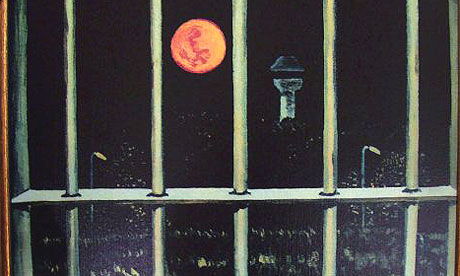
A canvas painted by Venezuela's president, Hugo Chávez, when he was in prison after his failed 1992 coup attempt has sold at auction for $255,000. Photograph: Reuters

"The mill of the gods grinds slowly!"

It was painted by a young army officer languishing in jail and it conjures loneliness and yearning: a full moon seen through the bars of cell. A message written in red letters beneath the portrait says: "The mill of the gods grinds slowly!"

Sixteen years later it seems the mill was not so slow in effecting dramatic change. The artist, Hugo Chávez, is the president of Venezuela and the painting has just sold for $255,0000 to help fund his socialist revolution.

Three Venezuelan businessmen paid the sum at an auction last week, surpassing all expectations for the picture, titled The Yare Moon, which opened bidding at $14,000.

The money will go to the PSUV, a socialist party that is carrying the president's banner in municipal and regional elections next month on the eve of the anniversary of Chávez's 10th year in power. He did the painting during a two-year jail sentence for leading a coup attempt in 1992, a military fiasco which nevertheless paved his path to electoral victory.

Hiroshima Bravo, a congresswoman and "chavista" loyalist, said she was surprised by the price but considered the painting a symbolic part of Venezuelan history.

Nelson Mandela's paintings of landscapes glimpsed through jail bars also fetched high prices, though subsequently doubts were raised about their authenticity.

Chávez's artistic credentials are not in question. As a boy in Sabaneta, a dusty, poor town in the plains, he used to paint friends, animals and landscapes. As a military cadet he drew caricatures of his comrades for their graduating yearbook.

Asked last year why he wanted to abolish term limits so he could run indefinitely - he has spoken of ruling until 2025 - the president said his revolution was like an unfinished painting and he was the artist. Giving the brush to someone else was risky, "because they could have another vision, start to alter the contours of the painting".

http://www.guardian.co.uk/world/2008/sep/18/venezuela?gusrc=rss&feed=worldnews


Three other World leaders were noted painters: Hitler, Churchill & Eisenhower

An article in Newsweek : The Art of Politics What happens when world leaders get creative. Hint: it isn't always pretty.

"Churchill bonded over painting with the American general, later president, Dwight Eisenhower. Eisenhower's tastes ran to plashing streams, dilapidated barns and birch-studded snowscapes in a style that might be called Greeting Card Pastoral. (In fact, when a small collection of his works was marketed as Christmas-gift prints, the publisher was Hallmark.) He was appropriately modest about his oeuvre, which he described as "daubs." Churchill, a far more accomplished and ambitious artist, was well aware of his amateur status, in comparison, say, to his hero Cézanne. "When I get to heaven," he once remarked, "I mean to spend a considerable portion of my first million years in painting, and so get to the bottom of the subject." But Hitler for many years regarded himself as an artist by profession. An authorized book of his watercolors referred to him in 1937 as "at once the First Fuehrer and the First Artist of our Reich."

http://www.newsweek.com/id/147791


Thursday, September 11, 2008

CHICAGO SCULPTOR MIKLOS P. SIMON 20 YEAR RETROSPECTIVE


CHICAGO SCULPTOR MIKLOS P. SIMON INVITED TO NOTRE DAME ISIS GALLERY FOR 20 YEAR RETROSPECTIVE, Round and Round We Go, Cycles in Art


CHICAGO (September 10, 2008) – Chicago-based sculptor Miklos P. Simon has been invited by the Art & Design Department of the University of Notre Dame to exhibit work at the ISIS Gallery on the Notre Dame Campus. The show will open on September 25 and will run through October 23. This one-man show marks the 20th anniversary of attending Notre Dame and is a retrospective of his body of work.


Miklos P. Simon is a Hungarian-American, an artist and educator born 1960 in Zalaegerszeg, Hungary. (Birthplace of the famous Hungarian Sculptor Zsigmond Kisfaludi Strobl) After four years in the School of the Arts at Pecs, and one-year additional study at the Academy of Fine Arts in Budapest, he left his homeland for the United States and settled in Chicago.

He continued his studies at the University of Illinois Chicago campus and later earned a Bachelor of Fine Arts degree from the School of the Art Institute of Chicago. Simon Miklos was naturalized as a U.S. citizen in 1987. The following year, he enrolled in the Master of Fine Arts program at the University of Notre Dame.

"The title of the show is 'Round and Round We Go, Cycles in Art' and I am exploring the cycle and internal revolutions of myself as an artist – from the perspective of deflecting from Hungary to my current life as a naturalized American, as well as the smaller, more mundane rotations and orbits experienced – what emerges is a re-thinking of my body of work and new whimsical installations that explore the literal and figurative play of cycles," said Simon.

Opening night is September 25, 2008 at 6:30pm
with an artist lecture followed by a reception – open to the public and runs through October 23, 2008. Isis Gallery is located on the Campus University of Notre Dame, ISIS Gallery (located in O'Shaughnessy Hall) Notre Dame, IN 46556. Phone: (574) 631-7085. Accessible by the Metra South Shore Line (http://www.nictd.com/).

Since graduation he has taught art at the School of the Art Institute of Chicago, the University of Notre Dame, and the University of Chicago. Since the fall of 1999, he has been a part-time faculty member at Columbia College Chicago. He has participated in numerous national, international, group and solo exhibitions such as with SOFA Chicago, Art Chicago/Thomas Blackman & Associates Gallery and Fernando Silio Galeria de Arte, Santander, Spain, and at Liget Gallery, Budapest, Hungary. He is the principal of Simon Sculpture Studios and has received commissions for the Naval Monument in D.C., Roosevelt Road Viaduct Project, and his work appears in many Chicago-area architectural buildings and public displays including the Fine Arts Building, Harold Washington Library, Garfield Park Conservatory, The National Kidney Foundation (read about here) and the Looking Glass Theatre Company.


MIKLOS P. SIMON Artist Statement


In my most recent work I am posing individual questions or problems per piece, not so much as developing a theme. With materials such as electric fans, charcoal, garden hose or a man‘s wool flannel suit, I realize in objects, installations, and performance pieces personal, cultural or purely aesthetic issues. A few of these works explore impossibilities, others are therapeutic and some are humorous.


For example, the impossible manifests itself in the piece „Suit of a man who was cut in half and survived“. The viewer is faced with an impossible truth or a contradiction. The suit has been tailored to be worn by someone who has been split in half. „My Private Island“, a private space defined by a garden hose, is a tongue-in-cheek metaphor of the need for escape and refuge. A vacation delineated on the gallery floor.

MIKLOS P. SIMON Website = http://www.miklospsimon.com/index.html

Sunday, September 07, 2008

Artist Statement : Sandra Ginter , Sculptress


Artist Statement

"Through the use of clay I have developed a strong desire to address the issues of touch. However, it is not just the touch which is transmitted by the fingertips that intrigues me, but the feeling of being surrounded and transformed. Large or small, we all want space. We are surrounded at every moment of every day by space, but we are seldom consumed by it.suit (detail)

I am currently working on a series of single chamber "suits." These suits are constructed primarily out of clay. The images I draw from are airplanes, shark's and the human body. Airplanes and sharks resmbel the human body's basic form, but they contrast it in their nature.


The human body's suit is its' skin, it is soft supple organic and sensitive to the environment around it. Because of this, we often need additional shelter. This shelter not only protects but often furthers our boundaries. For example, we design hard, metallic airplanes so we may fly with speed and power. Similar to airplanes, sharks have speed and power, but they are also stereotyped as fearless eating machines with wet, leathery suits.

I have chosen these three images not only for their basic resemblance in form, but for the metaphors I am able to draw between them. As an airplane, you may attempt to climb inand fly away. As a shark, you are invited to possible change your persona, feeling sharper, stronger, harder, or fearless. One may not always view the texture covering the interior as a safe haven. However, once you have climbed inside you've become shielded, and if only for a minute, you are consumed.

I want my work to create a space that lures the viewer in, entwining them with the sense of touch....

http://www.saintmarys.edu/~events/Calendar/MoreauGalleries/faculty/ginter/ginter1.html


It is interesting to compare this self-statement, with a reviewer statement. Clearly the reviewer must have gotten their facts from the artist. But the description becomes more explanatory rather than the almost metaphysical tone of the artist statement.


"Ginter, who received a MFA from Cranbrook Academy of Art and currently teaches at Saint Mary’s College in South Bend, Ind., uses her work to satire issues that surround being a mother and living in the Midwest and examines bits of Midwestern iconography with the piggyback perspective of a busy, working mom with three small children. She uses color and symbolic form to create small narratives that are all part of a larger tale in which cows and pigs hold particular significance. Larger issues are hinted at, such as genetic cloning, the significance of the individual and the ritualistic nature of living day to day."

http://www.iwu.edu/CurrentNews/newsrelease07/art_MayTermShowings_407.shtml
October 9-November 6, 2008:

Hammes Gallery goes….PINK! A ceramic sculpture exhibition curated by Prof. Sandi Ginter and Helen Otterson. Featuring work by: Tom Bartel, David East, Jeannie Hulen, Lisa Conway, Erin Furimsky, Sandi Ginter and Helen Otterson.

Hammes Gallery is located in the Moreau Center for the Arts at Saint Mary's College in Notre Dame, IN. Gallery hours are Monday through Friday from 10am-4pm; closed campus holidays

ARTIST'S STATEMENT : Tom Bartel

This is another interesting artist statement, part of our new collection of artist statements of contemporary artist.


ARTIST'S STATEMENT

Clay is my chosen material; ceramics is my chosen medium. I cannot do what I do with any other material or process; clay and its firing process usually allow me to manifest my ideas best.


I have always been fascinated by human form and tend to use this as a starting point in my work. My work questions various stages of life, which are determined primarily by the biological development of the body from birth to death. I see the human life cycle as an experience containing many beginnings and endings many "births and deaths"; the connection between the beginning and ending of life is a continual source of inspiration. I am observant of how powerful time can be and am intrigued by the many ways in which we are affected by its passage. The changes that take place over time are frighteningly subtle.

Some of my work is directly concerned with the relationship between clothing and growth and clothing and skin. Each has the potential to encompass physical as well as emotional concerns. The body, when patterned, usually refers to clothing... to some degree. I enjoy the ambiguity that this situation presents. Furthermore, I see our clothing and/or appearance as being capable of summing up who or what we are yet it is only a facade; the ideas of mask, disguise, transformation and identity are fundamental to my concerns.


The ceramic surfaces I obtain are a vital component of my work through which I intend to confront the viewer's attention with the outermost "skin" of the work. I am attracted to heavily worn, patinated surfaces that reveal the "history" of an object. I see our skin as having the same potential as the surfaces by which I am intrigued. Throughout our life as we age our appearance inevitably and slowly changes and in the process our skin records this story.

Tom Bartel
If interested in contacting Tom Bartel, please send e-mail to tom.bartel@wku.edu
His Bio is at http://www.sherriegallery.com/artistprofile.php?artist=9
http://artscouncil.ky.gov/whtsnew/FellowDec04/bartel.htm

He will in a group show at October 9-November 6, 2008:

Hammes Gallery goes….PINK! A ceramic sculpture exhibition curated by Prof. Sandi Ginter and Helen Otterson. Featuring work by: Tom Bartel, David East, Jeannie Hulen, Lisa Conway, Erin Furimsky, Sandi Ginter and Helen Otterson.

Hammes Gallery is located in the Moreau Center for the Arts at Saint Mary's College in Notre Dame, IN. Gallery hours are Monday through Friday from 10am-4pm; closed campus holidays

Sunday, July 13, 2008

Artists Statement : Willamarie Huelskamp

What is an artist statement? Is it fact's? Is it self opinion? Or self promotion. Here is one I particularlly like:


Willamarie Huelskamp


Statement


My paintings come from my heart. It would be easy to edit out all that is meaningful in art by judging an inspiration as too sentimental, too complicated, funny or just plain crazy. Wrestling with my inner voices, both angels and demons, I struggle to create a visual symbolic language.

Painting affirms from my love of the tactile world, the world of surfaces. The paint becomes my micro-universe where I play with textures, rhythms of line and patterns of form, and more importantly the duality of creation and destruction. I layer the paint and images to create real depth in the pictorial surface. Primitive art inspires my work in its disregard for anatomical correctness and illusionary effects of perspective. An Egyptian frontal view of the shoulders, an Aboriginal dot, an Assyrian eye facing forward in a facial profile and an Anasazi headdress can all be found in my work. Much inspiration comes from the work of Paul Klee, Picasso and Chagall who were each inspired by primitive art.

The imagery sometimes reflects the outer world of my life in Utah with my family but more accurately is a reflection of the inner experience of this mad and joyful journey called my life. I wonder about this humanness I share with all the people who have come before me and who will come after me. Through these simple drawings and rich layering of texture, the painting speaks beyond culture and time, exploring simple relationships. They explore the places where my consciousness overlaps and merges with the consciousness of others and my search for wholeness and connection is reflected in a symbolic language .

Visit her website at: http://www.willamarie.com/

See more of her work at http://www.worthingtongallery.com/default.aspx

Sunday, June 29, 2008

High rollers driving up prices: Monet sells -80.5 Million


Because they can

The big art news last week was, of course, the $80.5 million sale to an anonymous buyer of Claude Monet’s “Le Bassin aux Nymphéas” at Christie’s auction in London.

But it suggested a bigger story to National Public Radio, which reported that although ordinary folks don’t have enough money to buy expensive art, the high rollers are buying more than ever. And by paying huge amounts, they’re driving up the prices worldwide.

Russian billionaire art lover Roman Abramovich, for example, last month snarfed up a Lucian Freud painting ($33 million) and a Francis Bacon triptych ($86 million).

For the average art joes who spend their time at public museums, the trend has ominous implications. NPR quotes University of Illinois art history professor Jonathan Fineberg:

“Museums can no longer afford to buy the great works of art because they have consistently been outbid by private individuals making huge amounts of money in the corporate world.”

The art bubble, NPR surmises, isn’t going to pop anytime soon.

Bollybooty

Let’s see, what if in the middle of “Indiana Jones and the Kingdom of the Crystal Skull,” Harrison Ford and his co-stars suddenly took a cue from Indian movies and broke into song and dance. Hopping, dancing, swooping, crooning. Hey, it could happen. After all, movie titan Steven Spielberg and Indian billionaire Anil Ambani are sniffing around each other, hoping to cut a deal.

Spielberg and his DreamWorks want money, maybe $2 billion, so he can split from Viacom Inc.’s Paramount Pictures and have enough lucre to make five or six films a year. The Wall Street Journal reported he may get $500 million to $600 million of that from Ambani’s massive conglomerate, Reliance Entertainment.

Film is a growth industry in Bollywood. Analysts say “filmed entertainment” in India has grown 17 percent in the past three years and is worth $2.4 billion. But the industry could double in the next five years, according to Time magazine.

Ability, not disability

Years of war have given Cambodia one of the highest ratios of disabled people in the world. Hardly an enviable distinction. But that made it a perfect place for dancer Katie MacCabe to base her charity Epic Arts.

Epic, an acronym for Each Person Is Counted, opened in Phnom Penh in 2006 with a goal to help integrate the disabled into the arts, especially dance.

“This is not about sympathy or therapy,” MacCabe told the International Herald Tribune. “We want to show that impairment can actually enhance creativity and that virtuosity is not just the domain of the able-bodied.”

Epic’s mission is to change public opinion about disabled performing artists by showcasing their work. Currently, 33 artists train with Epic Arts, and eight are professionals.

Above compiled by Bill Luening at 816-234-4740 or bluening@ kcstar.com


Le bassin aux nymphéas is one of the great rarities of Impressionist and Modern art: a painting of Monet's beloved water lilies, forming part of his final painting campaign, that was signed, dated and sold by the artist soon after its execution.

Monet had begun a new series of large-scale Nymphéas in 1914, and these would lead ultimately to his Grandes décorations, the celebrated frieze now in the Musée de l'Orangerie, Paris. The large scale and bold, almost abstracted expressionistic brushwork that characterised those works is equally evident in Le bassin aux nymphéas; these qualities would later come to have a lasting influence on a range of artists including Pierre Bonnard, the Abstract Expressionists and even the ideas behind Informel. Dated 1919, when Monet signed the picture and sold it with three sister-works to Bernheim-Jeune in November that year, Le bassin aux nymphéas is one of the tiny handful of pictures from this period that he relinquished, as he tended to view his paintings of water lilies as a large, cumulative work in progress and guarded them all jealously, seldom allowing them to leave his studio. This, then, is not a study, like so many other works from this period, but instead a highly finished work. The rarity of Le bassin aux nymphéas is reflected by the fact that of its three fellow paintings, one is now in the Metropolitan Museum, New York, while another was sold from the estate of Ralph Friedman at Christie's in New York in 1992 for the then impressive price of $12,100,000; and the fourth was sadly cut into two (becoming W1893/1 and W1893/2).

The provenance of , itself speaks of its exceptional importance as, before becoming the centrepiece of the formidable collection assembled by J. Irwin and Xenia S. Miller, it was owned by Mr and Mrs Norton Simon. The founder of the Norton Simon Foundation that would come to give the celebrated Pasadena museum his name, Norton Simon was an immensely successful and philanthropic businessman whose private collection included a string of paintings by artists including Degas, Picasso and Van Gogh.

Monet's late Nymphéas took a motif that he had long adored and lent them a new scale and a new vigour. Le bassin aux nymphéas has an expressionistic flair that was less evident in his pre-1914 paintings which had evolved over the intervening half decade. The word 'décoratif' which was used in association with these works was less because of an inherent decorative quality, but instead because of the sheer modernity of these engaging and absorbing visions: it was a result of the subjective means of rendering the scene, which viewers felt was less linked than most art with the real world. Pictures such as Le bassin aux nymphéas were almost abstract, rather than realist, and therefore were considered décoratifs.

Monet had long been passionate about his water lilies. Decades earlier, he had successfully battled with local bureaucracy in order to gain permission to reroute the river Epte, damming a section and thereby creating a large pond and a water garden. He filled this with water lilies, selecting special hybrids in order to increase the range of colours of their flowers; the water lilies have roots embedded in the muddy bottom of the pond, hence the recurrence of the same or similar constellation-like arrangements through the period of the Grandes décorations. Monet's gardens at Giverny evolved over the many years that he had lived there; he had deliberately set about creating an area filled with motifs for his Impressionist pictures, filling flowerbeds with myriad coloured plants and creating panoramas, views and water effects. This led to his self-deprecating statement that, 'Gardening and painting apart, I'm no good at anything' (Monet, quoted in D. Wildenstein, Monet or The Triumph of Impressionism, Cologne, 1996, p. 368).

Monet's water gardens marked the pinnacle of his horticultural success and became his most celebrated subject. The play of light and textures condensed many of the interests that informed the Impressionist aesthetic. In Le bassin aux nymphéas, these are clear to see: the water acts as a vehicle for Monet's exploration of the varied textures of the water lilies and the water, as well as the light effects and reflections in the pond surface. Thus, snaking through the centre of the painting, the viewer sees the blue sky while to either side the trees, including what appears to be a weeping willow, are reflected. While Monet has tightly focussed his view on a patch of the pond, creating a closely framed composition that seemingly allows for no foreground or background, he has nonetheless used the water as a form of portal, allowing a complex interplay of the near and the far.

Monet's water lilies had long been an important motif in his paintings at Giverny, and he had already painted and exhibited several series showing them, albeit on a much smaller scale, referring to them sometimes as his 'water landscapes.' However, the paintings towards which he began working in 1914 marked a break from those earlier works. Following a brief lull in his output, Monet had been rummaging in his basement when he saw some old, abandoned pictures which held still the kernel of a great idea. Since his commissions in the 1870s for Ernest Hoschedé, the friend and patron whose wife he had later married, Monet had long contemplated a full 'decorative' frieze, and it was towards this end that the reinvigorated artist now worked. This was clearly already the case by April 1914, as a letter to Gustave Geffroy reveals:

'As for myself, I'm in fine fettle and fired with a desire to paint... I am even planning to embark on some big paintings, for which I found some old attempts in a basement. Clémenceau saw them and was amazed. Anyway, you'll see something of this soon, I hope' (C. Monet, 1914, quoted in R. Kendall (ed.), Monet by himself: Paintings, drawings, pastels, letters, London, 1989, p. 247).

It was as a part of this new concept that Le bassin aux nymphéas came into existence, the fruits of a project that had already occupied the artist for half a decade and which would dominate his output for years to come, culminating in the Grandes décorations at the Orangerie. Two metres wide and a metre tall, Le bassin aux nymphéas is one of a group of large paintings showing the same view that Monet appears to have executed during a single period. Approximately the same view would later be shown on a greater scale in the Orangerie paintings, while the relationship between the present work and the monumental panel in the Carnegie Institute, Pittsburgh is striking.

In painting his larger panels for the Grandes décorations, Monet worked in his newly-built studio, specially designed and constructed in 1915 despite the ravages and privations of the First World War, a mark of his passion for the project. While Monet could work on the largest canvases indoors in the studio all year long, come rain or shine, the 'smaller,' more manageable pictures like Le bassin aux nymphéas would often be propped up with an arrangement of ropes and weights so that he could paint them before the pond itself. An insight into this process was provided by René Gimpel, who wrote of a visit he made to Monet's studio in 1918, mentioning a group of pictures that Daniel Wildenstein stated almost certainly included Le bassin aux nymphéas:

'... we were confronted by a strange artistic spectacle: a dozen canvases placed one after another in a circle on the ground, all about six feet wide by four feet high: a panorama of water and water lilies, of light and sky. In this infinity, the water and the sky had neither beginning nor end. It was as though we were present at one of the first hours of the birth of the world. It was mysterious, poetic, deliciously unreal... 'I work all day on these canvases,' Monet told us. 'One after another, I have them brought to me. A colour will appear again which I'd seen and daubed on one of these canvases the day before. Quickly the picture is brought over to me, and I do my utmost to fix the vision definitively, but it generally disappears as fast as it arose, giving way to a different colour already tried several days before on another study, which at once is set before me-- and so it goes the whole day!'' (R. Gimpel, quoted in C. Stuckey (ed.), Monet: A Retrospective, New York, 1985, p. 307).

Monet's plan to surround the viewer with views of the pond and trees, which was finally embodied in the Orangerie pictures, had originally been conceived in peace time with a domestic scope. 'For a moment the temptation came to me to use this water-lily theme for the decoration of a drawing room,' he explained. 'Carried along the walls, enveloping all the partitions with its unity, it would have produced the illusion of an endless whole, of a wave with no horizon and no shore; nerves exhausted by work would have relaxed there, following the restful example of those stagnant waters, and to anyone who would have lived in it that room would have offered a refuge of peaceful meditation in the middle of a flowering aquarium' (C. Monet, quoted in R. Gordon & A. Forge, Monet, New York, 1983, p. 224). This sense of refuge and Monet's sense of mission became all the more integral to the project with the outbreak of the First World War. Monet was extremely self-conscious about the contrast between the turmoil of the Front, where many of his own family and acquaintance served, and the paintings with which he was engaged. To Monet, though, this cemented his sense of duty. He was upholding some of the beauty and some of the spirit of France, and each time an enemy push threatened, he refused to leave Giverny, insisting that he would rather die among his beloved pictures.

It was soon the entire Grande décoration project that would come to be associated with the War, or rather, with the Armistice. For, on 12 November 1918, the day after the Armistice was signed, Monet wrote to his friend, the original enthusiast for the Grandes décorations, the Prime Minister of France at the time, and hence the 'Father of the Peace,' Georges Clemenceau. In his letter, Monet explained that he was:

'... on the verge of finishing two decorative panels which I want to sign on Victory day and am writing to ask you if they could be offered to the State with you acting as intermediary. It's little enough, but it's the only way I have of taking part in the victory' (Monet, 1918, quoted in R. Kendall (ed.), ibid.).

This project gradually evolved into the large-scale offering that resulted in the Orangerie friezes which are to this day monuments to France. They are the culmination of Monet's career, his crowning glory, vigorous and expressive execution, escaping the rigours even of Impressionism in order to create something that is absorbing and subjective. Le bassin aux nymphéas is an important facet of that great project.
--------------------------------------------------------------------
Gift ideas From our sponsors:


*/ /* Use this with templates/template-twocol.html */