The acclaimed director talks to Peter Owen Nelson about his new show of surrealist paintings and mixed media assemblages. Plus, VIEW OUR GALLERY.
Posted using ShareThis
Sunday, September 20, 2009


Wednesday, September 16, 2009
Monday, July 13, 2009
Update: Updated: "Obama Hope" artist Separd Fairey pleads Guilty

The street artist Shepard Fairey, creator of the Obama "Hope" poster, has cut a deal with Boston prosecutors. In February Boston police arrested Fairey as he was on his way to DJ at a party to mark the opening of his big show at Boston's Institute of Contemporary Art, which runs through Aug. 16. He was later hit with multiple charges of vandalism, though many of them were subsequently dropped for lack of evidence. There didn't seem to be much to prove that it was Fairey who had pasted up the Fairey stickers that constituted the offending acts in those charges, since those stickers are available to anybody over the Internet.
But Fairey has now pleaded guilty to three of the charges, been sentenced to probation and agreed to pay $2000 to a graffiti removal group. In exchange prosecutors have agreed to drop 11 remaining charges.
Fairey will be headed back to the Boston ICA on July 31 to DJ at a replay of that party he never got to attend, but tickets are already sold out.
"Obama Hope" artist Separd Fairey Arrested"
Obama 'Hope' poster artist arrested in Boston
Shepard Fairey, the controversial street artist riding a roller coaster of publicity with his red, white, and blue posters of President Barack Obama, was arrested last night on his way to DJ an event kicking off his exhibition at the Institute of Contemporary Art.
Fairey, a 38-year-old known for his countercultural style, was arrested on two outstanding warrants and was being held at a police station, according to a police official with knowledge of the arrest who requested anonymity.
Police could not describe the nature of the outstanding warrants last night, but said they were based in Massachusetts.
Fairey has been arrested at least 14 times, he has told the Globe.
The artist was arrested at about 9:15 p.m. as he was about to enter a sold-out dance event at the Institute of Contemporary Art on Northern Avenue, known as "Experiment Night." The event is geared toward a younger-age crowd, with techno-style music, and more than 750 people were waiting for him, some of whom had bought tickets for the event on Craigslist for as much as $500.
Fairey was supposed to appear as a guest DJ for the kickoff of his exhibit, Supply and Demand, which will run through Aug. 16. He was scheduled to go on stage at about 10:30 p.m., and an hour later organizers reported to the crowd that he was arrested.
"We're very disappointed," said Paul Bessire, deputy director of the Institute of Contemporary Art.
"Shepard Fairey is a wonderful artist who created some positive work and we were very pleased to present his work here and around the city. We feel he is an influential artist."
Fairey, a street artist, graphic designer, and political activist, is best known for his "Obey Giant" campaign of stickers, stencils, and posters in the early 1990s.
Most recently, he has achieved fame with the red, white, and blue posters of Obama, emblazoned with the words "Hope," "Progress," and "Change."
The president used the posters during his campaign, and one of the displays in Fairey's exhibit includes a typed letter from Obama that read: "I am privileged to be a part of your art work and proud to have your support."
Fairey was recently seen with Mayor Thomas M. Menino in an event to promote his show, and banners raised at City Hall also announce the exhibit.
At the same time, however, anti-graffiti activists complained that a street artist was going to be the subject of a museum show.
But Bessire said, "We feel he is an influential artist. We were just very pleased and felt fortunate to show his work."
The arrest of Fairey -- who cites linguistic theorist Noam Chomsky with a poster that reads, "I lived with the system and took no offence/until Chomsky lent me the necessary sense" -- helped maintain his counterculture reputation.
"I wouldn't say it's cool he was arrested, but I think it shows he has integrity," said Bill Galligan, a graphic designer. Some in the crowd last night speculated the incident may have been a publicity stunt.
Ginny Delany, a 27-year-old graduate student from Cambridge, said, "It makes him even more of a hero to me.
"The fact that he is arrested for his art shows that it is meaningful tohim and he cares about what he is doing."
David Rosen, a 19-year-old from Allston, said last night that he was disappointed with the arrest, but "I understand that his art requires him to take risks."
Christopher Muther of the Globe staff contributed to this report.


Previously
Shepard Fairey once outlaw Artist now in National Gallery
Iconic Obama Artwork Finds a Home
January 18, 2009 2:12 PM
ABC News' Sunlen Miller reports:
The iconic image of President-elect Barack Obama’s campaign is now on display permanently at the National Portrait Gallery in Washington, D.C.
The original painting, by Los Angeles artist Shepard Fairey, was unveiled yesterday –- and now hangs in the “New Arrivals” section for the many visitors in the district during inauguration to see.

Fairey’s red, white and blue portrait collage with Obama’s face over the word “hope” was reprinted in mass quantities, donning campaign shirts, posters, hats, buttons and stickers throughout the campaign.
The painting was a gift to the Portrait Gallery of Tony and Heather Podesta.
This weekend’s inauguration festivities are bringing Obama fans to the museum in droves. Museum staffers say crowd control has been an issue in the less-than-24 hours the artwork has been on display. They have set up a black rope in the middle of the aisle, creating two lines to view the picture. Police officers hustle viewers to move quickly after snapping a quick picture.

After being hung in a temporary gallery within the museum the portrait will find a home in the permanent display.
-- Sunlen Miller
Connecting the Pieces of Grant Wood's Corn Mural
 COUNCIL BLUFFS, Iowa - An arts group is hoping to raise $120,000 to buy the remnants of a mural painted on a hotel wall by Grant Wood in 1927 that was cut to pieces nearly four decades ago and to put it back together.
Recent discovery of part of the border of that mural was found above a dropped ceiling. The border contained the painted refrain, “where the tall corn grows,”.
The group hope to make the mural the centerpiece of an art center planned for the Bluffs. Ideally, they'd like that art center to be in the mural's original home at Bluffs Towers.
The odd history:
In 1926, hotel magnate Eugene Eppley (April 8, 1884-October 14, 1958), also known as Gene, was a hotel magnate Eppley is credited with single-handedly building one of the most successful hotel empires, by the 1950s the largest privately owned hotel chain in the United States. At its peak in the 1950s, the Eppley Hotel Company owned 22 hotels in six states. Eppley sold the company to Sheraton Hotels in 1956 for $30 million. (1)) hired Wood to paint four murals for the dining rooms of his hotels in Sioux City, Council Bluffs, Cedar Rapids and Waterloo.
Three of the murals were `corn murals' (one in each hotel). They were painted to fill the room. The corn murals were supposed to make viewers feel as if they were sitting in an Iowa field with tall stalks of corn, rolling hills and barns dotting the horizon.The mural is a typical example of the kinds of landscape visible in the surrounding countryside.
"Wood was painting what he longed for, an agrarian paradise where the land took care of her own before the machine came to torment her; further, this was an America without urban centers and thus free of the social complexities of mass unemployment, crowded conditions, factories and industry." (2)
Wood's murals from the hotels in Sioux City and Cedar Rapids ended up in the Sioux City Art Center and the Cedar Rapids Museum of Art. But in 1970, owners of the Bluff Towers in Council Bluffs invited the public to cut away parts of their Wood mural and take them home.
Wood's technique in painting this mural was subtractive -- his assistant Carl Eybers would put a thin layer of paint on a prepared section of the canvas, and Wood would then wipe away from that paint to create the corn stalks, buildings and other imagery visible. The murals are faded today both because of this subtractive technique. The Canvas was then glued to the wall. (3)

The corn room mural mural for the Martin Hotel in Sioux City has been
kept whole, and a conservation process saved the mural, but damage has dimmed the imagery and shifted his colors towards golden-brown. That mural can be seen at the The Sioux City Art Center.
Grant Wood (1891-1942) born in Iowa has an international reputation. His best-known painting, American Gothic (1930) (at the Art Institute of Chicago), has become an iconic image of rural America. Wood spent the majority of his art career living and working in Cedar Rapids. He was the head of the Iowa section of the Public Works of Art Project which ran from 1933-1934.
Wood was the most prominent artist in the Regionalist art movement in the 1930s, and he remained a proponent of its approach to art for the remainder of his career. This movement was a democratic art accessible to everyone and reflecting local, rather than imported from Europe or elsewhere, interests and traditions. The ideas Regionalism describe are connected to the immediate, local audience for the art.(4)
Wood's canvases also came with the bonus of a recognizable subject, one that was bucolic and idyllic, that provided instant uplift and gratification. (5)
Grant Wood's Corn Room Mural is historically important because it shows that Wood was developing the ideas and approaches that would become Regionalism several years before he produced his first clearly-Regionalist works and achieved critical success with his invention: Woman with Plants (1929)


and American Gothic (1930). Both these paintings have their origins in the specific landscape of the Midwest, but fuse their local subjects with formal concerns drawn from seventeenth-century Dutch painting. Wood's concerns with landscape, visible in the Corn Room Mural, remain a constant reference point for his Regionalist works: it appears as the background to Woman with Plants and in the famous house seen behind the couple in American Gothic. The central imagery in one of the main panels -- conical piles of harvested corn -- reappears in his later work, notably as the central focus of his lithograph, January (1937), in the painting Iowa Cornfield (1941), and in his last known work, an oil sketch from 1941 called Iowa Landscape.(6)
 (Iowa Cornfield 1941)
Can you help?
The Bluffs Arts Council is encouraging anyone with pieces of Grant Wood's corn mural to contact the organization at (712) 328-4992.
The council also is accepting donations for the project. Send them to Bluffs Arts Council, City Hall, 209 Pearl, Council Bluffs, IA 51503.
Paul Grant (follower of Basho)
(1)http://en.wikipedia.org/wiki/Eugene_C._Eppley
(2)http://xroads.virginia.edu/~MA98/haven/wood/landscape.html
(3) http://www.tfaoi.com/aa/7aa/7aa827.htm
(4)ibid
(5)ibid
(6)ibid
Refrenced also:
http://www.tfaoi.com/aa/8aa/8aa392.htm
Monday, June 15, 2009
Canadian Artsist:: Christopher Cann
Part of my series: Contemporary artist from around the world.

I saw this work on an on-line competition called Art & Design. I was struck by the flowing element similar to early Japaneses painting. I was also struck by the pureness of the simple wood, something I used to do.
You can see more of his work on his website
The artist contact is currently living in the Yukon. (Northern Canada) Best way to get a hold of him is via e-mail brodapper@yahoo.com.

I saw this work on an on-line competition called Art & Design. I was struck by the flowing element similar to early Japaneses painting. I was also struck by the pureness of the simple wood, something I used to do.
You can see more of his work on his website
The artist contact is currently living in the Yukon. (Northern Canada) Best way to get a hold of him is via e-mail brodapper@yahoo.com.
Artist statement
I do what I do because I have an itch that needs to be scratched. If I am not creating, I feel like I have forgotten something - and it nags at me until I fulfill its need. It’s the same feeling you get when you leave the house, and get to where it is you were going and are not sure if you turned the stove off or not. I enjoy painting, but am ultimately compelled to do it, as it needs to be done. I hope one day to satisfy the itch and not need to scratch so often - but I know this will never happen. So I think by creating work I am happy with on a semi regular basis will keep the crabs at bay.
I learned how to paint through experimentation. Art school was a whole lot of dead ends for me. I was so turned off by the whole experience I finished as quickly as I could and went traveling. During these travels, I discovered that I am art. I am the subject of the most important documentary I will ever see. When I realized this, I saw that we are all in the same boat. I started to paint caricatures of everyday situations in my life, and before long these paintings took over the majority of what I chose to paint. Although I do quick gestures of my ideas, most decisions are made while I am sitting painting the image. My process is spontaneous and intuitive. Besides the gestures, they are mostly done from memory, and the way the situation that I am conveying made me feel.
I am currently painting on wooden panels. This allows me to use the natural patterns in the wood grain as part of the image. I often use the wood grain itself as a jumping off point. I also use a dremel to engrave images back into the wood panel, or use it to uncover layers underneath the paint; producing a flowing pin stripe effect. I am still painting with a stylized cartoon technique that I initiated in art school, which is inspired by Japanese animation, and graffiti. I use bold black out lines with varying weights. I feel that cartoons speak to the viewer’s inner child. By doing this, I hope to make my images accessible. I am no longer forcing myself to fill the entire panel with paint. Where my past work has not had much focus, my current body of work is a collection of moments that take place in my everyday life. Spontaneous ideas, everyday occurrences and daydreams are all a part of what motivates me to create. Although my inspirations are broad, my body of work is now focused. It reads like a photo album with an underling narrative which ultimately tells the story of the painter. Looking at another person’s photo album without context can make it difficult to make a connection. On the other hand, I think we can all relate to the collecting of special moments in ones life, as all of our lives are a series of these moments. I am trying to capture these moments on the panel when they are fresh. The hardest part is being aware of when they are happening and opening myself to experience them fully. To grow as a painter, I have to grow as a human being, by experiencing life and making mistakes. I hope by continuing to paint and producing images that are unique and accessible I will make a connection with the viewer.
Tuesday, April 28, 2009
Michelle Obama, Hillary Clinton, other prominent women unveil bust of Sojourner Truth

- It's Equal Pay Day -- designed to call attention to women's lower earning power -- and Secretary of State Hillary Rodham Clinton and first lady Michelle Obama will mark it by speaking in succession at an the unveiling of a Capitol Visitor Center bust of women's rights crusader Sojourner Truth.
The $3.2 million bust makes history as the first memorial bust of a black woman to be placed in the Capitol. The project was spearheaded by the National Congress of Black Women, Inc., and took nearly 10 years to complete.
Sojourner Truth (1797 – November 26, 1883) was the self-given name, from 1843, of Isabella Baumfree, an American slave, abolitionist, and women's rights activist. Truth was born into slavery in Swartekill, New York. Her best-known speech, Ain't I a Woman?, was delivered in 1851 at the Ohio Women's Rights Convention in Akron, Ohio.
Wednesday, April 22, 2009
Damien Hirst : Requiem, major retrospective in Kiev
Notorious British provocateur Damien Hirst is opening the largest single show of his career at the Pinchuk Art Center in downtown Kiev. 

"I always thought museums were for dead artists and I was afraid of that," said Hirst, who decided to mount his exhibit in the Ukraine because he believes audiences there are new to contemporary art. "I hope it will make people think."
Hirst, perhaps the most famous current living artist, sold his work at auction last year at Sotheby's for nearly US$200-million. Whatever it is that attracts art buyers to his fish skeletons, dead sharks and bewjeweled skulls will soon be making its way to Kiev."Art's about invention and we are all desperately trying to invent a better future, and to learn from the past." (Damien Hirst, in conversation with Eckhard Schneider)
In his work over the last two decades, Hirst has continually produced paintings, sculptures and drawings that radically and directly address our shared quest for life in the face of inevitable death. Through an exploration of beauty and decay, love and desire, science and religion, history and art, Hirst has created some of the most conceptually profound and challenging artworks of our time.

“Charity.” 2002-2003
Requiem brings together many of the artist's most celebrated works. Ranging from early iconic sculptures such as A Thousand Years, 1990 and Away from the Flock, 1994 to more recent works like the monumental butterfly triptych, Doorways to the Kingdom of Heaven, 2007 as well as Death Explained, 2007, a sculpture of a shark cut in half in formaldehyde, the exhibition shows the extraordinary breadth of Hirst's artistic enterprise.
Since the start of his career, Hirst has pushed the boundaries of art and what it means to be an artist. Requiem bears witness to a bold new direction in his work by showing for the first time a series of skull paintings he created between 2006 and 2008. In works such as Floating Skull, 2006, The Meek Shall Inherit the Earth, 2008 and Men Shall Know Nothing, 2008, Hirst returns to the solitary practice of painting and confronts, in very personal terms, the darkness that lies at the heart of human nature and experience.
The impulses driving Damien Hirst’s work stem from dilemmas inherent in human life: ‘I am aware of mental contradictions in everything, like: I am going to die and I want to live for ever. I can’t escape the fact and I can’t let go of the desire’. The materials he uses often shock, but he says he ‘uses shock almost as a formal element . not so much to thrust his work in the public eye . but rather to make aspects of life and death visible’. (Tate Britain.)
“The Physical Impossibility of Death in the Mind of Someone Living.” 1991
Victor Pinchuk: "This exhibition is of great significance but what is most important for me is that the opportunity to see Hirst's new body of work occurs first in Kyiv. Damien's exhibition in Kyiv symbolises the reciprocal and mutually beneficial relationship between contemporary Ukrainian culture and that of the rest of the world. They share a common ground."
Eckhard Schneider, General Manager of the PinchukArtCentre: "With this fundamental retrospective including a cycle of new paintings the PinchukArtCentre gives an important international contribution to the debate surrounding one of the leading artists of our time."
Requiem is made possible by the loaning of key works from private collections. The exhibition was curated by Eckhard Schneider and developed in close cooperation with Damien Hirst and Victor Pinchuk. In hosting a major retrospective of one of the most important artists working today, the PinchukArtCentre is testament to the Ukraine's ongoing cultural development. -- www.gagosian.com
Tuesday, April 21, 2009
Amedeo Modigliani Comprehensive Retrospective Exhibition (with video)

The `last bohemian of Paris' Amedeo Modigliani shows up in a major show in Bonn Germany 17 April – 30 August 2009.
Amedeo Modigliani was one of the most important artists of the 20th century. His works have long since gained iconic status in our collective pictorial memory. The Art and Exhibition Hall is holding a comprehensive retrospective exhibition to pay tribute to this outstanding artist, who died tragically young at the age of only 35. Born in Italy in 1884, Modigliani was a painter, draughtsman and sculptor. With the exception of a handful of landscapes, his creative energy was entirely devoted to portraits and nudes.


Modigliani's paintings are deeply rooted in Italian art history, drawing particularly on the formal languages of the Renaissance and Mannerism. These he combined with elements from Expressionism, Cubism and Symbolism as well as African sculpture, whose perceived primitivism and iconic presence equally fascinated many other avant-garde artists of his day. While Modigliani's work cannot be easily classified as belonging to any contemporary styles such as Cubism or Fauvism, it bears eloquent testimony to the restlessness and exuberance of an artist only too aware of his own vulnerability and mortality, and who needed the euphoria of intoxication to live and work. Even today, Modigliani’s idiosyncratic, at times melancholy portraits have lost none of their power to captivate the viewer. The exhibition is structured biographically, reflecting the decisive turning points of his life. The Art and Exhibition Hall hopes to present a representative selection of paintings,drawings and sculptures from 1900 to 1919, giving a vivid impression of the oeuvre of this exceptional artist
Sad: Artist and art-car sculptor Tom Kennedy Drowned

Artist and activist Tom Kennedy, known internationally for his work in "art car sculpturing" drowned about 2 p.m. Sunday April 19th, 2009 at Ocean Beach California.
The Bay Area artist was a pioneer in the art-car movement who built the Topsy-Turvy Bus for ice cream czar Ben Cohen and Ripper the Friendly Shark for himself.
Mr. Kennedy, who was 48, was pulled from the surf just south of the Cliff House.
The cause of death was not released Monday, but friends wrote on Laughingsquid.com that he had been body surfing and was hit by a large wave, and a companion pulled him to shore.
Rescue crews rushed him to a local hospital, where he was pronounced dead on arrival, according to officials at the Golden Gate National Recreation Area.
Mr. Kennedy's art cars were vehicles that have been turned into rolling works of original art - they look a lot different from ordinary, factory-designed cars.
Harrod Blank, a veteran of the art-car movement, said Mr. Kennedy's works "were, ironically, inspired by the sea - his famous art-car, Ripper the Friendly Shark, was one, and there was Fishbait, an angelfish bicycle, the Sharkbite bicycle, the Dolphin Car and the Whale."
Cobbling up cars that looked like sharks and upside-down buses was hardly in the offing 20 years ago, when Mr. Kennedy was living in Houston and plying the corporate trade.
"Tom worked at the Houston Chronicle" in circulation sales, Blank said, "and he did the typical things - buy a house, get married, get a good job, the whole traditional lifestyle. Then he went to a Houston drowned about 2 p.m. Sunday at Ocean Beach parade. After seeing the effect these rolling sculptures had on people, he decided he wanted to make an art car and join that group of people. He made Ripper the Friendly Shark.
"It suspends your disbelief. It's a car, but all you see on the highway is a giant shark. It's something you're not used to seeing on a highway."
Mr. Kennedy left the Houston Chronicle and began devoting every waking hour to his new and different life as an art-car sculptor, aided by his wife and collaborator, Haideen Anderson.
Mr. Kennedy did art cars for public exhibits and also for individual clients, such as Cohen of Ben & Jerry's ice cream. The Cohen bus was a rolling protest against military spending. Mr. Kennedy built more than 30 art cars in all, and his art-car career and life can be seen at his Web site: www.tomkennedyart.com.
Mr. Kennedy also did special cars, like the Whale, for the annual Burning Man festival in the Nevada desert, a place where he felt there was enough room to stretch.
"I told him about Burning Man," Blank said, "and that opened the doors to his creativity. It was a venue where he could make large-scale sculptures and blow fire.
"He was kind of a renegade," Blank added. "He would drive Ripper like a shark, zigzagging around. He celebrated that a lot - he wanted to live, and he lived by that principle."
He received his bachelor's degree in marketing from the University of Houston and then spent a couple of years studying at the university's School of Sculpture.
He will have a part in an upcoming documentary see www.artispatriotic.com )“He hit the road hard,” said California car artist and filmmaker Harrold Blank. “He called himself an ambassador of good will.”
Blank’s documentary, Automorphisis, which features Kennedy, will be screened this weekend at WorldFest-Houston International Film Festival.
“We thought this would be a celebration,” Blank said. “Now I guess it will be a memorialization.”

Among Kennedy’s early creations were the eye-shaped vehicle that shot Twinkies from a cannon and the Mack the Fin Mobile.
The Topsy Turvy bus — a school bus with a second upside down bus welded to its top — alluded to military expenditures made at the expense of education and health programs.
A truck bearing a large missile and accompanied by a bevy of female attendants made numerous appearances during the past presidential election.
Mr. Kennedy is survived by his wife.
Sad: Vandals deface historical and sacred site
 This is a picture of the rock art at Ubirr
Sacred Aboriginal sites, including rock art at Uluru and rock faces in Kakadu have been defaced by acts of graffiti in several locations.
In the heritage-listed Kakadu National Park two rock faces were damaged with graffiti.
No rock art in the park –among the oldest in the world- had been impacted, according to Shannon Murray from the Kakadu visitor services team.
There have been three graffiti incidents but none had defaced the rock art.
However, vandals had left scratchings of graffiti on Ubirr lookout, which is one of the most sacred sites in the national park.
The Aboriginal rock art at Ubirr is tens of thousands of years old, Ms Murray said. A Parks Australia spokeswoman was unable to confirm reports that traditional owners were incensed about the vandals’ acts. Ms Murray said that local Aboriginal people expect visitors to treat their land with respect.
Earlier this year vandals also damaged rock art at Uluru in central Australia, causing thousands of dollars worth of repairs.
People who deface any surface in a commonwealth park face fines of up to $2,500.
Berlin Wall renovation -Artist re-painting

"The concrete has been scrubbed, the graffiti removed, the metal de-rusted and now Thierry Noir, the first artist to paint on the Berlin Wall, is set to start all over again.
"We need to restore it to protect it for future generations," Noir said. "The wall will never be a thing of beauty, and nor should it. Too many people died because of it. It is there to remind a future generation of what happened."
Noir, who says he personally painted about three miles of the wall with his trademark figures, has devoted years to tracking down lumps taken by people as mementos or sold by dealers. "I found two big blocks being used as urinals in a Las Vegas casino. It's disgusting. The wall is a work of art and a historical monument."
The artists - from 21 different countries - who painted the wall 20 years ago have been painstakingly traced and paid to return to Berlin to re-create their works once the wall, badly damaged by years of vandalism, exhaust fumes, harsh weather and souvenir hunters, has been resurfaced."
Thursday, April 09, 2009
Outsider Art Show opening in April in Chicago
Culprits, Innocents and Outsiders Heartland Visions April 29- August 29, 2009 Opening Reception: Wednesday, April 29, 5-8pm Self-taught and outsider art is a worldwide phenomenon, and America’s Heartland boasts some of the most distinct, recognized and collected artists in this genre, as well as some whose talents are not so known. This exhibition will feature art by the venerable William Hawkins (1895-1990) and Elijah Pierce (1892-1984), plus works by lesser-known artists Mary Borkowski (1916-2008), Mary Frances Merrill (1920-1999), David Pond (1940-2001), Ernest “Popeye” Reed (1919-1985) and Morris Ben Newman (1883-1980). |  |
Notable or newly exhibited, the work of these artist reflect a creative spirit and expression that is very often moving and poignant, impressive and worldly, sometimes humorous and always personal. Revealed are values such as: love, self reliance, independence, self awareness, and a strong work ethic, expressed through such subjects as family, religion, personal tragedy, current and political events, America’s heritage, and nature. Simply put, they present the Midwestern and American experience without a filter. It is the raw presentation of people compelled to create using whatever means and materials necessary and the independent spirit of a region exemplified by the artists who call it home.
Sunday, November 30, 2008
Hitler wamted to castrate Picaso
Balls to Picasso's masculinity

Pablo Picasso on a beach in 1937.
I found this essay on Picasso dealing with Picasso's sexual imagery of himself as a Bull man, and Hitlers assertion that artist who paint` unusually' should be castrated so as not to pass down the genes. Interesting.
Hitler's resolve to castrate modern artists only strengthened Picasso's obsession with the bullish minotaur, writes Robert Nelson.
.
Picasso did paint one direct commentary on war, his mural-sized Guernica from 1936; but this famous picture is the exception that proves the rule.
For the rest, Picasso's pictorial agonies seem to lack a moral or political frame and, instead, you get a great sense of an artist proud of his masculinity.
I've always felt that the image of the weeping woman in Picasso proceeds straight from the artist's ego. The spectacle of female pain and vulnerability flatters the artist's power and boastful privileges - at the expense of female gratification - of exercising an imaginary superhuman potency.
For years, Picasso identifies with the image of the minotaur and once went so far as to describe the bull-man archetype as analogous to himself. This mythical creature is conveniently revived from ancient Greece as a grandiose pretext for showing off; for it allows Picasso to hang upon the human frame the formidable head and testicles of a bull.
What kind of courage did it really take Picasso to advertise his randy instincts? How can his manifest indulgence - supported by an establishment of collectors and museums - be construed as an act of resistance?
Never was ancient myth so prostituted in the service of an artist's delusion, and never were such fantasies turned so successfully to the marketing of conceit and the pomposity of genius. How can we celebrate all that big-headedness, especially when transacted in an age of mass extermination?
The Picasso exhibition at the NGV has made me rethink some of those claims to which previously I'd given no credence. It is a serious study of the relationship between Picasso and his volatile lover and model of the war years, Dora Maar, an interesting artist in her own right.
Anna Baldassari is more than the curator of the current exhibition; she's also the author of a learned monograph accompanying it. Among many fascinating historical explorations, this eloquent book introduces some chilling facts concerning the culture of the German occupation in which Picasso was domiciled.
In Picasso's library, Baldassari found a volume of a magazine (Lit tout) summarising Hitler's policy on art. It described a strategy so unsettling that I decided to check to see if the report on Hitler's plans was really true. So I hunted down the 'Urtext' to find a loathsome document that is predictably painful to read. This awful exercise proves the truth of the account that Picasso would have read in Lit tout.
In 1937, Hitler gave the inaugural address at the opening of the "Haus der deutschen Kunst". This was a defining moment in Nazi cultural history, launching not only the severe neo-classical building by the architect Paul Ludwig Troost, but announcing what kind of art should go into it. The only profession for which Hitler had any training was art; he had a special interest in controlling it and approached it with a vengeance.
Hitler's philosophy of art is much as you would expect. He hates modern fads and fashions; he wants to see eternal greatness and absolute beauty, as of the Greeks, beyond time and transcending the happenstance and contingencies of the epoch. Art should aspire to universal virtues and beauty.
These tenets, structurally speaking, are the same kind of essentialist aesthetic still pursued by some writers today who denounce the relativism of critical theory in contemporary art. But Hitler's diatribe against modern art isn't just an expression of scorn and contempt, such as conservatives rehearse still today.
By 1937, Hitler was not merely venting his frustration but redesigning the world to his plan. Just as he was determined to eliminate Jewry and homosexuality from Aryan dominion, so he was prepared to stamp out, by whatever means, the congenital sickness that expressed itself in modern art.
Towards the end of his somewhat reasoned speech, Hitler comes to the crunch. In regard to the distortions and perversions of modern art, he declares:
"There are only two possibilities: either these so-called 'artists' really see things in that way and believe in the (appearance of) things that they represent, in which case it would only remain to investigate whether their ocular failure has arisen in a mechanical way or through inheritance ('Vererbung').
"In the one case, it is deeply sad for these unfortunate ones, in the second, important for the Ministry for the Interior, which would then have to concern itself with the question of how, at the very least, to prevent ('unterbinden') further inheritance of such a ghastly disturbance of vision."
In other words, the most conservative or minimal treatment of the degenerate artists is to ensure that they don't have children, lest their congenital shortcomings are transmitted to another generation. Sooner or later, Hitler was going to have the balls of the avant garde; and Picasso's would have been close to the top of the list.
An artist facing the threat of sterilisation would have no recourse to excuses along theoretical lines to do with illusion and perspectival experiments. Hitler's next sentence excludes this appeal: "Or, however, they do not themselves believe the reality of such impressions, but are motivated by other grounds, to annoy the nation with this humbug, whence such a process falls into the area of the criminal justice system (Strafrechtspflege)."
The artist would be tried in court, I imagine, for subversion, the punishment for which would probably be the death penalty. Nazi culture was not compassionate and ultimately saw all forms of cultural difference in congenital terms. No artist could assume that these guys were joking. They were serious about deleting unwanted lines of defective progeny. You wouldn't have imagined that you could somehow laugh it off. If you were deemed degenerate, you feared the worst.
The report in Picasso's possession explains that Hermann Goering had given "instructions for carrying out artistic cleansing to the civil servants of Germany's fine arts institutions" with "the order to act without pity against all the partisans of modernism". Indeed, pity and Goering had no overlap and resisting compliance with his edicts would have been nigh suicidal.
Quite what it felt like in those years to be a modern artist in the occupied territory (1940-44) is hard to imagine. The urge to make radical pictures would not have been encouraged with the triumphal jubilation that it enjoys in hindsight, and the terror of cultural oppression would have weighed heavily on the brush. There's no doubt that painting in a non-illusionistic way would have required a brave spirit.
The circumstances covered in Picasso: Love & War 1935-1945 are exceptional and horrendous. But apart from inspiring some humility among us postmoderns in relation to Picasso's creative torment, the dark recesses of history help connect two qualities in tension within the pictures: one, a kind of ballsy swagger and the other cry for freedom, especially using the female model.
The case shouldn't be overstretched. After all, Picasso was painting somewhat similar pictures before and after the period of the Vichy government; and the Nazi threat of castration would have had no influence. So it would be unhistorical to see Hitler as somehow conditioning the imagery or the intention behind any of Picasso's pictorial innovations, subject matter or expressive habits.
The audacity that made Picasso archetypical is a condition all to do with art and personality; it isn't primarily directed against the fascists in Spain or Germany. But the authoritarian mood in Europe that grew explosively with Franco, Mussolini and Hitler had a much longer lead-time than just the later 1930s, and modern art adopted an unmistakably anti-authoritarian posture in relation to mass conformity and agreed symbols.
The period was also obsessed with origins, the racial origins of people and their psychology, their assumed character, culture and even physical traits. As well as totalising the diversity of people, the fascination in cultural origins followed a master-narrative of racial purity. Picasso, though not necessarily chauvinistic in this regard, somewhat shared the disposition.
In the cubist period (early 20th century), Picasso was interested in space and composition, using motifs such as jugs, mandolins and figures. But from the 1930s, the intellectual concerns of the cubist years receded in favour - certain sentiments more closely identified with the Latin patrimony. Picasso turned to the dark mythical strata that might propose some kind of explanation for the enduring rituals and psychology of the Mediterranean.
The bull, which is still a fetish in Spain through bloody rituals, is explored in relation to Greek myth, likewise steeped in genealogies and procreative sacrifices. Baldassari sees the obsession as being primarily about art: "This symbol of the Minotaur, this man-bull Picasso chose as the emblem of his own persona, is moreover the very figure of myth, and thus an expression of the possible that is the condition of art."
But I think this return to the archaic is more about a common stock of culture. Specifically, the figure of the minotaur is also about "kinds of men". Heroes. Men of original nature who are imagined with enormous bollocks and, consequently, all the metaphors of courage and sexual vigour that go with them.
And so it seems that in this epoch, the bollocks go full circle. As the seat of male genetic material, they're at once tossed to the audience as a trophy of the artist/lover and solicited by the fascist dictator who wants to control them and snuff their wanton sprog. Gratefully, I guess, there is another phase, where the genetic resources swing gleefully back into boastfulness and produce more modern progeny that recuperates the same ancient animal vim.
In our more modest epoch, this bizarre emphasis on manly prowess strikes us as repugnant in greatly different measures, but on all sides a bit disgusting.
It has also contributed to the persistent cultural conceit that it takes balls to make modern art. In this economy, you'd have to ask: what chance did Dora Maar have?
robert.nelson@artdes.monash.edu.au
Picasso Love & War, is on at the NGV International, 180 St Kilda Rd, until October 8.

Pablo Picasso on a beach in 1937.
I found this essay on Picasso dealing with Picasso's sexual imagery of himself as a Bull man, and Hitlers assertion that artist who paint` unusually' should be castrated so as not to pass down the genes. Interesting.
Hitler's resolve to castrate modern artists only strengthened Picasso's obsession with the bullish minotaur, writes Robert Nelson.
.
Picasso did paint one direct commentary on war, his mural-sized Guernica from 1936; but this famous picture is the exception that proves the rule.
For the rest, Picasso's pictorial agonies seem to lack a moral or political frame and, instead, you get a great sense of an artist proud of his masculinity.
I've always felt that the image of the weeping woman in Picasso proceeds straight from the artist's ego. The spectacle of female pain and vulnerability flatters the artist's power and boastful privileges - at the expense of female gratification - of exercising an imaginary superhuman potency.
For years, Picasso identifies with the image of the minotaur and once went so far as to describe the bull-man archetype as analogous to himself. This mythical creature is conveniently revived from ancient Greece as a grandiose pretext for showing off; for it allows Picasso to hang upon the human frame the formidable head and testicles of a bull.
What kind of courage did it really take Picasso to advertise his randy instincts? How can his manifest indulgence - supported by an establishment of collectors and museums - be construed as an act of resistance?
Never was ancient myth so prostituted in the service of an artist's delusion, and never were such fantasies turned so successfully to the marketing of conceit and the pomposity of genius. How can we celebrate all that big-headedness, especially when transacted in an age of mass extermination?
The Picasso exhibition at the NGV has made me rethink some of those claims to which previously I'd given no credence. It is a serious study of the relationship between Picasso and his volatile lover and model of the war years, Dora Maar, an interesting artist in her own right.
Anna Baldassari is more than the curator of the current exhibition; she's also the author of a learned monograph accompanying it. Among many fascinating historical explorations, this eloquent book introduces some chilling facts concerning the culture of the German occupation in which Picasso was domiciled.
In Picasso's library, Baldassari found a volume of a magazine (Lit tout) summarising Hitler's policy on art. It described a strategy so unsettling that I decided to check to see if the report on Hitler's plans was really true. So I hunted down the 'Urtext' to find a loathsome document that is predictably painful to read. This awful exercise proves the truth of the account that Picasso would have read in Lit tout.
In 1937, Hitler gave the inaugural address at the opening of the "Haus der deutschen Kunst". This was a defining moment in Nazi cultural history, launching not only the severe neo-classical building by the architect Paul Ludwig Troost, but announcing what kind of art should go into it. The only profession for which Hitler had any training was art; he had a special interest in controlling it and approached it with a vengeance.
Hitler's philosophy of art is much as you would expect. He hates modern fads and fashions; he wants to see eternal greatness and absolute beauty, as of the Greeks, beyond time and transcending the happenstance and contingencies of the epoch. Art should aspire to universal virtues and beauty.
These tenets, structurally speaking, are the same kind of essentialist aesthetic still pursued by some writers today who denounce the relativism of critical theory in contemporary art. But Hitler's diatribe against modern art isn't just an expression of scorn and contempt, such as conservatives rehearse still today.
By 1937, Hitler was not merely venting his frustration but redesigning the world to his plan. Just as he was determined to eliminate Jewry and homosexuality from Aryan dominion, so he was prepared to stamp out, by whatever means, the congenital sickness that expressed itself in modern art.
Towards the end of his somewhat reasoned speech, Hitler comes to the crunch. In regard to the distortions and perversions of modern art, he declares:
"There are only two possibilities: either these so-called 'artists' really see things in that way and believe in the (appearance of) things that they represent, in which case it would only remain to investigate whether their ocular failure has arisen in a mechanical way or through inheritance ('Vererbung').
"In the one case, it is deeply sad for these unfortunate ones, in the second, important for the Ministry for the Interior, which would then have to concern itself with the question of how, at the very least, to prevent ('unterbinden') further inheritance of such a ghastly disturbance of vision."
In other words, the most conservative or minimal treatment of the degenerate artists is to ensure that they don't have children, lest their congenital shortcomings are transmitted to another generation. Sooner or later, Hitler was going to have the balls of the avant garde; and Picasso's would have been close to the top of the list.
An artist facing the threat of sterilisation would have no recourse to excuses along theoretical lines to do with illusion and perspectival experiments. Hitler's next sentence excludes this appeal: "Or, however, they do not themselves believe the reality of such impressions, but are motivated by other grounds, to annoy the nation with this humbug, whence such a process falls into the area of the criminal justice system (Strafrechtspflege)."
The artist would be tried in court, I imagine, for subversion, the punishment for which would probably be the death penalty. Nazi culture was not compassionate and ultimately saw all forms of cultural difference in congenital terms. No artist could assume that these guys were joking. They were serious about deleting unwanted lines of defective progeny. You wouldn't have imagined that you could somehow laugh it off. If you were deemed degenerate, you feared the worst.
The report in Picasso's possession explains that Hermann Goering had given "instructions for carrying out artistic cleansing to the civil servants of Germany's fine arts institutions" with "the order to act without pity against all the partisans of modernism". Indeed, pity and Goering had no overlap and resisting compliance with his edicts would have been nigh suicidal.
Quite what it felt like in those years to be a modern artist in the occupied territory (1940-44) is hard to imagine. The urge to make radical pictures would not have been encouraged with the triumphal jubilation that it enjoys in hindsight, and the terror of cultural oppression would have weighed heavily on the brush. There's no doubt that painting in a non-illusionistic way would have required a brave spirit.
The circumstances covered in Picasso: Love & War 1935-1945 are exceptional and horrendous. But apart from inspiring some humility among us postmoderns in relation to Picasso's creative torment, the dark recesses of history help connect two qualities in tension within the pictures: one, a kind of ballsy swagger and the other cry for freedom, especially using the female model.
The case shouldn't be overstretched. After all, Picasso was painting somewhat similar pictures before and after the period of the Vichy government; and the Nazi threat of castration would have had no influence. So it would be unhistorical to see Hitler as somehow conditioning the imagery or the intention behind any of Picasso's pictorial innovations, subject matter or expressive habits.
The audacity that made Picasso archetypical is a condition all to do with art and personality; it isn't primarily directed against the fascists in Spain or Germany. But the authoritarian mood in Europe that grew explosively with Franco, Mussolini and Hitler had a much longer lead-time than just the later 1930s, and modern art adopted an unmistakably anti-authoritarian posture in relation to mass conformity and agreed symbols.
The period was also obsessed with origins, the racial origins of people and their psychology, their assumed character, culture and even physical traits. As well as totalising the diversity of people, the fascination in cultural origins followed a master-narrative of racial purity. Picasso, though not necessarily chauvinistic in this regard, somewhat shared the disposition.
In the cubist period (early 20th century), Picasso was interested in space and composition, using motifs such as jugs, mandolins and figures. But from the 1930s, the intellectual concerns of the cubist years receded in favour - certain sentiments more closely identified with the Latin patrimony. Picasso turned to the dark mythical strata that might propose some kind of explanation for the enduring rituals and psychology of the Mediterranean.
The bull, which is still a fetish in Spain through bloody rituals, is explored in relation to Greek myth, likewise steeped in genealogies and procreative sacrifices. Baldassari sees the obsession as being primarily about art: "This symbol of the Minotaur, this man-bull Picasso chose as the emblem of his own persona, is moreover the very figure of myth, and thus an expression of the possible that is the condition of art."
But I think this return to the archaic is more about a common stock of culture. Specifically, the figure of the minotaur is also about "kinds of men". Heroes. Men of original nature who are imagined with enormous bollocks and, consequently, all the metaphors of courage and sexual vigour that go with them.
And so it seems that in this epoch, the bollocks go full circle. As the seat of male genetic material, they're at once tossed to the audience as a trophy of the artist/lover and solicited by the fascist dictator who wants to control them and snuff their wanton sprog. Gratefully, I guess, there is another phase, where the genetic resources swing gleefully back into boastfulness and produce more modern progeny that recuperates the same ancient animal vim.
In our more modest epoch, this bizarre emphasis on manly prowess strikes us as repugnant in greatly different measures, but on all sides a bit disgusting.
It has also contributed to the persistent cultural conceit that it takes balls to make modern art. In this economy, you'd have to ask: what chance did Dora Maar have?
robert.nelson@artdes.monash.edu.au
Picasso Love & War, is on at the NGV International, 180 St Kilda Rd, until October 8.
Friday, September 19, 2008
Under Pressure :: Michalangelos David

Under pressure from viewers Michalangelos David is Cracking:
In a single day the news brougt up Michalangelos David, the first was about fears that the historic statue in Florence was cracking from the vibrations of the viewers walking around it.
The second was the concept of the "David Effect" (another explaination of that term here) about famed Harry Potter actor Danial Radcliffe enbaresment at first preforming nude.
"Daniel Radcliffe was so nervous about getting naked on stage -- his penis shrank when he first stripped off in Equus.
The Harry Potter star, 19, made his stage debut in London on February 27 2007 in the revival of Peter Shaffer's play, in which he does a full frontal scene.
And Radcliffe was so scared about the performance that he suffered from "Michelangelo's David effect".

Daniel tells the New York Times, "He [David] wasn't very well endowed, because he was fighting Goliath.
"There was very much of that effect. You tighten up like a hamster.
He might have been refuring to a Gaurdian article:
Shrivelled from the fear of mortal danger ... Michelangelo's David.
One of the most intriguing, if least openly discussed, mysteries in art has been resolved.
Michelangelo's David is meant to be a representation in marble of the perfect male form. So why did his creator not make him - how would one say - a little better endowed?
As every visitor to Florence will know, the modest dimensions of David's "pisello" are a running joke with Italians, and the stuff of irreverent postcards.
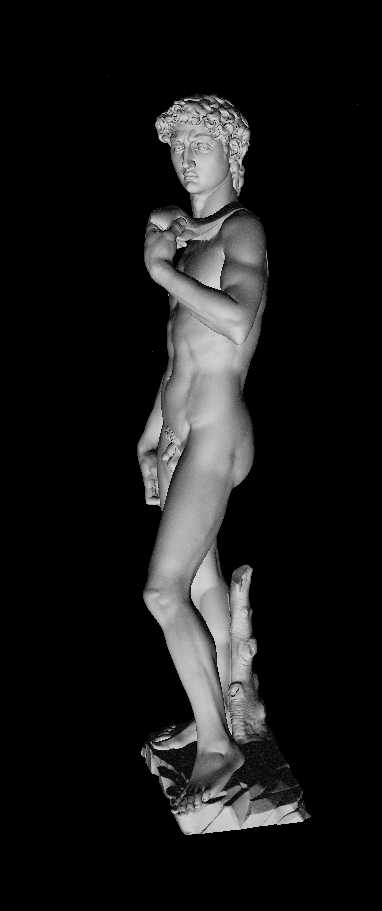
But, in a paper to be published at the end of this month, two Florentine doctors offer a scientific explanation: the poor chap was shrivelled by the threat of mortal danger. Michelangelo's intention was to depict David as he confronted Goliath.
What the new study shows is that every anatomical detail - right down to the shaping of the muscles in his forehead - is consistent with the combined effects of fear, tension and aggression.
One of the authors of the paper, Pietro Antonio Bernabei, of the Careggi hospital in Florence, said one such effect would be "a contraction of the reproductive organs".
Last autumn he and his collaborator, Professor Massimo Gulisano, of Florence University, conducted a computer-assisted study of the 4.34 metre-high statue, in the Galleria dell'Accademia. They emerged, in Prof Gulisano's words, "stupefied" by Michelangelo's physiological accuracy.
The only mistake is at a point in the centre of David's back that is hollow and ought to be rounded. Michelangelo was aware of the error. But, as he wrote at the time: "Mi manco matera" ("I lacked [enough] material").
Dr Bernabei said allowance had to be made for the conventions of high Renaissance art, which depicted activity in a "much more composed and elegant fashion than today". But, anatomically, everything about Michelangelo's David was consistent with a young man "at the moment immediately preceding the slinging of a stone".
His right leg is tensed while the left one juts forward "like that of a fencer, or even a boxer". Tension is written all over his face. His eyes are wide open. His nostrils are flared. And the muscles between his eyebrows stand out, exactly as they would if they were tightened by concentration and aggression.
"You see the same thing on Japanese opera masks depicting anger," said Dr Bernabei.
David is holding something in his right hand, and it has conventionally been assumed that it is a stone. But Dr Gulisano said their studies suggested otherwise.
"He is holding the handle of the sling. The arrangement of the muscles in his right arm is consistent with someone making, or about to make, a rotary movement, but not with someone about to throw a stone," he said.
Their full findings are to be given in a paper written for the Dutch Institute for Art History in Florence. A summary was published in the latest edition of the Italian journal Il Giornale dell'Arte.
The two experts' examination of one of the world's most famous statues was carried out using a specially constructed scaffold that was wheeled into place when the gallery closed its doors to visitors in the evening and on public holidays. Michelangelo's masterpiece, completed in 1504, was put back on display last May after cleaning which allowed its anatomical details to be studied much more easily than before.
Now we all know why he is rather less substantial in one area than might have been expected, just one great puzzle remains: why, since David was Jewish, did Michelangelo sculpt him uncircumcised?
The real David's problume is more serious
| ||||

Michelangelo's famous statue of David could collapse because of its exposure to mass tourism, Italian experts say. They say the massive statue of the naked boy-warrior is in danger because of its size, shape and the weakness of the marble from which it was carved. But they warn that the greatest risk comes from the footfall of many visitors who troop past it each day at Florence's Galleria dell'Accademia. The experts want to protect the statue by insulating it from the vibrations. This would cost about 1m euros (£785,000). Otherwise David could topple over, engineers from the University of Perugia say. Iconic status The warning follows a detailed study of the statue which showed that the cracks filled  during major restoration works four years ago - on the occasion of its 500th anniversary - have already reopened. That restoration was itself controversial because it involved using distilled water to clean the statue - which critics argued could damage it. Michelangelo's David has had iconic status almost since its completion at the height of the Renaissance. At the time it was seen as a powerful symbol of Florence's republican political ideals: David being the youthful warrior who felled the mighty Goliath in the Biblical Old Testament story. Since then it has enjoyed mixed fortunes: attacked by crowds when it was first displayed, then hacked by a deranged painter in 1991. The statue has also acquired kitsch status - its copies adorn everything from casinos in Las Vegas to tacky Mediterranean beach bars. | ||||

Thursday, September 18, 2008
Painting by Hugo Chávez president of Venezuela sells at Auction
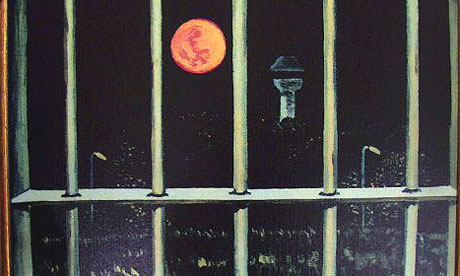 A canvas painted by Venezuela's president, Hugo Chávez, when he was in prison after his failed 1992 coup attempt has sold at auction for $255,000. Photograph: Reuters
"The mill of the gods grinds slowly!"
It was painted by a young army officer languishing in jail and it conjures loneliness and yearning: a full moon seen through the bars of cell. A message written in red letters beneath the portrait says: "The mill of the gods grinds slowly!"
Sixteen years later it seems the mill was not so slow in effecting dramatic change. The artist, Hugo Chávez, is the president of Venezuela and the painting has just sold for $255,0000 to help fund his socialist revolution.
Three Venezuelan businessmen paid the sum at an auction last week, surpassing all expectations for the picture, titled The Yare Moon, which opened bidding at $14,000.
The money will go to the PSUV, a socialist party that is carrying the president's banner in municipal and regional elections next month on the eve of the anniversary of Chávez's 10th year in power. He did the painting during a two-year jail sentence for leading a coup attempt in 1992, a military fiasco which nevertheless paved his path to electoral victory.
Hiroshima Bravo, a congresswoman and "chavista" loyalist, said she was surprised by the price but considered the painting a symbolic part of Venezuelan history.
Nelson Mandela's paintings of landscapes glimpsed through jail bars also fetched high prices, though subsequently doubts were raised about their authenticity.
Chávez's artistic credentials are not in question. As a boy in Sabaneta, a dusty, poor town in the plains, he used to paint friends, animals and landscapes. As a military cadet he drew caricatures of his comrades for their graduating yearbook.
Asked last year why he wanted to abolish term limits so he could run indefinitely - he has spoken of ruling until 2025 - the president said his revolution was like an unfinished painting and he was the artist. Giving the brush to someone else was risky, "because they could have another vision, start to alter the contours of the painting".
http://www.guardian.co.uk/world/2008/sep/18/venezuela?gusrc=rss&feed=worldnews
Three other World leaders were noted painters: Hitler, Churchill & Eisenhower
An article in Newsweek : The Art of Politics What happens when world leaders get creative. Hint: it isn't always pretty.
"Churchill bonded over painting with the American general, later president, Dwight Eisenhower. Eisenhower's tastes ran to plashing streams, dilapidated barns and birch-studded snowscapes in a style that might be called Greeting Card Pastoral. (In fact, when a small collection of his works was marketed as Christmas-gift prints, the publisher was Hallmark.) He was appropriately modest about his oeuvre, which he described as "daubs." Churchill, a far more accomplished and ambitious artist, was well aware of his amateur status, in comparison, say, to his hero Cézanne. "When I get to heaven," he once remarked, "I mean to spend a considerable portion of my first million years in painting, and so get to the bottom of the subject." But Hitler for many years regarded himself as an artist by profession. An authorized book of his watercolors referred to him in 1937 as "at once the First Fuehrer and the First Artist of our Reich."
http://www.newsweek.com/id/147791
Subscribe to:
Posts (Atom)