Tuesday, July 18, 2006

Shouldn’t museums be free?


Met to Raise Admission to Twenty Dollars

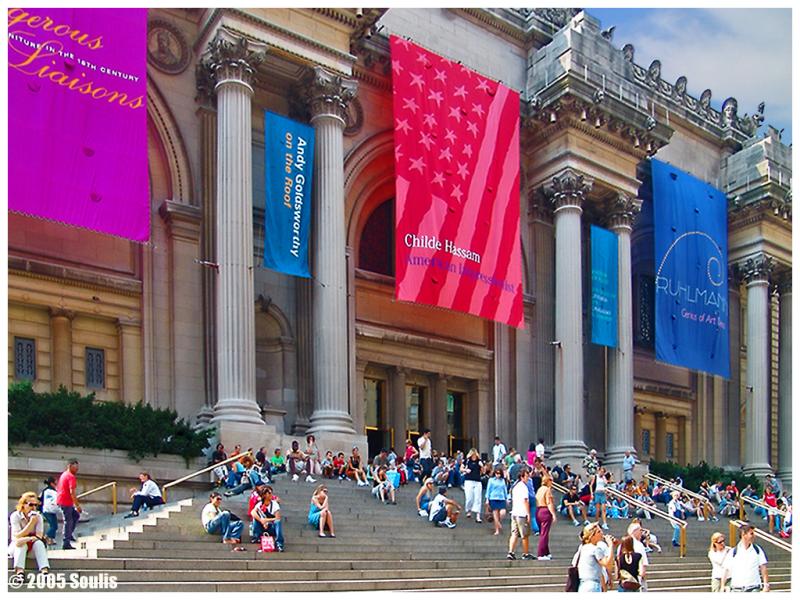
07.13.06 - The Metropolitan Museum of Art is raising its recommended admission price for adults to twenty dollars from fifteen dollars, reports Carol Vogel in the New York Times, making it one of the most expensive museums to visit in the world. Museum spokesman Harold Holzer said that the increase, which takes effect August 1, is intended to remedy an annual operating deficit that has averaged three million dollars in recent years. He emphasized that the fee was suggested, not obligatory. MoMA drew broad attention in 2004 when its compulsory admission fee soared to twenty dollars from twelve dollars upon opening its expanded home in Midtown Manhattan.

July 22, 2006
Critic's Notebook

Should Art Museums Always Be Free? There’s Room for Debate

A museum’s admission policy is charged with meaning. It encodes the institution’s core values — its sense of itself, its mission and its public — and broadcasts them to that public. It’s like a thumbprint, a tiny yet accurate key to a whole identity. It is also, periodically, a hot-button issue.

In a 2002 panel discussion at Harvard University that was recently quoted on the art blog Culture Grrl, Glenn D. Lowry, director of the Museum of Modern Art, remarked that “it’s almost a moral duty that museums should be free.” Another panelist, Philippe de Montebello, director of the Metropolitan Museum of Art, emphatically differed. Noting that people pay “huge amounts to money” to attend rock concerts and sports events, he asked, “What is it about art that it shouldn’t be paid for?”

That excellent question is front and center in New York this month, now that the Met has announced a rise in its suggested admission fee, to $20 from $15. Those who were upset by the increase should remember that the Met’s admission is still suggested, a voluntary donation. (Hello? You can pay a penny.)

The real offense is the museum’s coyness about publicizing this fact, having some time ago deleted from its ticket-desk signs the sentence “Pay What You Wish but You Must Pay Something.” Nonprofit institutions aren’t exempt from truth in advertising, and partial truth is not sufficient. On the other hand, the $20 admission fee is absolutely required at the Museum of Modern Art, which raised it from $12 — a 67 percent increase — in 2004.

To justify such fee increases, or for that matter the very existence of fees, this country’s museums have come to cast themselves as a blend of popular entertainment, corporation and school. From this has descended a confused identity and any number of ills: mall-like, low-functioning new wings and expansions; museum bookstores largely devoid of books; ever-larger departments of “education’’; and boards of trustees too willing to approve impulse sales from the permanent collection or to siphon authority from seasoned curators.

But museums only partly resemble popular entertainment. Unlike corporations, they were not founded out of a profit incentive. They are only marginally like schools, where the overriding goal is the learning of basic skills.

As has been said before, museums are most comparable to libraries. Like libraries, they are repositories of knowledge. Like books, artworks are tools for lifelong self-education; it is through them that we discover and explore important aspects of our humanness. They should be equally available to all, for the good of the individual and society as a whole. Most Americans would be appalled if public libraries charged entrance fees.

Setting out to write this article, I expected to make a plea for free museums and to propose that all museums pledge publicly to the principle and then work toward it, the way car manufacturers are working toward zero-emission engines. I call it the free-for-all pledge.

But my research revealed that an impressive number of museums appear to have made this pledge — that they have recently “gone free” or have been free, or almost free, to the public for quite some time. In late May, Baltimore’s most prominent museums — the Baltimore Museum of Art and the Walters Art Museum — announced that they would eliminate admission charges on Oct. 1 with the help of an $800,000 grant from the city and the county.

Baltimore follows the example of St. Louis, which in 1971 started using city and county tax revenue to guarantee free admission at the St. Louis Art Museum (a good thing, since the phrase “Dedicated to Art and Free to All” is engraved in the stone facade of its 1904 building), as well as the St. Louis Zoo, the St. Louis Science Center and the Missouri History Museum.

In 1988, the Minneapolis Institute of Arts went from pay-what-you-wish to free admission, with help from the Ford Motor Company, which supports Ford Free Museum Days at museums in five American cities. The Dayton Art Institute went free in 1994 with an endowment from Bank One. The Cincinnati Art Museum did the same in 2003 with an endowment from the Richard and Lois Rosenthal Foundation. Ford sponsorship and parking garage fees enabled the Nelson-Atkins Museum of Art in Kansas City, Mo., to go free in 1998. And it will remain free when its new wing, designed by the architect Stephen Holl, opens next June.

Of course, the Smithsonian’s Washington art museums and the National Gallery of Art are free. They are supported almost entirely by taxpayer dollars, which makes it hard to deny that the public owns them. Other museums that have long been free include the great Cleveland Museum of Art; the Toledo Art Museum in Ohio; the Kimbell Art Museum, the Menil Collection and the Amon Carter Museum in Texas; the Des Moines Art Center; the Virginia Fine Arts Museum in Richmond; and the Timken Museum of Art in San Diego. These museums usually charge for special exhibitions and have donation boxes prominently displayed. The J. Paul Getty Museum in Los Angeles is free.

Finally, the Brooklyn Museum, the Seattle Art Museum and the Detroit Institute of Arts are among the encyclopedic big-city museums that, like the Met, have pay-what-you-wish policies, with suggested admissions ranging from $5 to $8. A glaring exception is the Art Institute of Chicago, which on June 3 converted its $12 admission from suggested to mandatory. A press release huffed that the change is “NOT a fee increase,” citing research that showed most visitors already pay the full admission. But given that one could get in for a penny before, the increase is astronomical. The Art Institute is free one evening a week (two in summer), thanks to Ford.

Maybe the free-for-all pledge has to be preceded by a freer-for-all pledge: museums that charge admission should get serious about expanding both their free times and the categories of people who are granted free admission. (The Isabella Stewart Gardner Museum in Boston sets a standard of almost cynical frivolousness: anyone named Isabella gets in free. The Los Angeles County Museum, which is open till 8 p.m. five days a week and till 9 on Fridays, is free after 5, the result of sponsorship from Target.)

Big museums in Philadelphia, Boston and especially New York, the country’s most expensive, should shake off their sense of incurious entitlement and try their hardest in this regard. The Philadelphia Art Museum, which charges $12 for adults normally, is pay-what-you wish all day Sunday. The Whitney Museum (normally $15) and the Guggenheim ($18) are pay-what-you-wish for a few hours on Friday evenings, while the Modern, thanks to Target, is free from 4 to 8 p.m. Friday.

Museums speak of wanting to attract larger, more democratic audiences. They cannot even begin to know this audience, much less accommodate it, until they lower the barriers, at least to their permanent collections. Doreen Bolger, director of the Baltimore Museum, told The Washington Post that the number of nonwhite visitors nearly tripled during the museum’s free hours. Nor can museums begin to know themselves until they make reduced admission a top priority and start combing through their budgets to see how to make it happen.

The spokeswoman for the Toledo Art Museum, whose free admission is dictated by its 1901 charter and supported by its endowment, summed it up: “Our founders had a huge institutional commitment to always remaining free.”

According to the Association of Art Museum Directors, museums earn an average of 5 percent of their revenue from admissions. The Met and the Whitney say their admission revenues constitute 12 percent; the Modern says 15 percent. While these amounts are hardly negligible, there are other sources for this money, including corporate donations. And eliminating admission fees can attract new community support. When the Contemporary Arts Museum in Houston stopped charging admission in 1995, public donations increased enough to make up for the loss of income.

If museums were to broadcast unequivocally that their first priority is art and the public’s contact with art, their public image would improve and sharpen. And other things about them would start to change, from the people who sit on their boards, to the buildings they build.

While the art world often wonders out loud if art can change society, it seems fairly certain that museums can. They put us in touch with the world and its history. They reveal to us our own feelings, talents and capacities, shaping our idea of what we can become. They give us the visual equivalent of things sorely needed today: an understanding of difference, and therefore, of tolerance.

In times as dire as ours, everything matters more than art. Yet in such times, art matters more than ever.

Where will the money come from?

Vatican Seeks Modern Art

07.18.06 - The Vatican Museums, half a millennium old and home to works by Michelangelo, Raphael, Leonardo, and Caravaggio, are looking for modern art, reports the New York Times' Lawrence Van Gelder. Francesco Buranelli, director of the museums, told the newspaper La Stampa that he "would like very much to have a Picasso" and plans acquisitions "above all in sectors like contemporary art."

Sunday, July 09, 2006

Scot sold van Gogh paintings for a pittance | Reuters.com

Scot sold van Gogh paintings for a pittance
Sun Jul 9, 2006 10:07 AM ET

By Ian MacKenzie

EDINBURGH (Reuters) - When Scottish art dealer Alexander Reid returned from Paris with two paintings by Vincent van Gogh, his father berated him for bringing such "atrocities" home and sold them to a French dealer for five pounds ($9) each.

It did not matter that the paintings, a portrait of Reid and a still life of a basket of apples, were in fact gifts to the young Scot, who had lived for several months in Paris with Vincent and his brother, Theo, in Montmartre in 1886-87.

The two paintings and another van Gogh portrait of Reid are included in an exhibition of the Dutch painter's works that opened recently at Edinburgh's Dean Gallery, part of the National Galleries of Scotland. It runs to September 24.

The exhibition is based on British "pioneer collectors" who were among the first to appreciate Impressionist painters.

Frances Fowle, curator of the exhibition, said the anecdote about the sale of the two paintings by James Reid came in a book by Scottish student Alexander Hartrick, who met van Gogh in Paris in 1887.

Fowle said that in later life Alexander Reid, who became a major art dealer, bemoaned the sale of his two paintings and that "he hadn't realized what a great artist van Gogh would turn out to be and how marketable he would be."

Hartrick himself almost bought another still life with apples for two francs, but decided not to because he would have to carry it back to his hotel.

A century later, a van Gogh still life of 15 sunflowers was sold to Japanese insurance magnate Yasuo Goto for some 40 million dollars at auction in London in March 1987.

PAINTING STYLE

Van Gogh's two portraits of Alexander Reid in the exhibition, brought together for the first time, provide an insight into the evolution of his painting style.

The earlier portrait, with Alexander seated in an armchair, was painted shortly after he moved into the apartment.

"He still has that Realist style that he inherited from his time in the Netherlands ... so he had a much darker tone of pallet," said Fowle.

"But then you can see as soon as he got to Paris, his pallet lightened and I think the interest in neo-Impressionism is very clear in the second portrait."

Fowle also noted that Reid and van Gogh were remarkably similar physically.

"They were taken as twins and these portraits were originally catalogued as self-portraits (of van Gogh)."

The first portrait is now at the Art Museum of the University of Oklahoma in the United States, while the second is in Glasgow's Kelvingrove Art Gallery and Museum.

Fowle said Reid apparently acquired the still life of a basket of apples after setting out on a painting expedition with van Gogh.

"Van Gogh saw the apples in a market stall and decided he had to paint them. He didn't have any money on him, so Reid lent him the money or gave him the money, and he marched off back home with his apples.

"At the end of the day he was presented with this picture -- that's the story, anyway."

Thursday, June 22, 2006

"Wilted Sunflowers," = $21.7 million

By Belinda GoldsmithThu Jun 22, 2:04 AM ET

A painting by Austrian expressionist Egon Schiele that was discovered after being missing for over 60 years has been snapped up by a private collector after making a brief public appearance.

New York art dealer and advisory firm Eykyn Maclean bought the painting, "Herbstsonne" or "Wilted Sunflowers," or "Autumn Sun II," inspired by Vincent van Gogh's "Sunflowers," which was one of a half a dozen Schiele pictures thought to have been destroyed in World War II, was sold this week at Christie's in London for more than $21 million.at a Christie's auction in London.

This was almost double the estimated price for the painting, which was feared destroyed after being seized by the Nazis during World War Two.

Painted in 1914, the picture was bought by Mr. Grunwald, from Schiele whom he had befriended during World War One and helped by obtaining for him non-combat posts.

"An artist in the army is like a fish out of water," co-director of the Galerie St. Etienne in New York and author of the first comprehensive Schiele catalogue raisonne, Egon Schiele: The Complete Works, Jane Kallir, said. Mr. Grunwald "essentially allowed him to resume his career as an artist rather than serving as a soldier."

Schiele went on to paint an oil portrait of Mr. Grunwald, and watercolor portraits of his family.

According to Christie's, the painting was confiscated by the Germans in Strasbourg and was auctioned in 1942. The picture, considered to be one of Schiele's masterpieces, then disappeared.

Mr. Grunwald, who eventually found his way to America, spent much of his life trying to recover his art collection. Though he was only partially successful - he managed to recover the portrait Mr. Schiele painted of him - he could not find the "Herbstsonne" before his death in 1964, when the quest for his art was continued by his family.


Chris Eykyn, one of two former Christie's employees who set up Eykyn Maclean this year, said he acquired the painting on behalf of an anonymous European buyer who intended to keep the painting in his private collection.

"This painting is a true masterpiece, a really sophisticated and challenging picture, and this was a once-in-a-lifetime opportunity. The buyer now just wants to enjoy it," Eykyn told Reuters.

"It is one of the most important paintings by the artist in existence ... and its story is just extraordinary."

The painting was among a collection of about 50 paintings owned by Austrian art collector Karl Gruenwald that was confiscated by the Nazis in France and sold at auction in 1942.

Gruenwald unsuccessfully tried to find his collection after the war. He died in 1964 and attempts by one his sons to locate the paintings were also unsuccessful.

But in late 2005, Christie's was contacted by a person who had acquired a painting along with an apartment he had bought in France a few years earlier. He had no particular arts knowledge and wanted a routine valuation of the painting.

Christie's specialists were amazed to discover the painting was the lost masterpiece that was painted in 1914.

When the owner -- who remains anonymous -- realized the importance of the painting, he gave it back to Gruenwald's heirs. They put it up for auction.

The price tag makes it the second most expensive Schiele painting after the landscape "Krumauer Landschaft" which sold for $23.2 million in 2003.

Another painting seized by the Nazis -- a 1907 portrait by Gustav Klimt -- was bought by cosmetics magnate Ronald Lauder for $135 million, the highest amount ever paid for a painting, The New York Times said on Monday.

MET NEWS

Reuniting for the first time since 1663 the panels of an altarpiece that the young Raphael completed in 1504, the exhibition can feel both stretched thin and a bit padded. It struggles to fill three relatively modest galleries at the Met, yet within its borders aesthetic interest and art historical insights abound, as do big personalities and world-shaking events, vivid aesthetic minutia and other serendipities.


"Raphael at the Metropolitan: The Colonna Altarpiece" is at the Metropolitan Museum of Art through Sept. 3; Fifth Avenue at 82nd Street, (212) 535-7710.

Readers’ Opinions

Forum: Artists and Exhibitions

Photograph from The Metropolitan Museum of Art

"Madonna and Child Enthroned With Saints," the large central panel by Raphael, about 1504-5, oil and gold on wood.

Photograph from The Metropolitan Museum of Art

"God the Father Blessing, With Angels and Cherubim," the semi-circular lunette once owned by J. P. Morgan.

The museum had a head start in this show, since it owns three of the altarpiece's seven panels. The large central panel, which depicts the Madonna and Child enthroned, with the infant John the Baptist, St. Peter, St. Paul and two unidentified female saints, and the semicircular lunette of God blessing the world, were both gifts to the museum from the estate of J. P. Morgan in 1916. In 1932 the museum purchased its third and final portion: the small, soft-edged predella image of the Agony in the Garden. The seller was Clarence Mackay, a mining magnate, former trustee and the unwilling father-in-law of Irving Berlin who had suffered some reversals in the stock market crash.

The show has moments of inadvertent oddness. One gallery is presided over by the Virgin and Child, with God on an adjacent wall. The next is ruled by Morgan, glowering Moses-like from Edward Steichen's large, dark photograph of 1903. Perhaps nothing less could be expected of a show that by following the art, traces the migration of wealth and power for more than two centuries from Italy to France, to England, to the United States.

It may also seem strange that the reunited panels have not been physically reassembled, perhaps because of the galleries' relatively low ceilings. The upside here is that everything is at eye level, thrillingly available for close visual examination. This is especially true for the lunette and central panel, which have not been so near the ground in years. (The lunette is usually 10 feet overhead.) And nothing could be more fitting for Raphael, who always set out to deliver an eyeful.

With Leonardo and Michelangelo he forms the Big Three of the High Renaissance. He was routinely called "the prince of painters" but was perhaps more like a Sun King: glowing, formidable yet benign. His pellucid light, majestic compositional sense, idealized figures and radiant palette imbued the new system of one-point perspective with clarity, repose and happiness. Few other Renaissance painters attained such gleaming, supple wholeness.

His career was short and driven. The Colonna altarpiece, one of the last he painted, is a telling transitional work from an artist who was in a sense always in transition, always picking up ideas and making them his own. Commissioned by the Franciscan convent of St. Anthony of Padua in Perugia, Raphael's birthplace, it was completed when he was barely 21, already considered a master and in the process of relocating to Florence. He decamped four years later to Rome, the patronage of Pope Julius II and a stimulating rivalry with Michelangelo. In Rome, Raphael finally escaped both Christian themes and oil paint in his great frescoes for the Papal apartments. By 1520, at 37, he was dead; his tomb is in the Pantheon.

This exhibition has been organized by Linda Wolk-Simon, associate curator in the museum's department of drawings and prints, in collaboration with Keith Christiansen, curator in its department of European paintings. It traces its evolution in the altarpiece through Raphael's drawings and preparatory studies and works of the artists he learned from, including Perugino, a formative influence, and Fra Bartolommeo, the dominant artist in Florence in the early 1500's. There is one brilliant drawing by the inescapable Leonardo that is arguably the most intense work, inch for inch, in the exhibition.

Also on hand are two predella panels from an altarpiece that Raphael painted in 1501-2. Their crowded compositions accent the relative spare, spacious compositions of the Colonna predella images, and a predella panel of a Resurrection by Perugino from the 1490's indicates a source of that spaciousness.

The altarpiece was both conservative and forward looking in ways that reflect the working conditions of the Renaissance, in particular the desires of the client. The clothing on the Christ Child and the infant John the Baptist was probably dictated by the convent, as was the Gothic gold on the base of the Madonna's throne, her black, stippled robe and the textile hanging behind her head. In the lunette God is surrounded by a flat, heavy blue; dark ribbons flutter vivaciously around him in the manner of Perugino. The sleeves of the angels flanking God are highlighted with contrasting colors to indicate shadow and volume, an effect also visible in Perugino's full-length life-size painting of St. John in the first gallery; the saint's brown habit is highlighted, beautifully, but startlingly, with lavender.

And yet the central panel is another story: the sky is a white-to-blue fathomless space, and the thoughtful dignity, monumental stasis and sculptural yet solid-colored robes of Peter and Paul indicate an awareness of Michelangelo's latest innovations. In this panel especially, Raphael's light and space radiate with full force, and his colors dance. Saturated shades of red, yellow, blue and green rotate in changing pairs, among the robes and garments of the figures in the central panel and the small predella images.

So how did the altarpiece end up in pieces? It stayed put in Perugia until 1663, when the convent, deeply in debt, sold the five small panels of the predella. Matters did not improve, and in 1677 the altarpiece's large central panel and lunette were also sold. And so this work became telling in another way. Divided, it moved through history like a series of barium tests through the body, accumulating a stupendous collective provenance and providing localized illuminations of the effects of war, revolution, greed, aesthetic passion and, of course, death. The owners came and went, but the panels kept moving.

Rare catalogs of auctions and princely collections highlight the altarpiece's post-convent progress, as do engravings of various owners. The five predella panels stayed together until 1798, when they appeared in a famous London auction that introduced the English public to Italian Renaissance painting. (The sometime art critic William Hazlitt wrote ecstatically that the scales had fallen from his eyes.) By the early 1800's the small, full-length images of St. Francis and St. Anthony had entered the collection of the Dulwich Gallery near London.

The central panel and lunette spent more than a century in the collection of the Colonna family in Rome — hence the name — and then nearly as long in the hands of the Spanish Bourbon kings of Naples and the two Sicilies. Between 1860 and 1896 they were famously and unsuccessfully for sale, sent on approval to the Louvre and the National Gallery in London and then stored ignominiously in the South Kensington Museum. Finally they were purchased by the British dealer Martin Colnaghi, whose descendants remain active in the art business, and soon sold to Jacques Sedelmeyer, a French dealer.

Isabella Stewart Gardner considered buying the central panel and lunette, but Bernard Berenson advised against it. Morgan bought them in 1901, without benefit of a consultant, the first time he saw them. He paid two million francs, a record at the time. By then Mrs. Gardner had settled on a different part of the altarpiece (with Berenson's approval): the predella's Pietà. The predella's elongated Procession to Calvary entered the collection of the National Gallery in London in 1913.

This exhibition illuminates the enduring proximity of art and money, which lately has been lamented as if invented last spring by young, opportunistic art-school graduates. And the strangest thing is that except for two small sins of omission committed nearly 350 years ago, none of it might have happened. Each time the Franciscan sisters wrote to the Vatican for permission, in contemporary lingo, to deaccession, they neglected to mention that the altarpiece was by Raphael. Had they been more forthcoming, permission might have been denied and the altarpiece still intact and peacefully on display in either the Vatican Museum in Rome or the National Gallery of Umbria in Perugia. It houses an altarpiece by Piero della Francesca once owned by the convent — still whole.

Saturday, June 17, 2006

Paul Klee qoutes:


Beauty is as relative as light and dark. Thus, there exists no beautiful woman, none at all, because you are never certain that a still far more beautiful woman will not appear and completely shame the supposed beauty of the first.

Saturday, May 06, 2006

Recognize This Man? The Art World Doesn't - New York Times


Recognize This Man? The Art World Doesn't


The photographers were ecstatic. There they were, squeezed into a corner at the back of Sotheby's salesroom on Wednesday night — penned as far as possible from where the big buyers sit — when a mystery man brazenly raised his paddle, again and again.


Peter Foley/European Pressphoto Agency

Sotheby's auctioneer Tobias Meyer takes a bid on Picasso's "Dora Maar With Cat" on Wednesday night.

This unidentified bidder at Sotheby's auction in New York on Wednesday bid $95.2 million for a Picasso and $2.5 million for a Chagall.

Yesterday that man's face was being sent by e-mail around the world, as art dealers and collectors frenziedly speculated on his identity. He ended up spending $102.7 million, including a dizzying $95.2 million for a 1941 Picasso portrait, "Dora Maar With Cat." That was the second-highest price ever paid for an artwork at auction, after "Boy With Pipe (The Young Apprentice)," a 1905 painting that brought $104.1 million at Sotheby's in May 2004.

But who was he? Sotheby's has refused to say. It is unclear whether he was acting for a client or buying for himself.

In art world watering holes up and down Madison Avenue yesterday, everyone had a theory about his identity, whether he was a Russian or Asian billionaire or an American hedge fund manager. "People may never find out who he is," said Rachel Mauro, a Manhattan dealer. "It could be one of those great mysteries."

Experts from Christie's who were standing in the back of the salesroom on Wednesday evening said they did not recognize the buyer, and to the best of their knowledge, he had not been to previews of their sale, nor had he been seen at Christie's Impressionist and Modern art auction on Tuesday night. They too are trying to discover who the big spender is, in hope of luring him to their sales next season.

Those who sat near him at the auction said that they were convinced that he sounded Russian. There were also clues to support that theory. At the big auctions in London in February, a group of Russia's new rich drove up prices for masters like Gauguin, Warhol and Lucian Freud.

Then there is the matter of taste. In addition to the Picasso, the buyer bought an 1883 Monet seascape for $5 million. That told the art world's self-appointed sleuths nothing. More revealing was the purchase of a painting by the Russian-born master Chagall, a 1978 biblical scene, for which the man paid $2.5 million. Russians more than any other nationality are buying Chagalls right now.

A lot of names are being bandied about. Some of the Russian oligarchs who have been buying art recently are Pyotr Aven, the president of Alfa Bank; Viatcheslav Kantor, the real estate and fertilizer tycoon; and Roman Abramovich, the oil exporter who owns the Chelsea Football Club in London.

Officially, Sotheby's is declining to comment, but its executives were obviously caught off guard the night of the auction. Had they known that they had someone who might spend more than $100 million, he would have had a seat in the front of the salesroom at the very least, or more likely a skybox where he could bid in privacy, being served Champagne by white-jacketed waiters.

According to art experts here and in Moscow who have seen pictures of the buyer, he does not match descriptions of any of today's new rich, leading to the theory that the bidder, a man who appeared to be in his mid-40's, wearing a blue blazer, was working for one of the billionaires and acting on instructions.

But unlike most agents who bid for billionaires, he was not talking on a cellphone. Rather, he simply stared at his catalog until a painting came up he was going to buy, and then he started relentlessly waving his paddle.

That he was a novice was obvious. Seasoned buyers never start the bidding, especially if they intend to go above a work's estimate; they wait to see how much competition there is and jump when they feel the bidding is calming down. They also rarely bid by waving their paddles but are generally more discreet, making eye contact with the auctioneer and then simply nodding to signal to keep going.

And keep going he did. The $95.2 million winning bid for "Dora Maar With Cat" was nearly twice the $50 million low estimate. Four other bidders were intent on buying the Picasso, a large canvas — 50½ inches by 37½ inches — that depicts Maar, one of Picasso's mistresses, sitting on a chair as if on a throne, with a black cat perched on her shoulders.

As the race to identify the buyer continues, rumors abound about whether he is good for the money. Sotheby's had promised the seller of the Picasso, the Gidwitz family of Chicago, a guarantee — an undisclosed minimum sum regardless of the outcome of the sale — that people familiar with the deal say was $53 million, to be paid at the end of the month. Experts at Sotheby's have been telling clients the company has already been paid, although Matthew Weigman, a Sotheby's spokesman, said he could not confirm that.

If the deal falls through, the Picasso may surface again

Wednesday, May 03, 2006

Arms and Armor From Tibet at the Metropolitan Museum - New York Times


May 13, 2006
Art Review | 'Warriors of the Himalayas'

Arms and Armor From

Tibet at

the Metropolitan Museum

It's unusual to think of the Tibetans as warriors. This mostly Buddhist people, now ruled by China, is better known today as a deeply spiritual culture devoted to peace. But they were once fierce and, like others with turf to defend, held a vital stake in battles and weapons. Tibetan history includes long periods of heavy military activity, beginning in the seventh century. Tibet's early protector gods were worshiped as warriors, equipped with battle gear.

Tibetan skills in battle are made abundantly evident in "Warriors of the Himalayas: Rediscovering the Arms and Armor of Tibet" at the Metropolitan Museum of Art, a dazzling display of Tibetan war equipment from the 13th to 20th century. Replete with swords, saddles, guns, helmets and full body armor for man and horse, this group of some 130 objects reveals the multifarious Tibetan means of aggression and defense. And its handsome installation makes the comprehensive show all the more impressive.

Donald LaRocca, curator of the Met's department of arms and armor, organized the show and wrote most of its catalog, which includes an exceptional English-Tibetan glossary of arms and armor. He says that, surprisingly, many objects here were still being produced and used into the 20th century. That is explained by a sort of time lag between this remote plateau at the top of the world — an area roughly the size of Western Europe — and modern civilization. Many of the weapons were not outmoded by Tibetan standards.

Some older examples were kept for ceremonial use, particularly in the Great Prayer Festival held in Lhasa, Tibet's capital, at the start of each year. Votive weapons were also placed in monasteries and temples, housed in special chapels dedicated to Buddhism's guardian deities. But it has been possible, over the years, for the Met to build up its own collection, to which most of the objects on display belong.

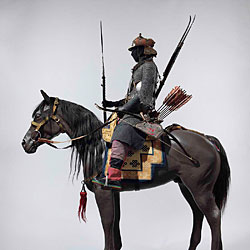
Tibetan skill at bodily protection is most dramatically displayed in a life-size replica of a 15th- to 16th-century Tibetan or Mongolian cavalryman on his horse. Both are in full battle dress.

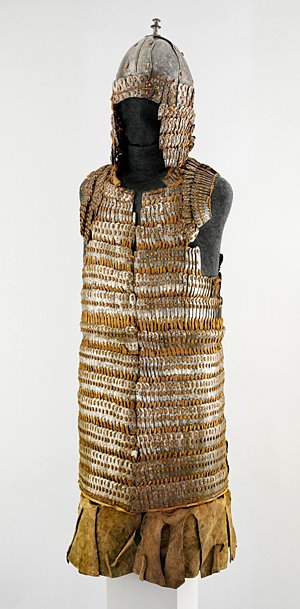
The warrior's three-quarter robe with elbow-length sleeves is made of lamellar body armor, a flexible, scale-like material thought to have been developed in the ancient Near East as early as the eighth century B.C. It consists of horizontal rows of small, overlapping plates of iron; unlike other small-plate armor, these are cleverly joined by leather lacing, with no lining or other support.

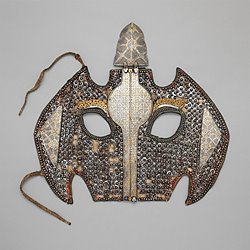
The horse wears one of the few surviving examples of full equine armor, made of iron lamellae augmented by panels of gilt and varnished leather. A face mask, or shaffron, is made of leather and covered with small, knob-studded iron plates sewn on by leather laces. The horse's neck is covered by two wing-shaped panels, covered with knobby plates like the ones on the shaffron.

Together, the man — who also wears a sword, helmet and shield — and horse are a strikingly invincible pair in their spectacular outfits, which faintly evoke those in your basic sword-and-sorcery movie.

A distinctive Tibetan look in the large array of helmets here evolved, perhaps, from one that dates to the 8th to 10th centuries. It is made of eight arched and overlapping plates, joined by leather laces and topped by a decorative finial meant to carry a plume. It is certainly an antecedent for a similar helmet dating to the 16th to 18th centuries, which was discovered in a dilapidated fort during a 1903 British invasion. The type seems to anticipate the Prussian helmet of latter-day German troops.

One oddball Mongolian iron helmet on view, dating from the 15th to 17th centuries, is of one piece, rising up in a high cone — closely resembling the oilcan headgear worn by the Tin Woodman in "The Wizard of Oz."

More flamboyant is the cavalry helmet, of one piece, with upturned fabric flaps; it is probably of Bhutanese origin but was adapted for use in Tibet. It is seen to smashing effect on another life-size replica of a cavalryman on horseback, assembled to represent 18th- to 19th-century military dress.

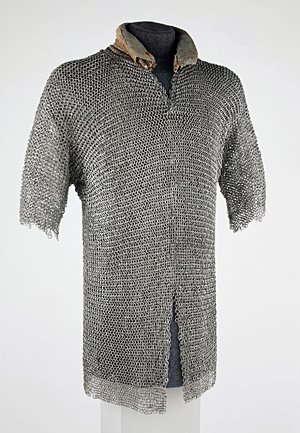
The helmet's bowl is topped by a finely chiseled and damascened (iron decorated with gold and silver) finial and sports an engraved and damascened iron brim. It is fitted with flaring neck and ear flaps made of a showy brocaded silk, probably from India. The horseman wears a mail shirt — different from lamellar armor in its alternating rows of riveted and solid rings — and carries a musket, a spear and a bow with a quiver of arrows, ready for all kinds of mayhem.

Tibetan artisans were capable of stellar work in metal, best seen here in the amazing decorations they produced for saddles. They were particularly adept at the pierced and chiseled metalwork that adorned the finest mounts, like a gorgeous set of saddle plates (about 1400) here — made of iron, gold, wood and semi-precious stones — that is said to represent a high point in the medium of pierced ironwork.

The seven plates, damascened overall with gold foil, are embellished with highly detailed dragons, writhing amid the intricate scroll patterning and punctuated by stone ornaments.

Superb metalwork is also seen in horse bridles, like one from the 15th to 17th century, in leather, iron and gold, that has an elaborate scheme of pierced and chiseled iron fittings damascened in gold. In the center of the forehead band, a plaque depicts a serpentine dragon on a scrollwork ground. Other adornments, including small animals, occur along the straps that hold the headstall on the horse's face.

So sumptuous is this bridle (owned by the Met but not acquired until 1998) that it was used on the horse ridden by Keanu Reeves in his portrayal of Prince Siddhartha, the founder of Buddhism, in the 1993 movie "Little Buddha."

There are so many other things to be admired here: elegantly jeweled swords and scabbards, magnificently damascened spears and muskets, beautifully decorated bows and arrow quivers. All qualify as beautiful objects, which paradoxically achieve aesthetic standing despite their being instruments of war.

"Warriors of the Himalayas: Rediscovering the Arms and Armor of Tibet" is at the Metropolitan Museum of Art through July 2; (212) 535-7710.


Tuesday, April 25, 2006

Art insight from Roger Bissiere

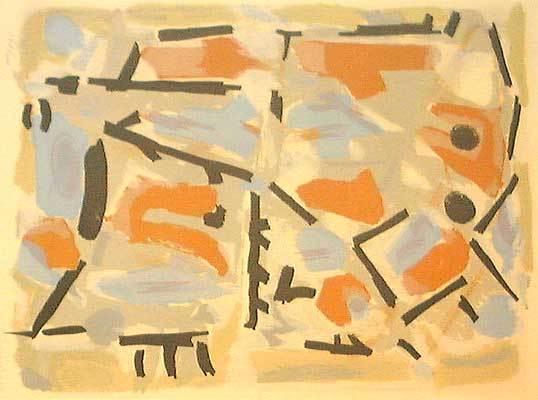
BISSIERE, Roger (1886 - 1964)

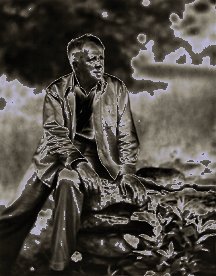
Photo of artist
"Painting, if we truly wish to contemplate its essence, is a living geometry of forms and
colors, a sort of new and more complex geometry in which colors and shapes would be inseparable and would react each upon the other, according to laws in which the elements of shape and of color would form one continuous whole."


Early work / Later work


__________________________________________________

Thursday, April 20, 2006

Education and inspiration by presence.

In a past post I showed a picture of an Amy Cutler piece with a short bit of comment following. I had never seen the piece in person, just on the web. Recently I saw the actual piece, and spoke to the gallery owner about the oddness of the physical power that an origional piece holds, that does not come through in a representation - especially on the web.

And then we reflected that at times a representation of a piece may be more agreeable in the smaller format.

Then we reflected on the amazing ability with modern technology for images to be duplicated, and the value of the image might become how recognizable it is - regardless of the fact of how many people have actually seen the original. Those that have seen a reproduction might well argue that they `know' the piece.

I came across this interesting antidote about Frost - that somehow fits into this contemplation, but not directly:


When Robert Frost read a the institute of Modern Literature at Bowdoin College earlier in the year he suggested, in passing, a new method of instruction, employed by him at Amherst, which he would like to see in more general use in the colleges and which he has taken with him to his new post at the University of Michigan. "Education by presence," he called it, pausing then only to emphasize the obvious effects upon university students of the mere presence among them (upon the campus) of leading scholars in major lines, even if those leaders never took textbook in hand to conduct ordinary courses of classroom instruction.

"My greatest inspiration, when I was a student, was a man whose classes I never attended. The book that influenced me most was Piers the Plowman, yet I never read it."

Monday, April 10, 2006

Follow up on the Munch Caper

A Silenced 'Scream' Haunts Art Heist Trial
Six men in Norway face charges in the theft of Munch's masterpiece, which is still missing.
By Jeffrey Fleishman, Times Staff Writer

This is a follow up to an earlier post:

The
Scream Stolen


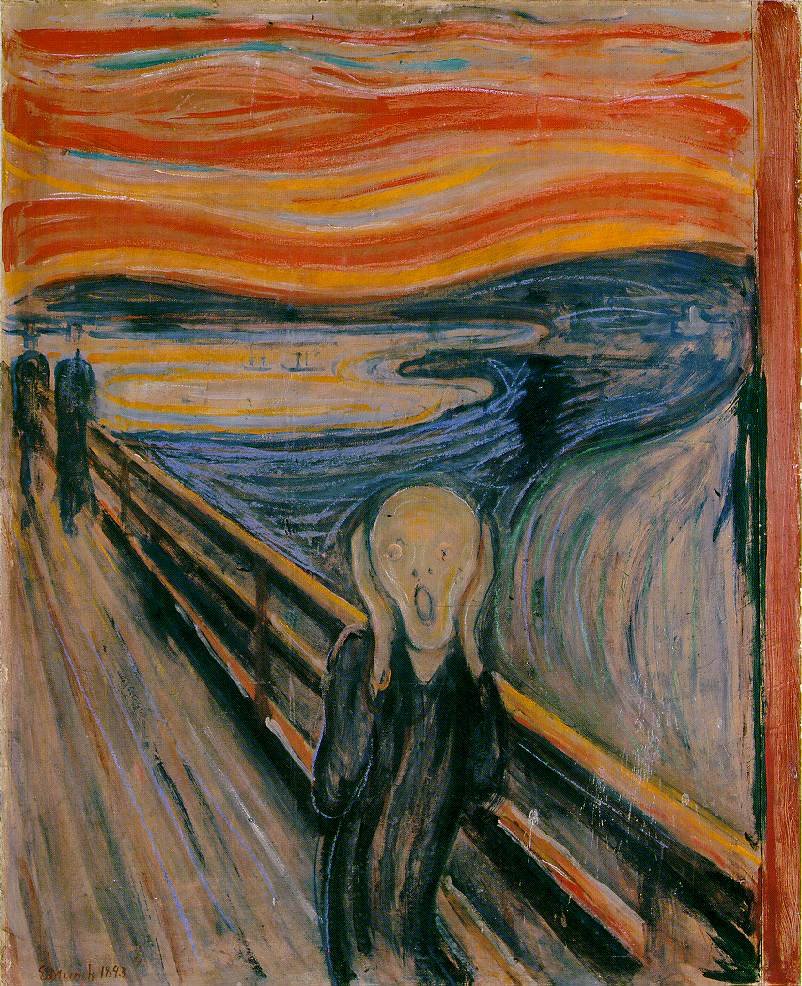
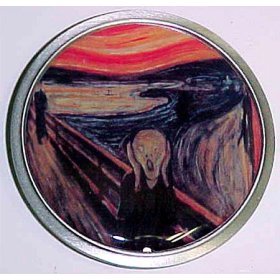
Oslo — They whirled past portraits and Impressionist nudes, masks pulled tight, chrome-plated .357 Magnum flashing, visitors scattering for cover, highbrow chatter turning to fear. The men stopped at the painting of the willowy figure with hands to his face, his mouth agape in bewilderment.
"The Scream" was ripped from the wall. The gloved thieves turned to another Edvard Munch masterpiece. "Madonna," her head tilted, her hair black and tousled in a way that is at once erotic and spiritual, was yanked from her silver cables.

The paintings were heavier than the men had anticipated. They struggled as they hustled out the museum's glass doors. A metallic-black Audi shimmied to life and roared away, speeding up a hill, pieces of pine frames blowing out the window, leaving a trail of splinters in the street. The car stopped near a train trestle. The paintings were shoved into another car; the Audi was sprayed with a fire extinguisher to smother fingerprints and traces of DNA.

The heist at the Munch Museum was executed minutes before lunch on Aug. 22, 2004, a warm Sunday in the land of the midnight sun. Today, snow falls across Oslo. It flickers outside the second-floor courtroom where six men accused of stealing Norway's national treasures stand trial. The state rested its case last week, and verdicts are expected soon.

Police have amassed 70,000 phone taps and surveillance tapes, but there's an air of incompleteness to the proceedings. Like a murder case without a body, the paintings have not been recovered. They were last seen wrapped in black plastic and rolled in carpets, stored in a bus near a barn.

"We do not know where they are," prosecutor Terje Nyboe said.


Munch limned the subconscious, sought the darkness. He once said he was born dying. But even he could not have reckoned that his work would disappear into a rough underground of robbery clans in this Scandinavian land where automated teller machines get blown up, gangs go by the names of Torpedoes and Bandidos, and thieves with tattoos running up their necks answer to aliases such as the Dog, the Beard and the Spirit.

Not even a genius of such dour demeanor could have imagined that his iconic vision of existential angst would be stolen not to grace the wall of a sinister collector, but, prosecutors believe, to divert attention from another crime — a $10-million heist four months earlier from the Norwegian Cash Service center that left one police officer dead and pierced a country the United Nations often describes as the best place in the world to live.


Enter crime boss David Toska. The aura, if not the presence, of Toska permeates the Munch trial. A pudgy-faced man in his 30s whose e-mail identity is Superstar, the onetime national chess competitor turned purveyor of sledgehammers and automatic weapons was sentenced to 19 years in prison this month for masterminding the break-in at the cash center known as Nokas

The robbery set off Norway's biggest manhunt; police say that while Toska was on the lam he ordered his crew to snatch the Munch paintings to draw the heat somewhere else.

"This crime lacked sophistication. It was not the work of fictional French thief Arsene Lupin with his tuxedo and white gloves," said Jorunn Christoffersen, the museum's communications director. "The paintings were stolen by bank robbers who deal in narcotics and weapons. Art is not their field. It seems they have no link to the art world dealers of new rich Russians and eccentric Americans."

Judge Arne Lyng sat impassively in his high-back chair the other day, fidgeting, chewing on a pen and listening to lawyers and the defendants at the heart of the case: Stian Skjold, a man with spiky brown hair and a tattoo who police say was one of the robbers; Bjorn Hoen, a wiry man with a shaved head and a previous robbery conviction accused of planning the theft; and Petter Tharaldsen, a compact man with a goatee charged with driving the getaway car.


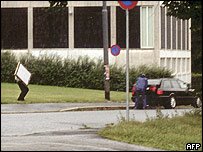
Actual picture of the theft

The heist was classic smash and grab. Two men — one in a hooded gray sweatshirt, the other dressed in black — overpowered four unarmed guards, terrified 80 visitors and escaped with two priceless paintings. The guard at the museum entrance thought the robbers might have belonged to a neighborhood youth gang out to cause trouble. That assessment abruptly changed when one of the men held the Magnum to a woman's head.

The museum alarm was hit at 11:10 a.m. Police didn't arrive for about 15 minutes. By then, the getaway car was gone.

"The Scream" and "Madonna," according to police and witness testimony, were stashed on the farm of Thomas Nataas, a race car driver. Police say Nataas has connections to criminal elements, but he says that he was competing in Germany when the paintings were delivered. Surveillance led police to the property the night of Sept. 24, 2005 — more than a year after the crime. But when two cars left the farm, police tailed the wrong one. The paintings vanished into the darkness and the police were again criticized for blowing the case.
That missed opportunity gnaws at Nyboe, the prosecutor. He has a stern face, as if cut from ivory, and blue eyes that can look at you a long time before they blink. He once served on Oslo's SWAT team and went to night school for a law degree.

Nyboe doesn't believe the pictures have appeared on the black market. Several art dealers and at least one industrialist have offered to buy the stolen Munchs and return them to the museum. Police officials suggest that Toska may attempt to barter the paintings for a shorter prison term in the Nokas heist.

Hoen's lawyer, Morten Furuholmen, has wavy, sandy-blond hair and a smile that invites conversation. He's a legal celebrity, a young, eloquent tactician who sometimes draws a subtle smile from the judge. He said it was a tragedy the police had not recovered the pictures. He quickly added that his client was the wrong man.

"Yes, Hoen knows Toska," Furuholmen said. "But Hoen was not involved in Nokas. That's why it's a bit strange for him to be accused of being the 'general' in the Munch robbery. Why should Toska rely on him? They have no criminal history together."

The Munch paintings are ghost exhibits in this drama, their images flashed occasionally on the courtroom slide projector. But the judge, lawyers and defendants know the gravity of what has been lost. It is as persistent as the snow. This is a small country, and Munch and playwright Henrik Ibsen represent its grandest artistic achievements. "The Scream" is Norway's contribution to the quiet fear and angst of the human spirit, a painting as recognizable as the "Mona Lisa."

Munch described the inspiration in his diary: "I was out walking with two friends — the sun began to set — suddenly the sky turned blood red — I paused, feeling exhausted and leaned on the fence — there was blood and tongues of fire above the blue black fjord and the city — my friends walked on, and I stood there trembling with anxiety — and I sensed an endless scream passing through nature."

Munch painted four versions of "The Scream." One of them was stolen from Norway's National Museum of Art at the opening of the 1994 Winter Olympic Games in Lillehammer. It was a bumbling caper that included a thief tumbling from a ladder and a note left for the museum: "Thanks for the poor security." The painting was recovered months later in a sting operation.

That heist seemed from a more whimsical time, before Norwegian gangs toted submachine guns and collaborated with Balkan and Albanian criminal organizations that deal in heroin, hashish, bank robberies and killing. Police have made numerous arrests in recent years but estimate that 30 to 50 hard-core robbery gang members remain at large.

The walls in the courtroom of the Munch trial are the color of corn silk. Lawyers wear black robes. Some of the accused smile; others are more taciturn, reading documents, whispering asides.

One is quite nervous. A bulletproof vest bulky under his sweater, Petter Rosenvinge, yet another Norwegian underworld figure with a shaved head who admits he's done some bad things, is in a predicament. He's accused of selling the getaway car to Hoen. He's also been cooperating with police while trying to keep a healthy distance between his name and the word "snitch." Hoen eyes Rosenvinge like a linebacker waiting for a halfback to dart through the wrong hole.

To listen to Rosenvinge on the witness stand is to marvel at how sentences can be coolly turned into mazes. He talks about evidence not being burned, chances being missed and about the "boys in Oslo being tailed." When pressed, however, he says such meanderings are hypothetical, things he could imagine but not necessarily know because, after all, "How could I know?" When phone taps featuring his conversations alluding to the heist are played, he tells Nyboe in his best Tony Soprano: "Sometimes I get a little overenthusiastic."


The snow was still falling when two school buses arrived outside the Munch Museum on a recent morning. With backpacks and mittens, the children looked to be about 8 or 9. They waited in line and grew perplexed as they stepped through thick sliding-glass doors, a metal detector and the gaze of security guards. The museum has spent about $6 million on security and other measures since the paintings disappeared.

"The politicians would have laughed if we would have requested money for protection against armed robbers before the 'Scream' and 'Madonna' theft," said Christoffersen, the museum's communications director.

She swiped her ID card and followed the route of the robbers, pointing out other security measures: a guard box, cameras dotting the ceilings, two gates that could trap thieves and a labyrinth of walls that allows visitors to snake past pictures while making it difficult for potential criminals to navigate.

Christoffersen stopped at the wall where "The Scream" once hung, looking as if she had lost her wallet on payday.

She spoke of splintered frames and broken glass and how a visitor from the U.S. on the day of the robbery identified the gun as a Smith & Wesson .357 Magnum.

"He said, 'I'm from Texas and I know what kind of gun that was,' " she said. "Of course, we wouldn't have known such things, but I suppose a man from Texas would."

She turned and walked through another set of sliding doors that led back to the foyer, where snow whirled against long windows.


Sunday, April 02, 2006

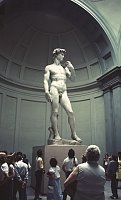
They call it "David Syndrome"


David syndrome' causes desire to destroy art


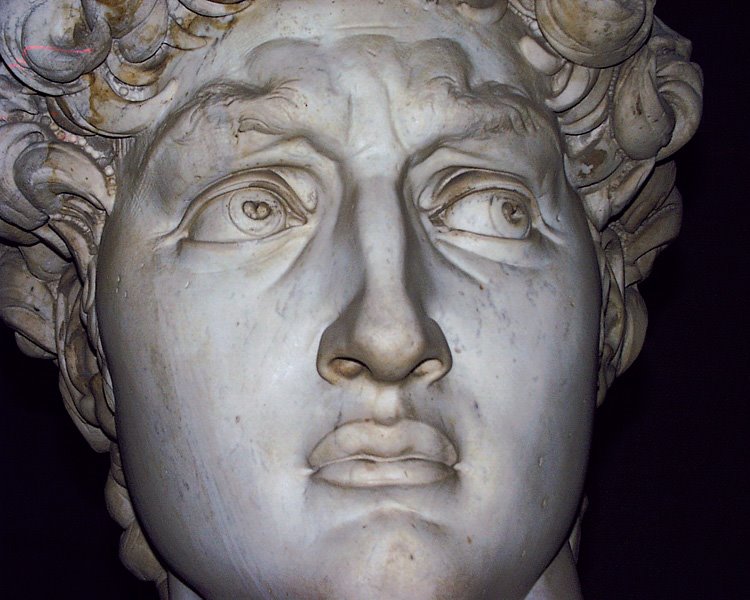
Great works of art, such as Michelangelo's David, can trigger aggression, nausea and a desire to destroy the work, according to Italian researchers.

"It's a range of strong emotions which go from enchantment, through vexation ... a vandalistic impulse, right through to panic attacks," said Graziella Magherini, who has dubbed the new affliction the "David syndrome."
Michelangelo's David

Magherini is the head of Italy's Art and Psychology Association. She reported her preliminary findings after a year-long study with a group of psychiatrists and art historians examining the syndrome.

The condition is similar to the disorientating "Stendhal Syndrome," which Magherini identified in the late 1970s. It's named after the French writer Henri Stendhal who experienced sensations of nausea and temporary panic to bouts of madness after viewing frescoes in Florence's Church of Santa Croce in 1817.


"A work of art is a very powerful stimulus," Magherini told Discovery News. "[It] can stimulate memories in our unconscious, sometimes triggering a crisis."

Magherini's team has spent months at Florence's Galleria dell'Accademia studying how visitors react to the marble nude David, considered to be the perfection of male beauty.


Her interviews reveal the range of emotions visitors feel when they see the 500-year-old masterpiece: rapid heartbeat, stomach pains, dizziness and even hallucinations.

Back in 1991, a deranged artist smashed David's foot with a hammer before being restrained. Magherini says the destructive urge may affect 20 per cent of people, but most manage to control themselves.

"Michelangelo himself destroyed some of his own works or parts of them," points out Magherini, who says the David syndrome is caused by people's deepest fears and desires of sex and death.

"Men of 35 to 40 years of age ... are attracted by the extraordinary masculine beauty and at the same time, are also agitated."

The study is slated to be completed in 2006.
Copyright ©2005 Canadian Broadcasting Corporation - All Rights Reserved
********

Read more about Michelangelo, or own a Michelangelo's David Made of white MARBLECast material


Wednesday, March 29, 2006

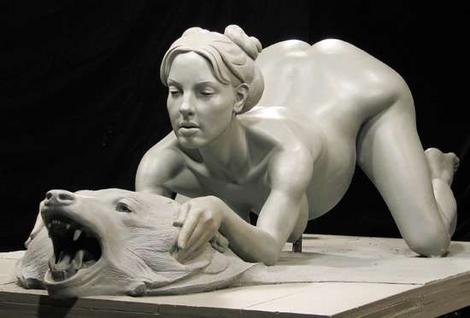
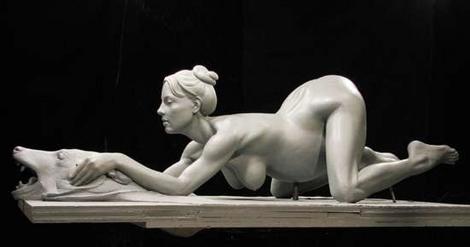
Naked & Very Pregnant Britney Spears Sculpture


March 29, 2006 - 12:35PM

A life-sized sculpture of a naked and very pregnant Britney Spears on all fours in the process of giving birth to her first-born has drawn thousands of hate emails from around the world.

US artist Daniel Edwards has described the aim of his sculpture in its title .

"This is a new take on pro-life. Pro-lifers normally promote bloody images of abortion. This is the image of birth," said Edwards, quoted by AP.

Spears did not pose for the sculpture and is yet to comment on the subject.


A press release by the Capla Kesting Fine Art gallery in Brooklyn, which will display the sculpture next month, described the sculpture as showing Spears tugging on the ears of a bearskin rug "with water-retentive hands".

It said the sculpture "is purportedly an idealised depiction of Britney in delivery. Natural aspects of Spears's pregnancy, like lactiferous breasts and protruding naval, complement a posterior view that depicts widened hips for birthing and reveals the crowning of baby Sean's head".

The release said that the sculpture "celebrates the recent birth of Spears's baby boy, Sean, and applauds her decision of placing family before career".

"She was number one with Google last year, with good reason - people are inspired by the beauty of a pregnant woman," Edwards said in the release.

"A superstar at Britney's young age having a child is rare in today's celebrity culture," gallery co-director Lincoln Capla said.

"This dedication honours Britney for the rarity of her choice and bravery of her decision."

Edwards's exhibit also includes anti-abortion materials provided by the Manhattan Right To Life Committee.

The gallery denied the sculpture was developed from a rumoured bootleg Britney Spears birth video.

However AP reports that when some bloggers heard about the exhibit the gallery was inundated with about 3000 emails from around the world in just a week, offering angry opinions from all sides.

"We also got calls from Tokyo, England, France. Some people are upset that Britney is being used for this subject matter," gallery co-owner David Kesting told AP.

"Others who are pro-life thought this was degrading to their movement. And some pro-choice people were upset that this is a pro-life monument."

Edwards told AP the aim of his sculpture was to stir up debate about a difficult topic that "is greater than the issues presented by either pro-life or pro-choice advocates".

When asked whether he was absolutely against abortion, he told AP, "You nailed me. I'm not saying that I am. I wouldn't march with either pro-life or pro-choice advocates. This is not meant to be political."

ART TALK BLOG Reader Comment:

I think this is a beautiful image. It is stunning and inspirational. I think it is a shame the artist had to make it about Britney to get the work talked about and viewed. Ideally it would get recognition without the publicity, but we don't live in an ideal world. I appreciate this piece for what it says about the beauty of childbirth and of women. I don't think it has anything to do with Britney other than her name is used as a catalyst for the piece.

Thanks for posting this.

Meredith


KEYWORD LINKS : Origional artical: Britney depicted in controversial nude sculpture , Other images of Britiney

******


Sunday, March 26, 2006

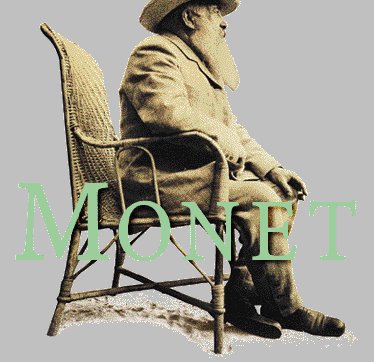
Monet fans get a chance to make big Impression


His scenes shimmer, like memories.
They are single, fleeting moments, reminders
of life's beauty and transience.

—John Berger about Monet

Monet fans get a chance to make big Impression
Fri Mar 24, 2006 12:21 PM ET

LONDON (Reuters) - A London hotel is offering art fans a chance to emulate Impressionist Claude Monet in the room where he painted his classic studies of the Thames skyline.

For 2,600 pounds ($4,500), a couple can stay two nights in the Savoy Hotel room where Monet painted 70 canvases.

For that price, they also get an easel, paints and the advice of an arts teacher on how to reproduce the French painter's famous works.

"The teacher will also take you round London's National Gallery to see the Monet paintings there and point out what to look for. It is a mini-painting holiday," said a Savoy spokeswoman.

The Savoy's artistic tradition was started by James McNeill Whistler who painted a picture of the scaffolding when the hotel was being built in the 1880s.

Monet followed him as a guest, as did fellow artists Oskar Kokoschka and Andy Warhol.

Key Kinks: Claude Monet Online, Claude Monet - Wikipedia, the free encyclopedia,


Saturday, March 25, 2006

University’s Decision to Sell Georgia O’Keeffe & Marsden Hartley Paintings Challenged

by Daniel Grant

A decision by Fisk University, Nashville, Tennessee, to sell two paintings in its art collection, which had been donated in 1949 by Georgia O’Keeffe from the Alfred Stieglitz collection, has been challenged by the Georgia O’Keeffe Foundation, Santa Fe, New Mexico.

The dispute focuses on O’Keeffe’s conditions pertaining to the 1949 gift to Fisk, which included provisions that the collection be exhibited intact and that no items could be loaned or sold at any time.

In December 2005, the university applied to the Davidson County Chancery Court for permission to be released from these conditions, citing changed circumstances. This was followed in January by documents filed by the Georgia O’Keeffe Foundation, which restated the artist’s intention of maintaining the collection as a whole.

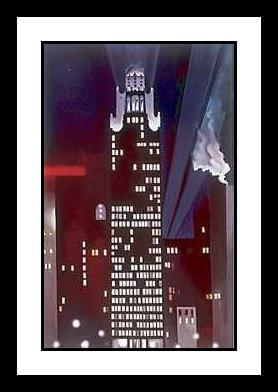
According to a statement released on February 3 by Fisk University President Hazel R. O’Leary, the historically Black institution is looking to sell Marsden Hartley’s Painting No. 3 (1913) and
Georgia O’Keeffe’s Radiator Building—Night, NewYork (1927), which art dealers have estimated could bring in a combined $16 to $20 million, in order to replenish the university’s endowment, endow faculty chairs in business, science, and mathematics, provide funding for the construction of a new science building, and pay for enhanced security and conservation for the remaining 99 works in the Stieglitz collection.

Fisk University currently has an art collection of 3826 objects, primarily African-American and African objects, according to spokesman Ken West. These include paintings by Romare Bearden and Harlem Renaissance muralist Aaron Douglas. The willingness to sell the Hartley and O’Keeffe paintings is not based on the view that “these two works don’t fit into the African-American experience,” he said, but because their deaccessioning (def: To remove a work of art from a museum's collection and sell it) is “the least disruptive way to achieve our strategic goals.”

**
Interesting to notes :
In 1926, Georgia O'Keeffe began to paint from the industrialization end of the spectrum with images of urban landscapes and sky scrappers which include: City Night; Shelton Hotel, New York #1; The Shelton with Sunspots; Radiator Building-Night, New York; New York with Moon; East River from the Shelton; Ritz Tower, Night; and New York Night. In these Georgia captured the height and distance of the structures in addition to the atmosphere in which they stand: the daylight or nighttime, the sky, the wind, etc. However, other characteristic urban components such as automobiles, streets, and people were not portrayed. In fact Georgia O'Keeffe never in her entire career painted people or any living creatures.


This is the review of the book :A beautifully illustrated, full-scale reappraisal of American painter Marsden Hartley (1877-1943), this rewarding biographical-critical study links his greatness, his mysticism and his private agony as a homosexual and an outsider. Born in Maine, Hartley retreated into his imagination after his mother died when he was eight and he relocated to Cleveland with his father and stepmother. Moving to Paris in 1912, he found his personal style in Berlin (1913-1915), blending autobiographical elements, cubist abstraction and personal symbolism. The death of a male friend, a German officer killed in battle in WWI, led Hartley to invest military iconography with erotic power. Returning to the U.S. in 1916, he reinvented himself through folk-art paintings on glass and revisionings of New Mexico's landscapes and Native American culture, a series he continued even after resettling in Berlin in 1921. Restless, plagued by poor sales, Hartley lived in Mexico, Hamburg, Nova Scotia, coming home to Maine in 1937, where he did strong figurative pictures, at once Christian and pagan, culminating in the mystical Mount Katahdin series. UC Santa Barbara art historian Robertson portrays a ``savagely direct'' painter who holds up a mirror to mainstream society.
********

Keyword Links:
O'Keeffe images, Marsden Hartley images, link to origional artical. Marsden Hartley was also a poet link to a site selling a CD with his works read - site includes free samples , Link to other art news on Art Talk Web Site (Our Index)

Posted by Paul Grant (follower of Basho)
*********
Other Books of interest:

Thursday, March 23, 2006

Warrant Issued for Arrest of Renowned Indian Artist


Maqbool Fida Hussain self portrait


Warrant Issued for Arrest of Renowned Indian Artist

03.24.06 - The New York Times' Lawrence van Gelder reports that an arrest warrant for ninety-year old Maqbool Fida Hussain, India's best-known artist, has been issued after he failed to appear in a case growing out of his painting depicting Mother India as a nude woman. After protests from Hindu nationalists, Hussain, a Muslim, withdrew the painting from a charity auction last month, but a militant organization offered $11.5 million for his murder. The warrant was issued in connection with a lawsuit filed by a Hindu in the city of Indore on the grounds that the painting was offensive. Lawyers for Hussain, expressing fears for his safety, had asked that the case be moved to New Delhi.


Saturday, March 18, 2006

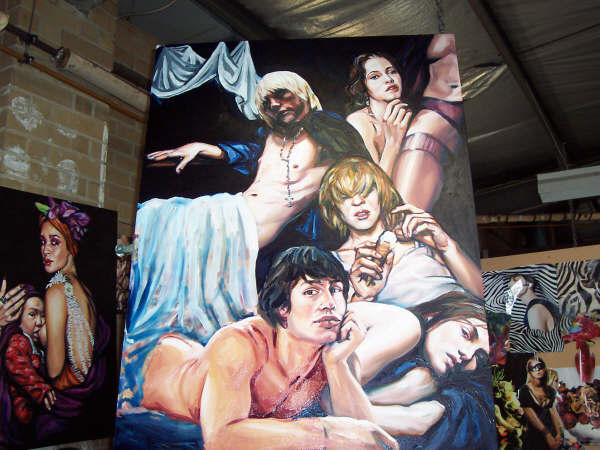
Pansexual artist Gavin Brown

Gavin Brown a New York Artist creates
according to the blogger `The Art Pimp' http://diaryofanartpimp.blogspot.com/
"semi-nudelicious paintings from one of the great pansexual art hos of our time"

Friday, March 17, 2006

Face it :: No more bombs


Protesting the War in Iraq, this protester chose his face for his canvas and produced a memorable image.

Monday, March 13, 2006

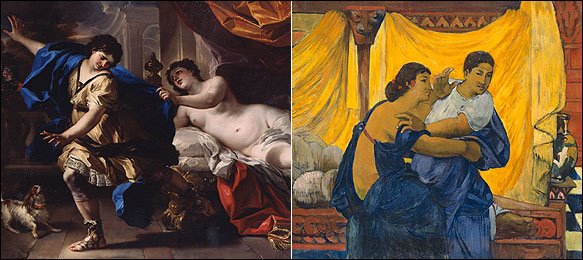
On the theme Joseph and Potiphar's Wife

Interpetation of a theme:
Paul Grant (Follower of Basho)


Left, Simon C. Dickinson, London; right, Wildenstein & Company


Solimena's "Joseph and Potiphar's Wife" (1689-90), left, is being offered for $2 million at the European Fine Art Fair in the Netherlands, while a version of that theme by Gauguin from 1896 is going for $25 million.


I found this interesting comparison of the two pictures on the same theme in an artical in The New York Times entitled : Modern Art Steps Up at Fair of Old Masters.

The artical was about an Old Masters Fair celebrating it's 27th anniversary, suddennly shpwong more modern works including prime examples of works by Picasso, Magritte, Mondrian, Jasper Johns, Robert Rauschenberg and Claes Oldenburg, and these modern masters selling well.

Modern is a clumbsy word to choose for a period, since it indicates a continuation of contemporay that actually does not exist. Choosing a better word for this time period will make for easier comprehension by students of art history in the future.

I will put a link for the New York Times artical at the bottom.

I wanted to add a little more information for our comparison of the two pictures.

First what is the scene being depicted by Joseph and Potiphar's Wife?

(see Genesis 39:1).

Joseph was a righteous young man who had been sold into Egypt. He served Potiphar, captain of Pharaoh's guard. Potiphar trusted Joseph and gave him an important position in his house. Potiphar's wife liked Joseph and kept trying to get Joseph to do wrong. Joseph refused to give in to her. Then one day Potiphar's wife caught hold of Joseph's cloak and tried to tempt him to sin. Again he refused, and he ran from the room, leaving his cloak in her hand. Potiphar's wife called to the men of the house and claimed that Joseph had come to try to do wrong with her. She told the same untrue story to Potiphar, who had Joseph put into prison. But the Lord was with Joseph and blessed him.:
"But the Lord was with Joseph" (Genesis 39:21). He loved Joseph and helped the keeper of the prison to think well of him. Soon the keeper of the prison put Joseph in charge of the other prisoners and all that went on in the prison. Joseph was successful, even in prison, because he was obedient and the Lord was with him. (See Genesis 39:2123.)

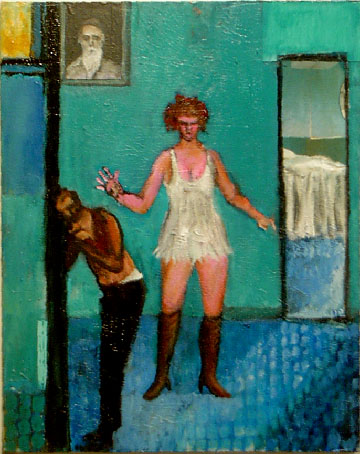
What other examples do we have of work on this theam?

(If you have others we should look at please let us know. This shows a pretty wide varriety of interpetations of the theam.)


Properzia De Rossi (1490- 1553) believed painted in 1520
(Properzia was a woman)


CIGNANI, Carlo
Italian painter, Bolognese school (b. 1628, Bologna, d. 1719, Forli)
Joseph and Potiphar's Wife
1678-80
Oil on canvas, 99 x 99 cm
Gemäldegalerie, Dresden


Marc Chagall (1887-1985)

"Joseph and Potiphar's Wife" oil on canvas (16 x 20) by Richard McBee

***
Link to the NYT artical

Friday, March 10, 2006

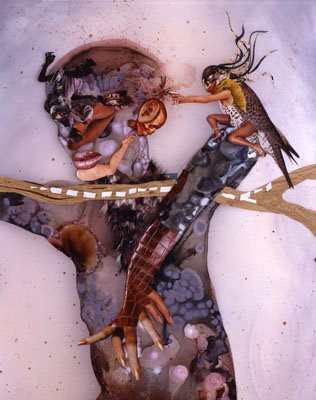
Thoughts on picture by Wangechi Mutu


Artist Wangechi Mutu
Bloody Old Head Games (detail), 2005.

at: SAN FRANCISCO MUSEUM OF MODERN ART
151 Third Street

December 16–April 02

Paul's Critique :

Learning to look is part of being an artist. An artist looks at something, either internal or external, either knowingly or subconsciously and produces a reaction to that sensation. As a viewer of art we are an extra step away from the original conception. And by original conception I am not talking about an absolute by rather a synchronic moment. That moment will have had a history of many combined concepts to arrive at a solidarity of form.

When walking a person through looking at a piece of art, I will first gather their first impressions and then ask them to notice specific parts of the picture – until it is apparent that a complete picture a grouping of distinct features. Sometimes a viewer because of their past histories may see and feel emotive energies that I do not. The key I always emphasis is that a solid work of art is a communication between the artist and the art viewer. The physical work stands as a code. It is a code that there is no decided meaning. If the artist feels ill, they might be better to write down `words’ rather than attempt to communicate with images. By abandoning language, they allow `the unspeakable’ to enter into the dialogue. By unspeakable, I refer to sensations that have no clear words that define them.

Knowing nothing about the artist, or the painting, and viewing it `freshly I can only express my personal feelings. First impressions: – it seems peaceful, it is figurative, it is not about depicting beauty, and there are two characters represented and a tree branch.

On closer inspection we see that this is not a peaceful scene. The smaller character seems to be shooting the larger. The larger character has feminine lips. The feminine hand has six oddly joined fingers coming out of a reptilian fore arm. The head of the larger picture is made up of other images. Reminiscent of Giuseppe Arcimboldo [1527-93] ( who long after his death had a strong influence on Dali)

The branch is in the upper two third of the picture and has white dashes along it, it reads to me as a code for crossing the line. Or for the larger figure the possibility of escape.

The second character, much smaller is a human morphed bird creature. It takes a dramatic pose. To me, in my perception, the pose is authoritarian. This is a David killing a Goliath depiction. Yet, the Goliath, possibly because of her feminine attributes does not come across to me as being criminal, so much as being distorted, possibly sick. There is a sense that we are to feel sympathetic for the larger figure.

As a total composition, after closer viewing has a surreal nightmarish quality. The soft tonality goes against the brutality of the story. The composition feels balanced even though it is made up of incongruous parts. It is technically well done picture. It has a recognizable storyline (though not explicit). It has interesting textural effects from the dotted background to the one figure being created out of unusual coloring while the second is done more representational realistic.

That said this is not a picture I would own. It has an unpleasant Edvard Munch “Anxiety” feeling, for me. Lingering on other people’s nightmares is fun for some, but not for me.

INSIDERS VIEWS:

"
Abuse of power comes as no surprise, as Jenny Holzer so lucidly put it some twenty-five years ago, and it remains a fitting slogan for the current geopolitical climate. Wangechi Mutu's skin-toned collages and body-referencing installation addresses the same subject—misused authority—with a range of heated corporeal references. Her site-specific installation, titled The Chief's Lair Is a Bloody Mess, includes two substantial collages, a series of sculptures, and wall works, and manages to address the dour tenor of the times by including wine bottles that drip their contents to the floor in blood-like splatters, infusing the gallery with earthy odors and Catholic subtexts. The bottles are suspended above a series of early American chairs with grafted-on leg extensions that make them seem like rickety thronelike spawn of a Louise Bourgeois spider. They face a truly dazzling constellation of red-tinted "wounds" that are gouged right out of a looming gallery wall. It's difficult not to think of violence in Iraq, though unlike our regulated media, Mutu pictures it with passion, color, and difficult truth.

—Glen Helfand"

 
*/ /* Use this with templates/template-twocol.html */