Monday, April 02, 2007

Art from Around the World: Contemporary Chinese artist Fang Lijun


One of the leading proponents of the early 1990s Cynical Realist movement, Fang Lijun’s work encapsulates the disillusionment of China’s youth; a generation defined by the events at Tiananmen Square and China’s internal domestic policies. Constructed around loose narratives Fang’s images personalise sentiments of disenchantment, angst, and rebellion; his fictional suggestions conveyed through his illustrative style and re-occurring bald-headed protagonist.

Fang’s practice exhibits a rarefied technical skill rigorously studied through his Social Realist training; his combination of this aesthetic with references to contemporary comics, folk art, and dynastic painting characterise a national identity in flux, distilling a position of integrity from tradition and the modern world.

Fang’s monumental sized prints revive the ancient Asian practice of woodblock printing -- a complicated and exacting process of carving a ‘negative’ image into a panel, coating the surface in ink, and impressing the image onto paper; each different colour and tone requires a separate plate and order of printing. Due to their immense scale, Fang’s images are composed on several adjoined scrolls; the elongated strips create both an emotive fragmenting of the image, and create a reference to memory and historical testimony. Thematically, each of these prints describe the plight of the individual against the ‘mass’, creating a spiritual contemplation of solitude the quest for personal probity in the face of adversity.

***


China Daily 07/07/2005
BALANCING ACT
Tan Rui

When Fang Lijun graduated from the print making department of the Central Academy of Fine Arts in 1989, he made an exceptional decision to most people at that time. In a time when the ideal, yet inevitable, outlet for college graduates was to follow the assigned job positions in various work units, Fang, at the age of 26, did not look for any work unit to take him on, but chose to be an independent professional artist living on his own.


In February of the same year, Fang, then still a student, took part in China's first national modern art exhibition in Beijing, during which he displayed, for the first time, his branded paintings of bald headed figures. Ever since, he has been pressing on with a personalized image of bald heads, both in his paintings and his real life. Nowadays, Fang Lijun has become arguably China's most shining "star painter" with successful popularity both at home and abroad.

"It (being called the most shining 'star painter' in China) has nothing to do with me. I am just an ordinary person," Fang said.

Born in 1963 in Handan, Hebei Province, Fang's life became artistic in 1980 when he entered the Hebei Light Industry School to study china and pottery art. In 1985, two years after he graduated from the school, he became a print major at the Central Academy of Fine Arts, where he met a flood of Western thoughts and images which led to a vigorous "new art movement" in the Chinese art circle.

Fang's art became more personal, tracking every step of his thoughts.

"The fantasticality of humanity is absolutely a huge convulsion and enlightenment to me. Humanity has always been the theme of my works, which I interpreted from different angles in different phases," Fang said.

"Currently speaking, my interest is in this aspect. Humans and humanity always remain a mystery to me."

As one of the early active avant-garde artists in China, Fang is widely labelled as the guru of China's "cynic realism," a coined phrase used to describe a small group of artists who take a playful, mocking attitude toward social life and issues. Whether young or old, students or peasants, exciting or bemused, all men in his paintings feature exaggerated expressions and all are bald-headed.

"I find the meaning of the bald head is a great and ambiguous thing. Bald heads are a bit rebellious, but also unclear. For example, monks, soldiers and prisoners are all bald-headed. The appearance of a bald head can eliminate individuality completely, which is totally different from our education. To me, the importance of a bald head is that it annuls the concept of a certain individual to manifest the concept of a person as a whole in a more forceful way. In art history, seldom did any artist bring the common people to the front of the stage," Fang said.

The artist, who has been sporting a shaved head since college, began receiving attention from both home and abroad soon after his art hit the scene. One of his works was even used for the cover of Time magazine in 1993. Fang found himself suddenly in the spotlight of the art circle internationally, and his works became hotly pursued by art establishments and collectors around the world. Despite disputes and comments, Fang proved himself to be a successful artist representing Chinese modern art with a high reputation. As time elapsed, Fang pulled through the phase of excitement and retained his understanding about success, art and life.


"Compared to my original painting intentions, many things have surpassed my original anticipation. The word 'success' does not have too much attraction to me. It is right for one to just live naturally," Fang said.

Like many other artists, Fang dwells in the so-called artists zone Songzhuang Village, where he bought a house and a two-storey studio prominently covered by flourishing Boston ivy. There, he spends his daytime leisurely, either painting, making arrangements, writing something, managing his painting and restaurant businesses or receiving an interview. Lunch is usually enjoyed with his family while dinner is often devoted to accompanying friends outside.

Different from the general conception of what a larruping life and attitude an avant-garde artist should have, Fang is actually quite "market-oriented." Apart from the wide employment of Chinese elements in his paintings to cater to foreign tastes, Fang also opened a stylish restaurant he regards as a media linking him to the real world.

"I work in the studio most of my time. After a long time, I feel terrible and a strong sense of crisis because a painter can become a madman. There isn't a social relation in that state, which means there is no possibility for others to correct you," Fang said. "But running a restaurant, I have to consider the cost and earnings. It provides me with a socialized space which enables me to be a natural person because you cannot take your art career as an excuse and reason to become a mad dog. Of course, the restaurant has many other functions as a place for me to meet my friends, to make money and to have food. It proves one's business ability and poses an important test to see whether you can cooperate with others."

As for the question of how an artists should balance between art and the market, he simply said: "To me, the market is just an additional value like the sound of wind when you run."

http://www.chinadaily.com.cn/english/doc/2005-07/08/content_458313.htm


Cynical Realist Fang Lijun
by ben davidson

A fool is someone still trusting after being taken in a hundred times. We'd rather be lost, bored, crisis-ridden misguided punks than be cheated. Don't even consider trying the old methods on us, we'll riddle your dogma with holes, then discard it in a rubbish heap.

I read those strong words in a newspaper article long before I ever saw a Fang Lijun painting. The words are Fang's, as quoted in a 1992 article by China's leading art critic Li Xianting. Li declared Fang the most gifted of the nation's post-89 generation of artists he christened Cynical Realists because of their articulation of the mix of ennui and rogue humor that pervaded Chinese society in the first half of the 1990s. I still had not seen a Fang Lijun painting when a Beijing art groupie told me: Fang Lijun is great. He is the only great artist I have ever met. And he is also a really nice guy. Dozens of art critics, fellow artists and Sino-culture vultures speak of the 36 year-old artist in the same glowing terms. When I did finally see a Fang Lijun painting, I understood what all the fuss was about.

Schooled at a young age in propaganda-style Soviet Socialist Realism, Fang's draughtsmanship is impeccable. He can add a few dabs of white to a canvas of blue oil paint and make you see a swimming pool. Then and this is what makes Fang remarkable he can paint in a bald man, swimming, with an odd facial expression that makes you think I know exactly how that man is feeling, but what the hell is that feeling? If Magritte was a cool Chinese guy, his work may have looked something like Fang Lijun's. Fang's paintings give you a comic book feeling; they hint at stories but a narrative never unfolds. They are peopled by the figure of a shaven-headed man, alone or with a group of clones. This enigmatic skinhead hunches his shoulders slightly, and smiles, sometimes idiotically, sometimes as though he knows something you don't. On a canvas of warm yellows and reds, the skinhead scratches his ear and hugs a plump woman; you feel that you've shared an intimate but comfortable moment with them. In another incarnation in varied hues of gray oil paint, the skinhead sits cross-legged on a beach. His eyes are clenched tight; his face bears the frustrated grimace of straining against constipation. It is uncomfortable to look at but it speaks of a feeling that, if you are human and especially if you live in China, you surely have experienced before. I have an opportunity to meet this enfant terrible of the Chinese art world by tagging along when an old friend of his pays a visit. We drive east out of town on the whimsical sounding Jing Ha Expressway, through the grays and washed-out yellows of the Beijing suburbs to a small village near Tongxian. We turn off onto a small country road cluttered with tacky billboards and sprawling factory complexes. Peasants on bicycles and horse carts carry their implements of labor, children wearing yellow caps cycle home from school in noisy flocks. After getting lost a few times we find the address we are looking for. Pushing open a green sheet-metal gate, we step into a large yard in front of a box-shaped brick warehouse. Two Tibetan Mastiffs who are bigger than me come running for us.


Fang emerges from the warehouse and calls the dogs off. He is wearing Indian-style loose cotton clothes and a navy blue PLA surplus waistcoat. His hair is close-cropped but he doesn't look like a skinhead or a convict. Fang smiles shyly as we shake hands and walk into the studio that he built himself. It is a massive L-shaped brick and blonde-wood building with a loft in the short side of the L. The long side contains a pine desk. On the desk is a slim volume of Chinese history and what the marketing people call a home office: a computer, modem, scanner and fax machine. Behind the desk is a bookshelf holding art books and disorganized looking stacks of papers. Fang takes a fax off the desk and gives it to my friend to translate. It is written in English: an invitation to the 1999 Venice Biennial, a prestigious international art show at which Fang has become a regular feature.

Everything else in the warehouse is completed art or work in progress. A quartet of two-by-four meter canvases lean against a wall. Two of the paintings depict a man swimming, the others consist of groups of people stuck together collage-like against a background of deep blue sky. There is a blink-inducing contrast between the bright colors of these paintings and the brown drabness of peri-urban Beijing in winter, but the difference between Fang's childhood in smalltown Hebei and his current life is no less extreme. Fang's rise to prominence is a Chinese version of the American dream a tale of a young man who leaves his provincial hometown for the promise of a new life in Beijing. He was born to a blue-collar family in the small city of Handan in Southern Hebei. Fang's father was a cadre in the Machinery Division of the Ministry of Railways, but during the Cultural Revolution (1966-1976) he was classified as a rich peasant and demoted to the post of train engineer. The ten years of turmoil were not easy on the Fang family. In a short essay entitled Remembrances Fang recounts his experiences:

A lot of capitalists, landlords, members of the KMT and counter-revolutionaries were dragged out and struggle sessions started to happen all over the place. Being a stupid kid, I went along with the grown-ups shouting out slogans and was happy to go to every denunciation session. One day, when like before I was shouting with the adults for the overthrow of who knows who, my grandfather was forced onto the stage. Around his neck was a placard with the words 'Landlord Fang.'

This happened in 1968. During the next eight years, Fang Lijun was frequently forced to intone Down with Landlord Fang, a slogan that was also pasted by Red Guards on the family house. Fang was persecuted at school by teachers and classmates. His family's house was ransacked by neighbors and Red Guards. The surreal political campaigns of the time did however give the young artist-to-be some opportunities for public expression, although probably not the kind that Dr. Spock would recommend. Fang wrote an essay entitled Dickhead Confucius is a Stupid Pig that was well received in criticism sessions and at school. His cartoons of Lin Biao and Confucius aroused such public mirth that Fang's interest in painting was firmly established, even though his motivation at the time was to further the cause of criticizing an ancient sage and to propagate the thoughts of Chairman Mao.

The Cultural Revolution over, Fang began studying ceramics at the Hebei Light Industry College in 1980. Despite the unpromising-sounding name, this school was where Fang's painting and his ideas about art began to develop. He studied woodcuts. He was introduced to Li Xianting who had just been made the modern art editor of Fine Art (Meishu) magazine. Fine Art intended to publish some of Fang's woodcuts, but the magazine was shut down just after Li's appointment.


After graduation, Fang was assigned to an advertising agency in Handan. He continued to paint, mostly rural scenes depicting huge expanses of bleak land and sky, unpeopled except occasionally for a peasant and mule in the far distance. In 1985, Fang entered the Central Academy of Fine Arts in Beijing. If you have spent more than a few hours in the crowded capital, you will not be surprised to learn that people became a more important feature of Fang's work. His signature motif the man with the shaved head first appeared in 1988. Slumped and defeated looking, skinhead figures began to dominate the once empty landscapes. In some paintings, the figures look like automatons marching in unison; in others they appear to be posing for a family or group photograph.

Fang was still a student in Beijing in 1989. The events of that year crystallized some of his attitudes to art. In Remembrances he describes his feelings at the time: I felt the same suspicions as when I was a kid. I felt doubts about the same things that had troubled me before. I was fascinated by those people who seemed to be just fooling around. To make sense of other people, I concentrated on myself. After all, I was just one of them. But whenever I felt I had made some sort of discovery, everything would just become a blur again. That is when I began my work. Fang painted prolifically during the next few years, producing a body of work recognized both for its formal qualities and for its articulate expression of the zeitgeist. Much of that work was done at Beijing's version of Greenwich Village, the artists' colony that grew up in the area around Yuanmingyuan (the old Summer Palace) between 1990 and 1995. Fang was a leading figure of the Yuanmingyuan Artists' Village, but he left long before 1995 when the police chased all the artists away.


Painting is my life, Fang explains. The Artists' Village became too crowded, it got to be the only way I could work was to sneak in over the back wall and then not answer the door all day. The artists' colony was fine when it started, he continues. But when it got to be well-known and groupies began to make the pilgrimage, the sheer artistic ferment began to decline and it was time to leave. Sure I miss having friends around to drink and eat with when I want to take a break from work, but I do get more work done now.

Soon after Fang moved out to Tongxian (known by some as the East Village to distinguish it from the Old Summer Palace in Beijing's Western suburbs) to pursue a quieter life, he was joined by his former classmate Liu Wei who had also established himself on the international art scene. Since then, many of the artists from the Artists' Village have moved out to Tongxian too, but because they are spread out all over the county, a Tongxian bohemian scene has not developed. Which suits Fang just fine. He is not interested in schools or in labels. When I ask him if he thinks the Cynical Realist tag still makes any sense, he replies with a grin: Well, that's the name everybody knows, but labeling art is not right. Art must be original to be of value, and therefore defies categorization.


It is difficult to get Fang to talk about his paintings, although he is happy to describe the traditional woodcut techniques he is using on a new series of massive black and white prints that are to be attached to Chinese silk scrolls and exhibited for the first time at this spring's Venice Biennial. I ask him about his plans for the future but he doesn't really answer. I'll paint, play with my dogs, dig in the garden. The angry young man has mellowed, and gone back to the land. I wonder whether Fang's quiet life is a withdrawal from society, the traditional response of the Chinese scholar to the complexities of public life. He interrupts my musings by telling us that he has just returned from Yunnan. I smile: Fang will not be losing touch with the zeitgeist anytime soon. He was not alone in going to Dali and Lijiang this winter, just to hang out. Large numbers of Beijing's hipoisie made the same trek down south, for the same reason. Fang says Yunnan is haowan'r (fun). He smiles wryly as he talks about his holiday. The smile reminds me of an attitude that I see in his paintings, an attitude that might be the only sane way to look at China and the world at the butt end of the twentieth century: easy going cynicism grounded in the acceptance of a flawed reality. I look forward to seeing what Fang's smiling skinhead will make of the early years of the new millennium.

Sunday, April 01, 2007

Turkish Artist: Orhan Taylan

Contemporary artist from around the world: Turkey


Orhan Taylan Art and essays:

On Contemporary Turkish Art and a Global Problem

.....I will speak little on Turkish art, and more on a general global problem of the art of our time, which I think will clarify the position of Turkish art in connection with modern art in general.

.....In the meantime please tolerate my insufficient command of the English language; and also my comments on Art History, and please take them as speculations of an artist and not a scholar.


.....Turkey, as you all know, is a bridge between the east and the west. İt is the Orient of Europe, and the Occident of a vast world of the East. İn the beginning of the 20.th century, it was a great empire that was defeated in all the major wars, and confined to a small nation state. İn postwar treaties Turkey was forced to abandon all its traditional social, political and economic intuitions and adopt those of the western Eropean countries. And then on Turkey was named among the emerging democracies. To deserve the title of an emerging democracy, all traditional culture had to be negated. When I speak of traditional culture , I do not mean a national cumture of the Tudks, nor a tradional Islamic culture. The traditional culture of this land is a combination of the religions, philosophies and the arts of ancient Greeks, arabs, armenians, Persians and Slavics of the Balkans and the influences each one of these had on the others. All that the intellectuals of this land gathered from so many civilizations, from so many different peoples that lived on this land was now to be negated. This is officially considered a reform. Turkey went through this negation of traditional culture very dramatically, and adopted the European institutions in all fields of social, political and economic life.. Tendencies of Europeanisation of the country had started already in 1830'es. And that is when the history of Turkish painting starts.


.....Yesterday, when I had some of our friends visiting my studio, some of them noticed a thick book called "the History of Turkish Painting", published by the Ministry of Culture. İt Consisted of paintings done in oil paint on canvas,in the European style.

.....İn fact, many Turkish critics agree on the assumption that Turkish painting in the western style starts with the depicting of shadow.

.....Shadow ( and perspective) are, as you all know, distinctive characteristics of the European renaissance. Turks, Persians, Indians, Chinese or Egyptians did not make use of shadow nor perspective in the European sense.

.....Shadow and perspective were problems of philosophy, of different ways of thinking, of beliefs.. A very interesting tale to clarify this point is in a recent novel of Orhan Pamuk; "My name is red". A young painter working in the miniature studio of the Ottoman Sultan in the early 16th century, happens to travel to Venice and see the works of the Venetian masters. As He returns to İstanbul, very excited, he gathers the painters in the royal studio to tell them of what he saw. He says "Just imagine, my friends, they draw a street and you feel like you can walk into it." The master painter of the studio answers; "We know about this new perspective style the venetians are using. But they do not know that when we paint, we depict the world from an angle that god looks at his creation, whereas the venetians depict it from an angle which cats and dogs look at the world." The excited young painter insists; "but master," he says "They even paint shadow itself. When they paint an apple, you feel like holding it." The Master in all his patience "İf the shadow was a thing created by god and given a meaning, then it would be a thing worth painting."


.....This is a very interesting tale to remind us that when painters of different cultures painted things in their own styles, it was not the superiority of one compared to the other, that differentiated them , but their different ways of thinking.

.....The renaissance with its new style, in fact, is a negation of all painting of the previous major cultures of Persia, India, Mesopotamia, China and Egypt.. These paintings used to be a painting of intellect. İt was what they knew and what they believed in that they painted. Whereas The Renaissance introduced a painting of vision. This aspect of the art of the Reniassance could also be discussed as a deviation in the history of civilisations. As the religious subjects of the dark ages faded away the masters of the high Renaissance like Caravaggio and Velasguez and Rembrandt, turned to paint life itself, and whatever was surrounding them. While European philosophers elevated the importance of the individual; painters discovered the correct sentence to go with it;"I paint what I see". Thus the freedom of the artist came to mean that he could paint whatever he liked-the way he saw things-, and be completely free from the Aestethical preferences of the community surrounding him. This subjectivism in art was convenient as far as the market was concerned. But , as time passed by, the art public became increasingly suspicious and unconfident and unsatisfied and at last indifferent to what is being done as modern art.

.....Today we have two main trends in what we call modern art. The more powerful trend supported by the art market is what starts with Marcel Duchamps and follows up to Andy Warhol, and conceptual art and installations of ready-mades etc. The other trend is weaker, but in my opinion sticks firmly to the depiction of human drama, and is represented by Matisse and Picasso.


.....The last twenty years of modern art -or we could call it postPicasso period-is often said to be "İn crisis". İn fact, it is going through a phase of negating the negation of the Renaissance.

.....Greenberg, the American critic put it very clearly when he declared that"the painting of our time is whatever is done on a two dimensional flat surface." Today, many painters all around the world are painting, not what they see around them, but their opinions on what they see, their thoughts, their fantasies. This is already a negation of the Renaissance culture. İn a country like Turkey, this means the negation of the official negation.


.....Now, parallel to the policy of globalisation, (if this policy does not turn into the invasion of the world by the American art market), a democratic trend in modern art is rising throughout the world. Democratic in the sense that the intellectuals and artists of different cultures are getting to know, to understand, to respect and to learn from each other. This is no longer the time of the rising of nation-states. This is leading contemporary art towards new universal forms of expression that are no longer national forms.

.....And this will create, all over to world, a new democratic culture, new ways of thinking and new forms of art. This, I believe, is going to be freedom of Turkish art, and all art in the world.

Orhan Taylan

Essay: Notes On Painting, Values, Success, Freedom Etc.


I.
Nowadays nobody tends to believe that an artist without a fancy car could be a good artist. It might not be a car he is after but wings.
II.
Would the total value of the jewelry worn by a lady who tries to despise sagacity and virtue, make her right?


III.
Artists have always been empirically dubious in terms of succes. In their opinion, the contemporary criteria of success may not be in harmony - like a dress of a transvestite that doesn't fit the ground it's on- with their criteria of what is good art.
IV.
Success in our days, seems to be more reachable than ever. But the difficulty in reaching it lies in the fact that those who control the distribution of success are in obscurity.

V.
Many young artists wish to come up with an art that is original, unseen and unexecuted. Whereas good painting does not really point out the theme or form of painting, but the painter. A persons’ self is particular and unique. The painter, while dealing with life around him, reveals himself.
VI.
The secret of the success -which is hardly an aim- of an artist lies in the historical overlapping of subjective and objective factors. This may occur, irrelevant with the quality of the art produced. Or, an artist may never meet success although having worked hard, if times are, let's say, times of a military coup or of calamity. But after all, does all this have much significance?
VII.
Where exactly is the mystery of a painting hidden? In the painting or in the painter?
VIII.
Could an artist, hide behind his work? Could he produce an acceptable style that does not reveal his personality frankly, and say that this is his art?


IX.
An experienced artist will keep at a distance from his success. He will not let it predominate his work. Because success is conservative and stagnant. It is a plot against the development of an artist.
An artist will not give up his freedom for that.

Notes written for the catalogue of the N.Y. exhibition, sep.2000

His Web Site : http://www.orhantaylan.co

Chocolate Sculpture of a Nude Jesus


Editors note: I included some of the comments from readers of this story.


He seeks new home for 'Jesus'

Choc-statue artist sez offers abound


BY CHRISTINA BOYLE and NICOLE LYN PESCE
DAILY NEWS WRITERS


Artist Cosimo Gavallero with his controversial chocolate Jesus sculpture.

The chocolate sculpture of a nude Jesus is being held in a secret location, but it could have a new home soon.

The artist who created "My Sweet Lord" said he's gotten offers from around the world to buy or exhibit the controversial figure booted from a Manhattan gallery.

"I've got thousands of e-mails of help and donations, people who want to support it, give money, even offer exhibition space, from Holland to Japan," Cosimo Cavallaro said yesterday.

"It's quite amazing."

While Cavallaro weighed the offers, the uproar over his work was causing problems for a fellow artist who also carves religious figures out of chocolate.

George Heslop displayed a chocolate Jesus on a crucifix in his native England last year and was hoping to reprise the show in the U.S.

"Now I'm having second thoughts," he said.

Cavallaro's 200-pound sculpture was supposed to be shown at the Lab Gallery in the Roger Smith Hotel on E. 47th St. during Holy Week.

But a Daily News story about the work - which presents Christ with his arms outstretched and without a loincloth - sparked complaints from some Catholics, and the hotel pulled the plug.

Now the dark chocolate figure is in a refrigerated truck in a secret location, living a "gypsy" existence "going around and trying to find a home," Cavallaro said.

"I don't want to disclose the location because of people, some people who are fanatics," he said, adding that he's received threats.

When Heslop exhibited his life-size Jesus last year, it also ignited a firestorm, but the show went on.

He now lives in Arizona and expected to submit applications to show the sculpture to U.S. galleries - a plan he is rethinking.

"I probably won't send it now," he said.

"Obviously the U.K. and America are very, very different," he said.

npesce@nydailynews.com
Related Articles

*
satan666
Apr 2, 2007 10:43:10 PM

When are we going to put a stop to the Catholic church and their threats. I am so sick and tired of them trying to stop whatever it is that they do not agree with this is a free country and we sending so many of our young people to die in yet another religious war. When are we going to see the stupidity in our lives and how it is slowly going to destroy us. The Catholic church let how many of its so called leaders rape and abuse young men and then they paid off their stupid parents and they have the gall to tell me that I cant look at a sculpture of jesus made of chocolate? What is wrong with you idiots? Dot you care about your children and you rights? This is a free country and that is what we are fighting for right now so you can have your stupid religion and and believe what ever is programed into what is left of your brain. I am working on putting a stop to this once and for all the number of Americans that are simply sick of this is growing by the numbers we will not seat and le
*
daber35
Apr 2, 2007 9:15:40 PM

You know what? I'm just going to start selling chocolate Mohammed and Moses...See if anyone would buy them. It's that simple.
*
ysmwph
Apr 2, 2007 7:59:13 PM

This message is for Island Hal who seems to have stored up quite a bit of hostility towards Christianity. Well, Hal, admit it. Much as you say you might like the idea, there is NO WAY a nude depiction of Moses would be put on display on Passover without hearing cries of "Nazi," anti-Semitism, and probably the whole of Borough Park filing a class action law suit for emotional distress. Also, Hal, take another look the rabbis who have been accused of child molestation. One of the latest fled to - guess where - Israel, which refuses to extradite him. As for freedom for artists - well I remember one man who tried to get into the Brooklyn Museum with a painting of Rabbi Schneerson with donkey's ears and he was arrested before he got to the door. Freedom? For whom? - And this hatred for St. Patrick's Cathedral! Hmmmm. My friend's husband, an Irish Catholic, went to his Jewish dentist the day after September 11, 2001, and the dentist made a wisecrack that the terrorists were really aiming at
*
donna salazar
Apr 2, 2007 5:39:46 PM

Are there no Tom Waits fans over at the Daily News? His Mule Variations album has a song entitled "Chocolate Jesus". The words: ( I ) don't go to church on Sunday Don't get on my knees to pray Don't memorize the books of the Bible I got my own special way But I know Jesus loves me maybe just a little bit more I fall down on my knees every Sunday At Zerelda Lee's candy store Well it's got to be a chocolate Jesus Make me feel good inside Got to be a chocolate Jesus Keep me satisfied Well I don't want no Abba Zabba Don't want no Almond Joy There ain't nothing better suitable for this boy Well it's the only thing that can pick me up Better than a cup of gold See only a chocolate Jesus can satisfy my soul When the weather gets rough and it's whiskey in the shade it's best to wrap your savior up in cellophane He flows like the big muddy but that's ok Pour him over ice cream for a nice parfait Well it's got to be a chocolate Jesus good enough for me
*

Saturday, March 31, 2007

'Bleeding' Jesus portraits draw crowds in India


'Bleeding' Jesus portraits draw crowds in India

PORT BLAIR: Thousands of people are flocking to a policeman's house in India's remote Andaman Islands to pray in front of two portraits of Jesus Christ, which are said to have been "bleeding" for the past two weeks, police and witnesses said.

Eric Nathaniel, a police radio operator, found red fluid trickling down a portrait of Jesus in his house two weeks ago which he believed was blood.

"We lit candles and prayed all night and a little later the blood dried but it soon started trickling down from the hands and heart of another portrait in the house," Nathaniel said in the islands' capital Port Blair on Wednesday.

Officials said red paint used in the portraits could be melting in the extreme humidity, but islanders and priests were coming in boats from remote parts of the Andaman and Nicobar archipelago to pray.

"This is indeed a miracle and shows that Jesus was in pain because of our sins," said John Chrysostom, a priest at the Anglican Church of Port Blair.

One portrait was temporarily moved to the local bishop's house for public viewing after police found it difficult to control swelling crowds

Tuesday, March 27, 2007

Self Portraits: Andrew Sloan


Me & My Ideas.
Acrylic on Canvas.
Painted during a massive pre-solo-show studio session. This is me and all that was coming out of my head (and going in) at that time. Seemed appropriate then and works for now as well. Good to have your arms out - not just for balance, but to receive all that the world has to offer.
All the best,
Andrew

Andrew Sloan
Providence Rhode Island
andrew@newsheriff.com

Friday, March 09, 2007

Gwenn Seemel :: Self Portraits


"The gaze of a self-portrait is a curiously intimate one: it is the
gaze of a person that scrutinizes her-him self. Looking at an
artist's self-portrait is a most delicious intrusion on a private
moment."


Gwenn Seemel

www.onefaceatatime.com


Gwen paints portraits one face at a time. Her web site chronicles her work. Not just portraits for portrait sake (which she does do) but also what she considers to conceptual projects:"When do you become a woman? Is it through puberty or after marriage? Maybe when you become a mother? How do modern gender surgeries affect what it means to be a woman? Can a breast enlargement surgery make you more of a woman? Or a male-to-female sex reassignment surgery? Is menopause the end of womanhood? Or is a woman always someone older than you? Are you a woman?

My next series questions whether physical changes have anything at all to do with becoming a woman. Each of my subjects has undergone some kind of physical change in 2006, transitions that are traditionally--as well as not so traditionally--associated with becoming a woman. I am capturing this year of change with two portraits of each subject, one "before" image and one "after."

Also, I am currently gathering subjects around the question "what does it mean to be an American?" Most of the subjects are immigrants or children of immigrants, because I tend to think that first and second generation Americans are more American than people whose families have been in the U.S. for many generations. What do you think?"
Please email her if you are interested in participating in this series or if you would like to be added to her mailing list: gwenn.seemel@gmail.com.

Chris Ellis :: Self Portraits

"Self Portrait" age 21 ( Graphite )
graphite self portrait created during
my student years.


"Self Portrait with Skull" age 35 ( photograph )
eye patch resulted from a severe shingles
attack to the optic nerve.


************
*Chris Ellis*
***Artist***
United States
*************

Wednesday, March 07, 2007

Lisa Scrivner :: Self Portraits


These stylized self-portraits depict very different views of self-perception. In trying to capture the 'essence of me', if you will- there is no one moment that can describe it all. The same goes for you...from every angle is a new view, a new idea, a new you. Embrace them all.
-Lisa Scrivner

Charlie Alan Kraft :: Self Portrait


Thoughts on the picture of self portraits: ( self portraits in general )

How very rare to find a self portrait that contains the very music of the artist themselves. Too often do I find myself looking at Hollywood reproductions of what a person is not instead of what a person is, using the self as a way to express entertainment instead of sacrifice. Self portraits should reflect the rawness of the core inside of ourselves. The empty that no one else can see or hear. When I see painting after painting of eyes and smile or smug lips and casual hair I am reminded of nothing and no piece of the painter has been given to me.
Charlie Alan Kraft

You can see more of Charlie Alan Kraft's work at his website. Cool Stuff.

http://www.charliealankraft.com/index02.html#

keith farris :: Selp Portrait


this portrait is several years old now. i was in the classroom and the lighting was such and from a mirror i imagined myself emerging, bourbon soaked, from the magnolia bar and grille at closing time; all lit up with neon and brimming with nihilism.

keith farris
portland


You can visit him at his MYSPACE place: existing in space

http://www.myspace.com/grinchly_schleprock

Tuesday, March 06, 2007

Call for Submissions - self portraits with links to artist sites


Self portraits

A focus on fifty artist self portraits- Could be you

What we are looking for-

1. Self portraits by artist -(physically sent via email- link below )

2. Your comments or thoughts about the picture of the subject of self portraits

What we will Do

1. Make a blog entry on Art Talk titled: (Your name) Self portrait.

You may send up to four pictures.

2. We will include a link to your website (or blog or myspace)- if you want

Why?

Because we thought it would be cool

Are you willing to expose your view of yourself?

Send entries HERE


;

Wednesday, February 28, 2007

Two Picasso paintings stolen


Two Picasso paintings stolen from his granddaughter Diana Widmaier-Picasso's house in Paris,police said Wednesday. The paintings are Maya and the Doll and Portrait of Jacqueline.

Though police only mentioned the two paintings, the director of the Picasso Museum, Anne Baldassari, said several paintings and drawings were stolen.

Picasso family lawyer, Céline Astolfe said in a telephone interview that Ms. Widmaier-Picasso and her mother, Maya, the daughter of Picasso’s longtime mistress Marie-Thérèse Walter, were asleep in the house when the theft occurred.

“They heard a noise, went downstairs and saw nothing,” Ms. Astolfe said. “They went to bed and the following morning they saw that two paintings were missing.”

The lawyer said the theft appeared to be the work of professionals because the home’s alarms were neutralized and there were no signs of a break-in. “They blocked the alarm, and they had either the code or keys,” she said.

"It was a very large theft," she said, without giving details.

The value of the two paintings is estimated to be about $66 million

The Pictures:

The burglars cut the edges of "Maya and the Doll," to take it out of its frame.

"Maya and the Doll" is a colorful portrait of a young blonde girl in pigtails, eyes askew in a Cubist perspective. Another version of the painting hangs in the Picasso Museum. It portrays Maya Widmaier, the daughter of Picasso and Marie-Therese Walter, his companion from 1924-1944.

The painting had sentimental value for Widmaier-Picasso: It shows her mother, Maya, as a young girl in pigtails, eyes askew in an off-kilter Cubist perspective. A similar version of the painting hangs in the Picasso Museum in Paris.

Maya was the artist's daughter with Marie-Therese Walter, whom he met when she was a fresh-faced, blonde teenage girl. Their affair did not last.

Four years after Picasso died in 1973, Walter committed suicide by hanging herself.

Maya married Pierre Widmaier had three children, Olivier, Richard and Diana Widmaier-Picasso, an art historian and author of a book called Art Can Only be Erotic.

The other missing painting was "Portrait of Jacqueline," and the burglars took the frame with it, police said. That painting showed Picasso's second wife Jacqueline.

Neither Diana Widmaier-Picasso nor her mother could be reached on Wednesday.

Other missing Picaso's


The Art Loss Register, which maintains the world's largest database on stolen, missing and looted art, currently lists 444 missing Picasso pieces, including paintings, lithographs, drawings and ceramics.

Among recent missing Picasso's reported to the register was the theft of an abstract watercolor stolen in Mexico, said staff member Antonia Kimbell.

The number of missing Picasso's is so high simply because Picasso was so prolific, Kimbell said. She said the Paris theft was "definitely quite significant."

Picasso's treasured paintings

After Picasso died of a heart attack in 1973, his heirs divided up the paintings that he treasured over the years - which might explain why Widmaier-Picasso ended up with a painting of a woman who was not her mother.

The stolen paintings were important because they were works Picasso chose to keep, said Pepe Karmel, an associate professor at New York University and the author of "Picasso and the Invention of Cubism."

"They were meaningful to him, so he didn't sell them," he said.

The artist’s descendants have had artworks stolen before. One famous theft involved pieces worth about $17 million, taken from the Cannes home of Marina Picasso, another of his granddaughters, in 1989. Those were later recovered.

-------------------------------------
Books mentioned in article:


Friday, February 23, 2007

A nice little video tour of the Art Institute of Chicago

The Art Institute, for its extensive collections of 19th-century French painting (Impressionist works and the work of Claude Monet in particular) and 20th-century European and American painting. Among its best-known works are Georges Seurat's A Sunday Afternoon on La Grand Jatte — 1884 (1884--86), Grant Wood's American Gothic (1930), and Edward Hopper's Nighthawks (1942)

posted by ghaile123 on YouTube

Wednesday, February 07, 2007

Seven works of John Brewster A Deaf Artist in Early America


A travelling exhibit- now showing in Portland Maine. January 25, 2007 - March 25, 2007

A Deaf Artist in Early America: The Worlds of John Brewster, Jr.


The first comprehensive exhibition on the important American painter John Brewster, Jr. (1766-1854), this show features 50 outstanding paintings illustrating the full range of Brewster’s long and successful career. Brewster was not an artist who incidentally was Deaf but rather a Deaf artist, one in a long tradition that owes many of its features and achievements to the fact that Deaf people are, as scholars have noted, visual people. The exhibition and companion book provide a major assessment of Brewster’s life and art within his four worlds: his artistic influences, his distinctive painting style and techniques, his elite clientele, and the world of the Deaf in early America. He is particularly noted for his portraits of children, who are depicted with an angelic innocence rarely achieved in portrait painting.

John Brewster Jr. (1766-1854), born a deaf-mute in rural Connecticut, was an itinerant portrait artist who created images of American life during the formative period of the nation, images of haunting beauty. He was a key formulator of a style of American folk portraiture that came to dominate rural New England, a striking adaptation of the English Grand Manner filtered through the works of Connecticut portraitist Ralph Earl. The Grand Manner style entailed a romanticized view of the sitter, with rich colors and an exploration of detail in the sitter’s features, costume and setting. Working in a folk art style that emphasized simpler settings, broad, flat areas of color, and soft, expressive facial features, Brewster achieved a directness and intensity of vision rarely equaled.

The exhibition was organized by the Fenimore Art Museum, Cooperstown, New York, and is funded in part by the Institute of Museum and Library Services, the American Folk Art Society, Robert and Katharine Booth, and Jon and Rebecca Zoler. This exhibition has been made possible through a grant from the National Endowment for the Arts as part of the American Masterpieces program.


Monday, January 15, 2007

James Allen: Love of trains leads to career in art


As a child James Allen had a fascination for the railroad. He was 6 years old when he began sketching trains. Now, at 23, he is still absorbed by that passion

"The mechanical complexity, things like the wheels to the air conditioning parts of the train those are just very intriguing," said James Allen, artist.

Allen has never had an art lesson.

"I was drawing because it was just an everyday hobby for me. I started to recognize it the moment that people would acknowledge and say you be very grateful for what you have," said James Allen.

Allen is a participant in Project Onward, a 3 year old program for artists with special needs based at the cultural center.

Rob Lentz is cofounder and program director of the project.

"James is an incredible talent. I think he has a lot of natural ability for someone his age. I think what distinguishes him is that he's really got a lot of passion and drive for what he's doing," said Rob Lentz, co-founder.

A high school drop out, he was homeless for time and slept in the subway.

"You'd see various rare maintenance vehicles you'd see these workers cleaning at the wee hours of the morning occasionally you would see really very large rats it was an experience. Its something I wouldn't want to go back through," said James Allen.

He has become self sufficient as his reputation as an artist grows. About his first sale?

"I couldn't believe it. I thought it was just one of my farfetched dreams that I'd actually be an artist. But it actually came to life," said James Allen.

To learn about James Allen's work and Project Onward, visit projectonward.org


Legendary Chicago newsman Harry Porterfield profiled Allen for his segment "Someone You Should Know" on ABC7 News, broadcast January 11, 2007

sparking curious mind: Advertising: 5 rules of creativity

Advertising: 5 rules of creativity

Wieden+Kennedy's five rules of creativity:


1. Act Stupid.

"Our philosophy is to come in ignorant every day. The idea of retaining ignorance is sort of counterintuitive, but it subverts a lot of [problems] that come from absolute mastery. if you think you know the answer better than somebody else does, you become closed to being fresh." states Jelly Helm, creative director.

2. Shut up.
"The first thing we do when we meet with clients is listen. We try to figure out what their problems are. Then we come back with questions, not solutions. We write these out and put them on the wall. And then we circle the ones that we think are interesting. More often than not, the questions hold the answer."

3. Always say yes.
"What I've learned from improvisation is to let go of outcome and just say yes to what4ever the situation is. If you say an idea is bad, you're creating conflict--you're breaking an improv rule. You want an energy flow that moves you forward, as opposed to a creative stasis."

4. Chase Talent.
"Find people who make you better. It's best to be the least talented person in the room. It's reciprocal. It challenges you to keep up."

5. Be Fearless.
"Do anything, say anything. In the worlds of our president, Dan Wieden, 'You're not useful to me until you've made three momentous mistakes.' He knows that if you try not to make mistakes, you miss out on the value of learning from them."

Sunday, January 07, 2007

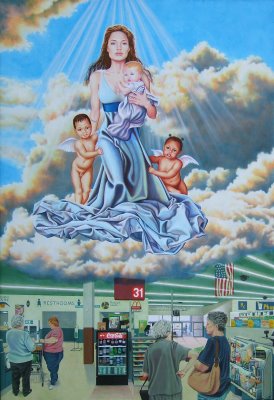
Painting of Jolie as the Virgin Mary hovering over a Wal-Mart check-out line draws notice


By MARTHA WAGGONER, Associated Press Writer Fri Jan 5, 6:57 PM ET

RALEIGH, N.C. - A North Carolina artist intrigued by the public obsession with celebrity has found herself feeding that obsession with a painting of actress Angelina Jolie as the Virgin Mary hovering over a Wal-Mart check-out line.


Kate Kretz has painted for 20 years but none of her previous work has garnered the attention given "Blessed Art Thou," showing this weekend at Art Miami, an annual exposition of modern and contemporary art.

The painting has gotten much attention from celebrity web sites and blogs. Since the buzz started, the number of daily unique visitors to Kretz's own blog has jumped from an average of 30 to 15,000 on Wednesday.

"My intention was to ask a question and get people to think," Kretz said in a telephone interview Friday from Miami. "I had no idea so many people would be asking a question and thinking."

The painting — acrylic and oil on linen — depicts an angelic Jolie in the clouds, holding her newborn daughter, Shiloh, with children Maddox and Zahara at her legs. Below them is a Wal-Mart checkout line. The painting is for sale for $50,000 through Chelsea Galleria in Miami, which represents Kretz.

On her blog, Kretz, 43, said the painting addresses "the celebrity worship cycle." She said she chose Jolie for the subject "because of her unavoidable presence in the media, the worldwide anticipation of her child, her 'unattainable' beauty and the good that she is doing in the world through her example, which adds another layer to the already complicated questions surrounding her status."

Washington Post art critic Blake Gopnik, asked to comment about "Blessed Art Thou" on a Post blog, was unimpressed. "Once you've deciphered it, there's not much chance of giving it a second look," Gopnik wrote.
On the Net:

The artist web site: http://www.katekretz.com

The artist Blog :http://katekretz.blogspot.com/ In her blog she talks about her amazement at the publicity that this one picture recieved.

To give you another example of this artist work:

Putting Moonlight to Sleep
acrylic/oil/collage
38 x 42”
1999

Thursday, December 28, 2006

National Palace Museum - Taipei, Taiwan - Design - New York Times


The National Palace Museum in Taipei is celebrating its rarest works. More Photos >

*
E-Mail
* Print
* Reprints
* Save
* Share
o Digg
o Facebook
o Newsvine
o Permalink

Article Tools Sponsored By
By KEITH BRADSHER
Published: December 28, 2006

TAIPEI, Taiwan, Dec. 27 — After four years of renovations that closed two-thirds of the building, the museum housing the world’s most famous collection of Chinese art is reopening this winter and holding a three-month exhibition of its rarest works.

The National Palace Museum, home to the best of the 1,000-year-old art collection of China’s emperors, is often compared to leading Western institutions like the Louvre, the Prado and the Metropolitan Museum of Art. But while this museum’s holdings are magnificent, the institution has been known for being a highly politicized place where priceless porcelain sat in poorly lit display cases and where invaluable paintings were kept in a damp manmade cave for fear of Communist attack from mainland China.

That has now changed. Heroic statues of Chiang Kai-shek, Taiwan’s former leader, and of Sun Yat-sen, the founder of modern China, have been banished. New lighting, air-conditioning, climate-controlled storage vaults and other features rival the newest museums in the West. Even the wall labels attached to the artwork are now written in clear and specific Chinese, English and Japanese.

And after many years of hiding its most valuable and most fragile artworks — those from the Northern and Southern Sung dynasties that ruled China from 960 to 1279 — the museum has brought them out for a “Grand View” exhibition that opened on Christmas. Four of the best known Northern Sung dynasty paintings — one of them on loan from the Metropolitan Museum in New York — are being shown together for the first time, along with other rare paintings, scrolls and some of the world’s earliest printed books.

The four paintings are magnificent landscapes that tower over visitors but still have the exquisite detail of miniatures. The Chinese characters of the name of one artist are so subtly hidden in the trees of one painting that they went unnoticed until this century. A deputy director of the museum is credited with discovering them, although rumor says that a janitor was really the first to find them, said Ho Chuan-hsing, a museum specialist in early paintings and calligraphy.

Many of the pieces are so fragile that they are never lent to museums elsewhere. Some will only be on display here for half the exhibition: either from Christmas to Feb. 7 or from Feb. 8 to March 25. Museum policy allows these works to be shown only for 40 days, after which they are loosely rolled and placed in a vault to rest for at least three years; the exhibition here will not go on tour.

Art scholars describe the “Grand View” as unique.

“To see all of these paintings come out at one time again is just not going to happen,” said Marc F. Wilson, a Chinese-art specialist who is the director and chief executive of the Nelson-Atkins Museum of Art in Kansas City, Mo., which lent two rare scrolls to the exhibition here. “These are the foundations of modern Chinese pictorial sensibility.”

Also on temporary display this winter in a single case are 50 of the 70 known examples of Ju Ware, one of the world’s rarest and most valuable kinds of porcelain. Manufactured for imperial use at a single kiln in central China for just two decades at the end of the 11th century, Ju (pronounced rue) Ware is glazed with a lustrous, green-tinged shade of blue that has a faint, rose sparkle.

Craftsmen ground up agate, a semiprecious quartz, to make the glaze, using a technique that was soon lost and has never been rediscovered. The 50 pieces on exhibit here include the museum’s own 21 examples and 29 borrowed from other collections around the world.

The presentation of the Ju Ware is raising eyebrows at a museum so conservative that many of the curators wore the traditional blue silk robes of Chinese scholars into the 1970s. The vases and dishes sit on a 100-foot-long, waist-high white surface that is an imitation of the runways on which models promenade at fashion shows.

Jimmy Yang, a 33-year-old Taiwan-born but Australian-educated architect and designer who showed up at the opening on Christmas in a black T-shirt and blue jeans, arranged the exhibition.

“We wanted it to be a little more up-to-date, a little humorous even,” he said as visitors began ogling the spotlighted vases.

Chi Jo-hsin, the chief curator of the museum’s antiquities department, acknowledged that the presentation had been controversial within the museum’s staff. “Some think it is good, and some think it should be different,” she said.

The Imperial Palace in Beijing, better known as the Forbidden City, became a museum in 1925 as part of a republican bid to prevent the restoration of the last emperor, Pu Yi. When Chiang Kai-shek’s Nationalists became worried in 1933 about a possible Japanese attack, they secretly sent the collection in wheelbarrows to Beijing’s train station to be transported south, the start of the collection’s 16-year odyssey during war with Japan and China’s civil war.

The Nationalists ended up shipping the most valuable art to Taiwan, where it has remained ever since. The mainland government has since gathered at museums in Beijing and Shanghai a large number of the works that were left behind, together with the fruits of archaeological excavations as well as the purchase or confiscation of mainland collections and gifts from tycoons in Hong Kong and elsewhere.

The exhibition here is taking place in rooms that have been heavily renovated as part of an extensive overhaul of the museum. Elevators and other features have also been added to make the building completely accessible to the elderly and the disabled, and the building has been strengthened to improve protection against earthquakes, including one that shook Taiwan on Tuesday evening but did not damage the museum or its collection.

Tu Cheng-sheng, who started the renovation as the museum’s director in 2002, said then that it would be too controversial to remove the memorial hall dedicated to Sun Yat-sen, a symbol of Taiwan’s ties to the mainland. But the hall and its giant bronze statue are gone now, a disappearance that Ms. Lin and Mr. Tu, now Taiwan’s education minister, declined in separate interviews to discuss.

The building’s exterior still has jade-green tile roofs and yellow walls designed to evoke the Forbidden City. But the museum’s celebrated tearoom has been transformed as part of an effort by Ms. Lin, the director, to address a problem facing art museum directors all over the world: how to draw the young and trendy.

While the museum’s collection has an international reputation among art connoisseurs, it has been distinctly less popular in Taiwan, and especially among young Taiwanese who feel little connection to the mainland. Slightly more than half the museum’s two million visitors a year come from outside Taiwan, mainly from Japan, Korea and other countries in Asia.

The tearoom, on the museum’s top floor with lovely views of the surrounding mountain valley, used to be a reproduction of the Three Treasures room at the Forbidden City, complete with an elaborately carved and flamboyantly painted ceiling. The ceiling has now been covered with gray-brown paint and the room turned into a very contemporary Taiwanese tearoom with sturdy furniture made of oak, not traditional sandalwood.

The “Grand View” this winter may also represent the last chance for visitors from the United States and elsewhere to see the best of China’s art without having to push through throngs of mainland Chinese tourists.

Taiwan is negotiating with Beijing officials to allow mainland tourists to start visiting here this spring. While the number of tourists is supposed to be limited to 1,000 a day at first, the tourism industry is expected to press for quick increases in that cap.

Jason Kuo, a Taiwan-born professor of Chinese art history at the University of Maryland who studied at the National Palace Museum from 1971 to 1973, said the museum faced a difficult balance as it prepares to handle more visitors, appeal to young Taiwanese and protect the art collection.

“They want to be open to the West,” he said, “but they want to maintain their heritage.”

Thursday, December 21, 2006

John Berger: Here Is Where We Meet, season of events in London, April - May 2005

I can't tell you what art does and how it does it, but I know that art has often judged the judges, pleaded revenge to the innocent and shown to the future what the past has suffered, so that it has never been forgotten.

I know too that the powerful fear art, whatever its form, when it does this, and that amongst the people such art sometimes runs like a rumour and a legend because it makes sense of what life's brutalities cannot, a sense that unites us, for it is inseparable from a justice at last. Art, when it functions like this, becomes a meeting-place of the invisible, the irreducible, the enduring, guts and honour.
John Berger

Wednesday, December 20, 2006

De Kooning


I cant stand this artist works. I can somewhat understand his emotional demeanor behind the picture, but it is a demeanor I do not like. People are often afraid to say they don't like artist that have been accepted by society, often using the `I don't understand' comment. There , for me is nothing loving or positive about this work, and for me it cannot be considered beautiful and holds no referential value ( as being a portrait of a known person.) -Paul Grant (follower of Basho)


Willem de Kooning, American, 1904-1997, b. The Netherlands
Woman IV, 1952-1953


Oil, enamel, and charcoal on canvas
59 x 46 1/4 inches (149.86 x 117.48 cm)

Gift of William Inge, 56-128

Location: Gallery L2

In Woman IV a figural form, frontal and iconic, fills the surface of the canvas. The woman has enormous arms and breasts, bulging eyes and appears to either grin or grimace. Painted in intense and garish colors, she shifts, disassembles, reassembles and merges into a field of painterly brush strokes. Dramatic brushwork, over painting, scrapes and scumbles create a myriad of layered effects that set the canvas in motion and record the dynamic painting process.

De Kooning identified the complex fusion of references present in Woman IV: Venus, the nude, ancient fertility goddesses, Mesopotamian idols, contemporary women, the pin-up of the early 1950s and even the abstract forces of nature.

Fully aware of the ambiguity of form and content in his paintings, he observed: "Content is a glimpse of something, an encounter like a flash." De Kooning's Women are never definitively interpreted. Instead, they remain open, inviting speculation, while suggesting the artist's intense engagement with the concept of woman.

Video - Picasso

picasso

Anew video on YouTube by ghaile123.

"Everyone wants to understand art. Why don't we try to understand the song of a bird? Why do we love the night, the flowers, everything around us, without trying to understand them? But in the case of a painting, people think they have to understand. If only they would realize above all that an artist works of necessity, that he himself is only an insignificant partjavascript:void(0)
Publish of the world, and that no more importance should be attached to him than to plenty of other things which please us in the world though we can't explain them; people who try to explain pictures are usually barking up the wrong tree."
-- Picasso

Monday, December 11, 2006

the Plain English Campaign

Germaine Greer, the British-based Australian academic and writer, won the campaign's Golden Bull award, which recognises the "worst examples of written tripe".

She wrote in her arts column in The Guardian on October 23: "The first attribute of the art object is that it creates a discontinuity between itself and the unsynthesised manifold."

Sunday, December 10, 2006

Aminah Brenda Lynn Robinson Symphonic Poem


Symphonic Poem

Fragment of Aminah Brenda Lynn Robinson's Symphonic Poem Exhibit at the Brooklyn Museum

AMINAH BRENDA LYNN ROBINSON

Columbus native Aminah Brenda Lynn Robinson has created over 20,000 works, including cloth paintings, sculptures, drawings, prints, book illustrations, and quilts. Her work is based on extensive research, oral history, and first-hand observation, but all of it is primarily concerned with documenting the lives and history of her family, friends, and community.

Robinson often works for many years on a fabric piece, incorporating buttons, shells, twigs, and fabric to create richly textured works that weave a memory into a colorful and grand collage. Her work is in the collections of, among others, the Columbus Museum of Art and the Wexner Center for the Arts.


My work is about people, historical data, traditions, lost communities. For me, there is no distinction between life and art. The button work is the core. It is important because of long traditions in my family, especially from my mother. These traditions are still being passed on today, not only through me but through the younger generation. It takes time to produce work. It takes everything you have because it takes your life to leave something for those who are coming after


African American artist Aminah Robinson (b. 1940) works her magic in a stunning array of richly textured, wildly colorful multimedia works. Grand collages on fabric, sculptures, drawings, paintings, carvings, quilts, and books weave memory into a moving and unique art that documents her own and her community's history. Symphonic Poem--the catalogue for a major traveling exhibition celebrating her work--brings together more than 100 of Robinson's works with essays exploring her life, African influences and spirituality in her art, and her work in relation to that of other contemporary African-American artists.


About the book


Throughout this book Robinson herself speaks about her life, her family, her travels, and her work, and provides a view of The Dollhouse, the workspace she has built in her backyard. This strikingly designed, oversized volume, complete with three gatefolds, is a lush and inviting look at the work of an exceptional artist.

About the Author


Carole Genshaft is Co-curator of the accompanying exhibition of Aminah Robinson's art. Leslie King-Hammond is Dean of Graduate Studies at the Maryland Institute College of Art. Romana Austin is Director of the Hampton University Museum of Virginia. Annagreth Nil, Curator of the Columbus Museum of Art, is Co-curator of the exhibition.

Friday, November 24, 2006

Scotsman.com News - Latest News - Artists track every stuffed polar bear in UK

Artists track every stuffed polar bear in UK

By Paul Majendie

LONDON, Nov 24 (Reuters Life!) - Two artists prowled the country in search of stuffed polar bears -- and uncovered 34 of the proud Arctic icons discarded in stockrooms or languishing in stately homes.

The result is "Great White Bear" -- a new photo exhibition that explores mankind's fascination with the magnificent creatures and underlines the fragility of their future.

Mark Wilson and his Icelandic partner Bryndis Snaebjornsdottir -- her name means Snow Bear's Daughter --- spent three years tracking down and photographing their elusive quarry everywhere from dusty museum basements to a hotel's glass showcase.

Depending on the whim of the taxidermist, some stand proud, reared up to their full height, snarling in fury. One poses with a seal pup between his paws, another even gets used as a lampstand.

They were brought to Britain by aristocratic explorers, mapping expeditions and whalers who had no compunction about killing up to 50 bears on a hunt.

Today the Polar Bear faces an even more perilous future in a melting sea that is being inexorably diminished by global warming across the Arctic, with environmentalists petitioning the U.S. Fish and Wildlife Service to classify the bears as threatened because of the new difficulties they face.

"They are used to swimming 60 miles a day. Now they have to swim so much further to find sea ice from which they are able to hunt. So, as a result, many of them drown," Wilson said.

"We felt as many responses photographing the bears as viewers feel looking at the pictures," he told Reuters in an interview to mark the exhibition at London's Horniman Museum.

"There is very real pathos when you think how many were shot on a single expedition. Some were just shot and left there," he said.

"The settings for the stuffed bears are cluttered and decrepit, sometimes farcical. They set off uncomfortable little triggers when you look at the photos."

But are there any more stuffed polar bears languishing out there in some forgotten corner of a musty attic?

"The show has had a massive amount of publicity in the newspapers and we have had a couple of contacts by e-mail. Two more have come to light," Wilson said.

The photos lining two walls of the Horniman certainly do stir strong emotions -- and above all a poignant sense of regret over the cavalier way mankind can treat marvels of nature.

The Times, reviewing the exhibition, said: "The images send a chilling premonitory frisson down the spine. This is a species in the process of being junked."

And Wilson agreed: "The Polar Bear is in dire danger. There is no doubt of that. It is very iconic and acts as a kind of barometer for the Arctic itself."

(c) Reuters 2006

Saturday, November 18, 2006

Top Indian artist bemoans "exile" over nude painting


Top Indian artist bemoans "exile" over nude painting
Nov 17 7:38 AM US/Eastern

India's most celebrated artist M.F. Husain says he is very homesick in London where he lives in voluntary exile to escape prosecution over his paintings of nude Hindu gods and goddesses.

"I am extremely homesick," the 91-year-old told The Hindustan Times, adding that he is yearning for Mumbai.

"I long to walk through the streets of Grand Road and Byculla where I have spent some of the best years of my life," he said.

"As far as I know there are at least 900 cases registered against me (in India). Matters are so legally complicated that I have been advised not return home.

"I have become an international gypsy. It is no secret that I am wandering around the world with only my art for company." His paintings fetch tens of thousands of dollars.

Last May, the Indian government alerted the police fearing Hindu-Muslim riots over a nude painting by Husain, a Muslim.

The work depicts a nude "Mother India" and raised the hackles of Hindu groups, one of which this year offered an 11.5 million dollars for Husain's murder.

One of the cases pending against Husain is for hurting the sentiments of Hindus.

The law ministry has examined half-a-dozen works by Husain and told the government that prosecutors would have a strong case against him if they sued him for deliberately hurting religious feelings.

Tuesday, October 31, 2006

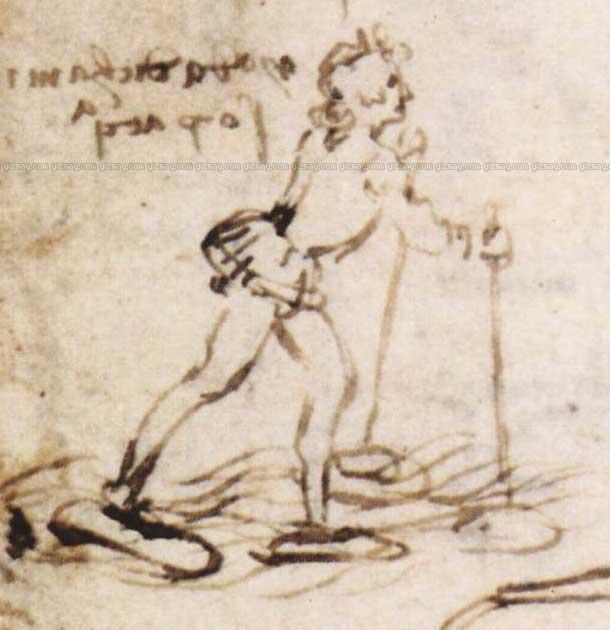
Leonardo da Vinci's sketch becomes a reality : walking on water


gizmag Article: Patent granted for walking on water invention: "

October 31, 2006 History suggests humans have always been captivated with the possibility of walking on water with references to it in Christianity, Hinduism and Buddhism. In Egyptian mythology the god Horus walked on water, and in Greek mythology Orion, the son of the gods walked on water. Indeed, Leonardo da Vinci even conceived a set of shoes and stocks which would enable this highly improbable act.

Now, thanks to an invention by Massachusetts inventor Yoav Rosen, it seems we may be in need of a new colloquialism for the impossible. Rosen’s Da Vinci-like pontoon shoes have just been granted a patent by the United States Patent and Trademark Office (USPTO) for an “Upright Human Floatation Apparatus And Propulsion Mechanism” and enable him to do just that (video here). Rosen’s company wishes to focus its business activities on its equally remarkable standing kayaks, and is seeking to license or sell its water-walking technology. We spoke with Rosen about his invention.

The new water-walking patent (patent number 7,121,910) is a continuation to a previous patent (patent number 6,764,363) with an identical name that was published in August 2004.

Rosen’s company, Wavewalk makes kayaks that people can paddle while standing and is a firm proponent of offering people the alternative of standing instead of sitting in their recreational boating.

“Snow skiing and snowboarding are more popular than snow sledding, and surfboards are more popular than surf skis, and most people prefer to ride a cycle upright rather than recumbent, so why shouldn’t people do their boating standing up,” says Rosen. That was the standing rather than sitting imperative that motivated Rosen to begin work on his pontoon shoes for walking on water and subsequently to develop the WaveWalk.

“I was a teenager then, and I just couldn't accept the fact that walking on water wasn't possible. After all, people have been surfing standing for hundreds, maybe thousands of years!”
“Humans are bipedal, and we like using our legs,” he continues. “We're also very good in doing that, if and when we're given a chance."

We asked Rosen if he had seen Leonardo da Vinci's sketches before or after he had the idea? “I saw it recently, but if you look at Leonardo's sketch it's clear he wasn't thinking about walking on water at all but rather about human powered water skiing.”

“In the "prior art" section of my patents, I'm quoting some 70 patents and inventions, starting with ancient catamarans, Leonardo Da Vinci and the first known patent in the field of water-walking dating 1858, that was granted to a Bostonian named H. R. Rowlands. The problems with all prior water-walking inventions were mainly in the areas of effective propulsion and sufficient stability.


“Think about it this way. You load and unload a tiny "canoe" with your entire weight at a rate of once per second ... in this short period of time you also have to generate maximum water-resistance from one leg, while you minimize the water-resistance from your other leg that's making a full, long step forward.

“And you also have to be able to make turns without using a rudder or a paddle, and you should be able to keep a maximal distance between your "shoes" because if your legs spread you'll lose balance and fall ... and you need to be able to enter the equipment on firm land and then access the water since you definitely don't want to struggle with getting your feet into it while you're already in the water.

“It is no wonder it took so long for this apparently simple "technology" to mature,” he smiles. Why are you selling or licensing the walking on water patents rather than developing them yourself, we asked Rosen. His response: “I'm offering the patent for sale since my company doesn't have the resources to develop the potential markets for both Wavewalk and water-walking products.”
 
*/ /* Use this with templates/template-twocol.html */