Tuesday, April 25, 2006

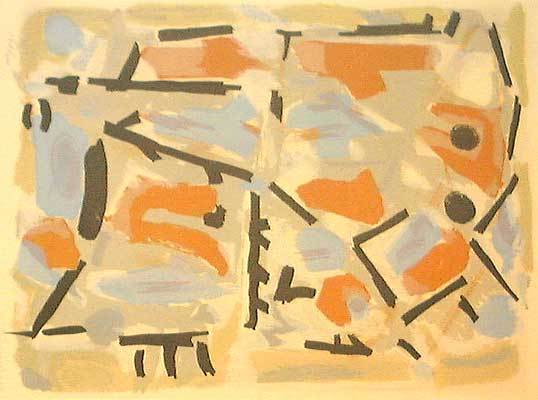
Art insight from Roger Bissiere

BISSIERE, Roger (1886 - 1964)

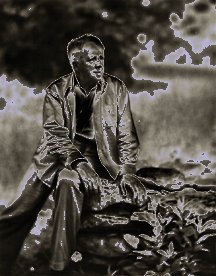
Photo of artist
"Painting, if we truly wish to contemplate its essence, is a living geometry of forms and
colors, a sort of new and more complex geometry in which colors and shapes would be inseparable and would react each upon the other, according to laws in which the elements of shape and of color would form one continuous whole."


Early work / Later work


__________________________________________________

Thursday, April 20, 2006

Education and inspiration by presence.

In a past post I showed a picture of an Amy Cutler piece with a short bit of comment following. I had never seen the piece in person, just on the web. Recently I saw the actual piece, and spoke to the gallery owner about the oddness of the physical power that an origional piece holds, that does not come through in a representation - especially on the web.

And then we reflected that at times a representation of a piece may be more agreeable in the smaller format.

Then we reflected on the amazing ability with modern technology for images to be duplicated, and the value of the image might become how recognizable it is - regardless of the fact of how many people have actually seen the original. Those that have seen a reproduction might well argue that they `know' the piece.

I came across this interesting antidote about Frost - that somehow fits into this contemplation, but not directly:


When Robert Frost read a the institute of Modern Literature at Bowdoin College earlier in the year he suggested, in passing, a new method of instruction, employed by him at Amherst, which he would like to see in more general use in the colleges and which he has taken with him to his new post at the University of Michigan. "Education by presence," he called it, pausing then only to emphasize the obvious effects upon university students of the mere presence among them (upon the campus) of leading scholars in major lines, even if those leaders never took textbook in hand to conduct ordinary courses of classroom instruction.

"My greatest inspiration, when I was a student, was a man whose classes I never attended. The book that influenced me most was Piers the Plowman, yet I never read it."

Monday, April 10, 2006

Follow up on the Munch Caper

A Silenced 'Scream' Haunts Art Heist Trial
Six men in Norway face charges in the theft of Munch's masterpiece, which is still missing.
By Jeffrey Fleishman, Times Staff Writer

This is a follow up to an earlier post:

The
Scream Stolen


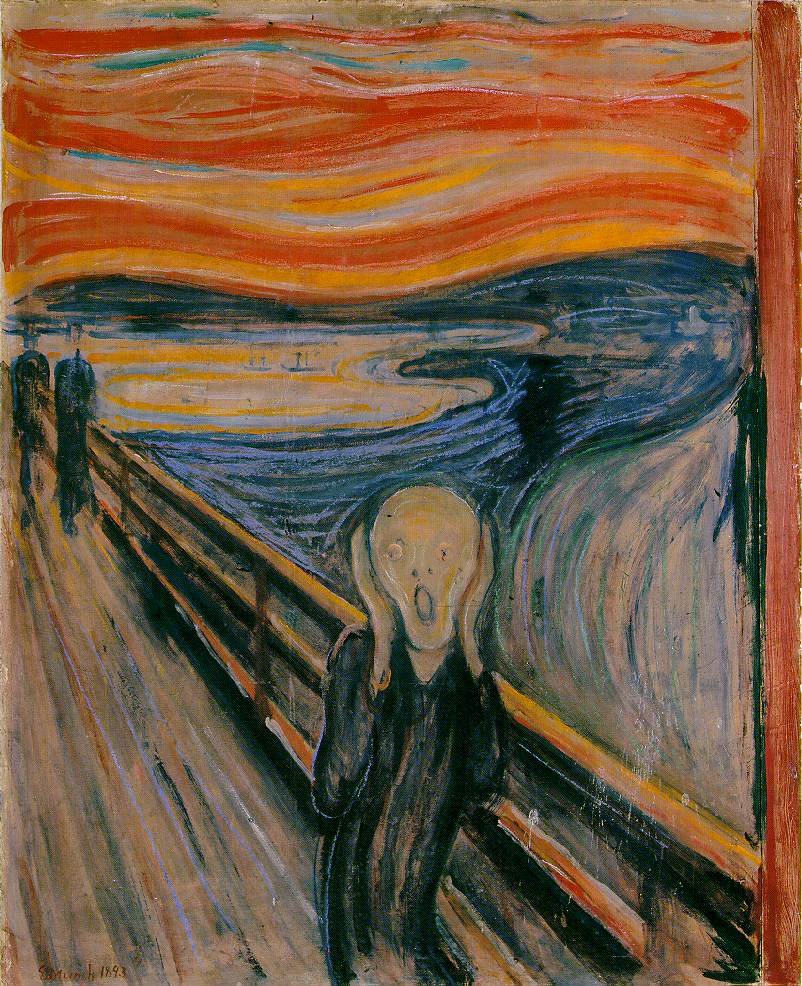
Oslo — They whirled past portraits and Impressionist nudes, masks pulled tight, chrome-plated .357 Magnum flashing, visitors scattering for cover, highbrow chatter turning to fear. The men stopped at the painting of the willowy figure with hands to his face, his mouth agape in bewilderment.
"The Scream" was ripped from the wall. The gloved thieves turned to another Edvard Munch masterpiece. "Madonna," her head tilted, her hair black and tousled in a way that is at once erotic and spiritual, was yanked from her silver cables.

The paintings were heavier than the men had anticipated. They struggled as they hustled out the museum's glass doors. A metallic-black Audi shimmied to life and roared away, speeding up a hill, pieces of pine frames blowing out the window, leaving a trail of splinters in the street. The car stopped near a train trestle. The paintings were shoved into another car; the Audi was sprayed with a fire extinguisher to smother fingerprints and traces of DNA.

The heist at the Munch Museum was executed minutes before lunch on Aug. 22, 2004, a warm Sunday in the land of the midnight sun. Today, snow falls across Oslo. It flickers outside the second-floor courtroom where six men accused of stealing Norway's national treasures stand trial. The state rested its case last week, and verdicts are expected soon.

Police have amassed 70,000 phone taps and surveillance tapes, but there's an air of incompleteness to the proceedings. Like a murder case without a body, the paintings have not been recovered. They were last seen wrapped in black plastic and rolled in carpets, stored in a bus near a barn.

"We do not know where they are," prosecutor Terje Nyboe said.


Munch limned the subconscious, sought the darkness. He once said he was born dying. But even he could not have reckoned that his work would disappear into a rough underground of robbery clans in this Scandinavian land where automated teller machines get blown up, gangs go by the names of Torpedoes and Bandidos, and thieves with tattoos running up their necks answer to aliases such as the Dog, the Beard and the Spirit.

Not even a genius of such dour demeanor could have imagined that his iconic vision of existential angst would be stolen not to grace the wall of a sinister collector, but, prosecutors believe, to divert attention from another crime — a $10-million heist four months earlier from the Norwegian Cash Service center that left one police officer dead and pierced a country the United Nations often describes as the best place in the world to live.


Enter crime boss David Toska. The aura, if not the presence, of Toska permeates the Munch trial. A pudgy-faced man in his 30s whose e-mail identity is Superstar, the onetime national chess competitor turned purveyor of sledgehammers and automatic weapons was sentenced to 19 years in prison this month for masterminding the break-in at the cash center known as Nokas

The robbery set off Norway's biggest manhunt; police say that while Toska was on the lam he ordered his crew to snatch the Munch paintings to draw the heat somewhere else.

"This crime lacked sophistication. It was not the work of fictional French thief Arsene Lupin with his tuxedo and white gloves," said Jorunn Christoffersen, the museum's communications director. "The paintings were stolen by bank robbers who deal in narcotics and weapons. Art is not their field. It seems they have no link to the art world dealers of new rich Russians and eccentric Americans."

Judge Arne Lyng sat impassively in his high-back chair the other day, fidgeting, chewing on a pen and listening to lawyers and the defendants at the heart of the case: Stian Skjold, a man with spiky brown hair and a tattoo who police say was one of the robbers; Bjorn Hoen, a wiry man with a shaved head and a previous robbery conviction accused of planning the theft; and Petter Tharaldsen, a compact man with a goatee charged with driving the getaway car.


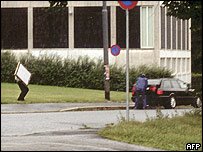
Actual picture of the theft

The heist was classic smash and grab. Two men — one in a hooded gray sweatshirt, the other dressed in black — overpowered four unarmed guards, terrified 80 visitors and escaped with two priceless paintings. The guard at the museum entrance thought the robbers might have belonged to a neighborhood youth gang out to cause trouble. That assessment abruptly changed when one of the men held the Magnum to a woman's head.

The museum alarm was hit at 11:10 a.m. Police didn't arrive for about 15 minutes. By then, the getaway car was gone.

"The Scream" and "Madonna," according to police and witness testimony, were stashed on the farm of Thomas Nataas, a race car driver. Police say Nataas has connections to criminal elements, but he says that he was competing in Germany when the paintings were delivered. Surveillance led police to the property the night of Sept. 24, 2005 — more than a year after the crime. But when two cars left the farm, police tailed the wrong one. The paintings vanished into the darkness and the police were again criticized for blowing the case.

That missed opportunity gnaws at Nyboe, the prosecutor. He has a stern face, as if cut from ivory, and blue eyes that can look at you a long time before they blink. He once served on Oslo's SWAT team and went to night school for a law degree.

Nyboe doesn't believe the pictures have appeared on the black market. Several art dealers and at least one industrialist have offered to buy the stolen Munchs and return them to the museum. Police officials suggest that Toska may attempt to barter the paintings for a shorter prison term in the Nokas heist.

Hoen's lawyer, Morten Furuholmen, has wavy, sandy-blond hair and a smile that invites conversation. He's a legal celebrity, a young, eloquent tactician who sometimes draws a subtle smile from the judge. He said it was a tragedy the police had not recovered the pictures. He quickly added that his client was the wrong man.

"Yes, Hoen knows Toska," Furuholmen said. "But Hoen was not involved in Nokas. That's why it's a bit strange for him to be accused of being the 'general' in the Munch robbery. Why should Toska rely on him? They have no criminal history together."

The Munch paintings are ghost exhibits in this drama, their images flashed occasionally on the courtroom slide projector. But the judge, lawyers and defendants know the gravity of what has been lost. It is as persistent as the snow. This is a small country, and Munch and playwright Henrik Ibsen represent its grandest artistic achievements. "The Scream" is Norway's contribution to the quiet fear and angst of the human spirit, a painting as recognizable as the "Mona Lisa."

Munch described the inspiration in his diary: "I was out walking with two friends — the sun began to set — suddenly the sky turned blood red — I paused, feeling exhausted and leaned on the fence — there was blood and tongues of fire above the blue black fjord and the city — my friends walked on, and I stood there trembling with anxiety — and I sensed an endless scream passing through nature."

Munch painted four versions of "The Scream." One of them was stolen from Norway's National Museum of Art at the opening of the 1994 Winter Olympic Games in Lillehammer. It was a bumbling caper that included a thief tumbling from a ladder and a note left for the museum: "Thanks for the poor security." The painting was recovered months later in a sting operation.

That heist seemed from a more whimsical time, before Norwegian gangs toted submachine guns and collaborated with Balkan and Albanian criminal organizations that deal in heroin, hashish, bank robberies and killing. Police have made numerous arrests in recent years but estimate that 30 to 50 hard-core robbery gang members remain at large.

The walls in the courtroom of the Munch trial are the color of corn silk. Lawyers wear black robes. Some of the accused smile; others are more taciturn, reading documents, whispering asides.

One is quite nervous. A bulletproof vest bulky under his sweater, Petter Rosenvinge, yet another Norwegian underworld figure with a shaved head who admits he's done some bad things, is in a predicament. He's accused of selling the getaway car to Hoen. He's also been cooperating with police while trying to keep a healthy distance between his name and the word "snitch." Hoen eyes Rosenvinge like a linebacker waiting for a halfback to dart through the wrong hole.

To listen to Rosenvinge on the witness stand is to marvel at how sentences can be coolly turned into mazes. He talks about evidence not being burned, chances being missed and about the "boys in Oslo being tailed." When pressed, however, he says such meanderings are hypothetical, things he could imagine but not necessarily know because, after all, "How could I know?" When phone taps featuring his conversations alluding to the heist are played, he tells Nyboe in his best Tony Soprano: "Sometimes I get a little overenthusiastic."


The snow was still falling when two school buses arrived outside the Munch Museum on a recent morning. With backpacks and mittens, the children looked to be about 8 or 9. They waited in line and grew perplexed as they stepped through thick sliding-glass doors, a metal detector and the gaze of security guards. The museum has spent about $6 million on security and other measures since the paintings disappeared.

"The politicians would have laughed if we would have requested money for protection against armed robbers before the 'Scream' and 'Madonna' theft," said Christoffersen, the museum's communications director.

She swiped her ID card and followed the route of the robbers, pointing out other security measures: a guard box, cameras dotting the ceilings, two gates that could trap thieves and a labyrinth of walls that allows visitors to snake past pictures while making it difficult for potential criminals to navigate.

Christoffersen stopped at the wall where "The Scream" once hung, looking as if she had lost her wallet on payday.

She spoke of splintered frames and broken glass and how a visitor from the U.S. on the day of the robbery identified the gun as a Smith & Wesson .357 Magnum.

"He said, 'I'm from Texas and I know what kind of gun that was,' " she said. "Of course, we wouldn't have known such things, but I suppose a man from Texas would."

She turned and walked through another set of sliding doors that led back to the foyer, where snow whirled against long windows.


Sunday, April 02, 2006

They call it "David Syndrome"


David syndrome' causes desire to destroy art


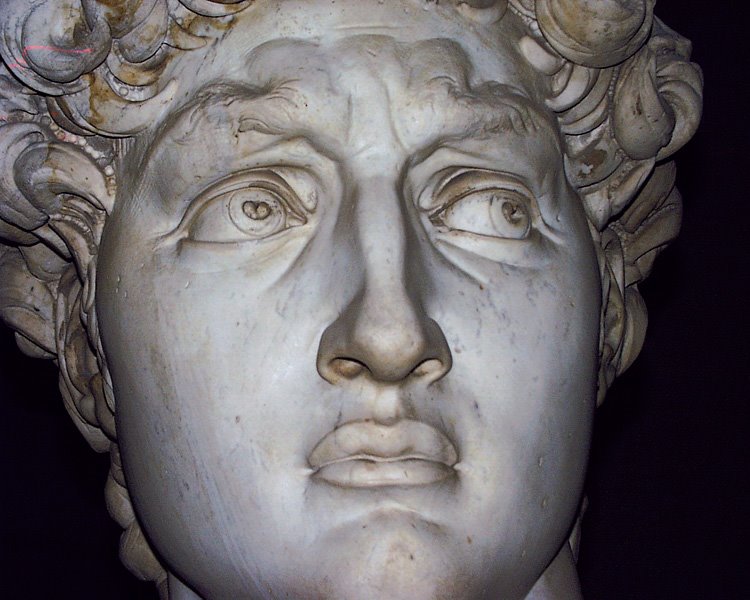
Great works of art, such as Michelangelo's David, can trigger aggression, nausea and a desire to destroy the work, according to Italian researchers.

"It's a range of strong emotions which go from enchantment, through vexation ... a vandalistic impulse, right through to panic attacks," said Graziella Magherini, who has dubbed the new affliction the "David syndrome."
Michelangelo's David

Magherini is the head of Italy's Art and Psychology Association. She reported her preliminary findings after a year-long study with a group of psychiatrists and art historians examining the syndrome.

The condition is similar to the disorientating "Stendhal Syndrome," which Magherini identified in the late 1970s. It's named after the French writer Henri Stendhal who experienced sensations of nausea and temporary panic to bouts of madness after viewing frescoes in Florence's Church of Santa Croce in 1817.


"A work of art is a very powerful stimulus," Magherini told Discovery News. "[It] can stimulate memories in our unconscious, sometimes triggering a crisis."

Magherini's team has spent months at Florence's Galleria dell'Accademia studying how visitors react to the marble nude David, considered to be the perfection of male beauty.


Her interviews reveal the range of emotions visitors feel when they see the 500-year-old masterpiece: rapid heartbeat, stomach pains, dizziness and even hallucinations.

Back in 1991, a deranged artist smashed David's foot with a hammer before being restrained. Magherini says the destructive urge may affect 20 per cent of people, but most manage to control themselves.

"Michelangelo himself destroyed some of his own works or parts of them," points out Magherini, who says the David syndrome is caused by people's deepest fears and desires of sex and death.

"Men of 35 to 40 years of age ... are attracted by the extraordinary masculine beauty and at the same time, are also agitated."

The study is slated to be completed in 2006.
Copyright ©2005 Canadian Broadcasting Corporation - All Rights Reserved
********

Read more about Michelangelo, or own a Michelangelo's David Made of white MARBLECast material


Wednesday, March 29, 2006

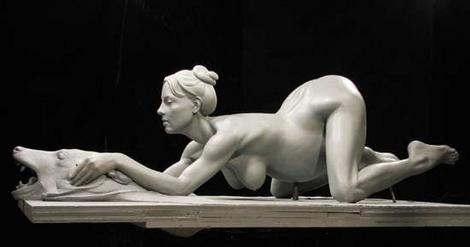
Naked & Very Pregnant Britney Spears Sculpture


March 29, 2006 - 12:35PM

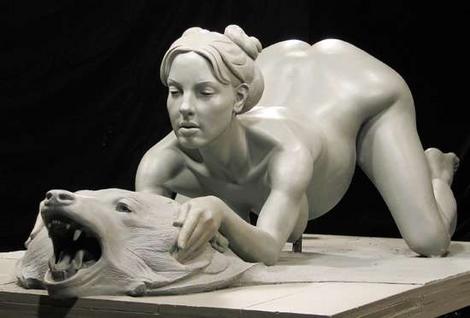
A life-sized sculpture of a naked and very pregnant Britney Spears on all fours in the process of giving birth to her first-born has drawn thousands of hate emails from around the world.

US artist Daniel Edwards has described the aim of his sculpture in its title .

"This is a new take on pro-life. Pro-lifers normally promote bloody images of abortion. This is the image of birth," said Edwards, quoted by AP.

Spears did not pose for the sculpture and is yet to comment on the subject.


A press release by the Capla Kesting Fine Art gallery in Brooklyn, which will display the sculpture next month, described the sculpture as showing Spears tugging on the ears of a bearskin rug "with water-retentive hands".

It said the sculpture "is purportedly an idealised depiction of Britney in delivery. Natural aspects of Spears's pregnancy, like lactiferous breasts and protruding naval, complement a posterior view that depicts widened hips for birthing and reveals the crowning of baby Sean's head".

The release said that the sculpture "celebrates the recent birth of Spears's baby boy, Sean, and applauds her decision of placing family before career".

"She was number one with Google last year, with good reason - people are inspired by the beauty of a pregnant woman," Edwards said in the release.

"A superstar at Britney's young age having a child is rare in today's celebrity culture," gallery co-director Lincoln Capla said.

"This dedication honours Britney for the rarity of her choice and bravery of her decision."

Edwards's exhibit also includes anti-abortion materials provided by the Manhattan Right To Life Committee.

The gallery denied the sculpture was developed from a rumoured bootleg Britney Spears birth video.

However AP reports that when some bloggers heard about the exhibit the gallery was inundated with about 3000 emails from around the world in just a week, offering angry opinions from all sides.

"We also got calls from Tokyo, England, France. Some people are upset that Britney is being used for this subject matter," gallery co-owner David Kesting told AP.

"Others who are pro-life thought this was degrading to their movement. And some pro-choice people were upset that this is a pro-life monument."

Edwards told AP the aim of his sculpture was to stir up debate about a difficult topic that "is greater than the issues presented by either pro-life or pro-choice advocates".

When asked whether he was absolutely against abortion, he told AP, "You nailed me. I'm not saying that I am. I wouldn't march with either pro-life or pro-choice advocates. This is not meant to be political."

ART TALK BLOG Reader Comment:

I think this is a beautiful image. It is stunning and inspirational. I think it is a shame the artist had to make it about Britney to get the work talked about and viewed. Ideally it would get recognition without the publicity, but we don't live in an ideal world. I appreciate this piece for what it says about the beauty of childbirth and of women. I don't think it has anything to do with Britney other than her name is used as a catalyst for the piece.

Thanks for posting this.

Meredith


KEYWORD LINKS : Origional artical: Britney depicted in controversial nude sculpture , Other images of Britiney

******


Sunday, March 26, 2006

Monet fans get a chance to make big Impression


His scenes shimmer, like memories.
They are single, fleeting moments, reminders
of life's beauty and transience.

—John Berger about Monet

Monet fans get a chance to make big Impression
Fri Mar 24, 2006 12:21 PM ET

LONDON (Reuters) - A London hotel is offering art fans a chance to emulate Impressionist Claude Monet in the room where he painted his classic studies of the Thames skyline.

For 2,600 pounds ($4,500), a couple can stay two nights in the Savoy Hotel room where Monet painted 70 canvases.

For that price, they also get an easel, paints and the advice of an arts teacher on how to reproduce the French painter's famous works.

"The teacher will also take you round London's National Gallery to see the Monet paintings there and point out what to look for. It is a mini-painting holiday," said a Savoy spokeswoman.

The Savoy's artistic tradition was started by James McNeill Whistler who painted a picture of the scaffolding when the hotel was being built in the 1880s.

Monet followed him as a guest, as did fellow artists Oskar Kokoschka and Andy Warhol.

Key Kinks: Claude Monet Online, Claude Monet - Wikipedia, the free encyclopedia,


Saturday, March 25, 2006

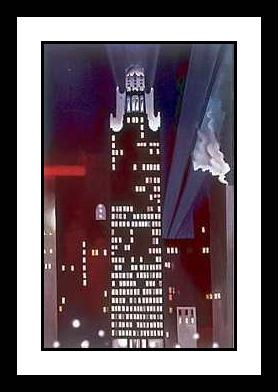
University’s Decision to Sell Georgia O’Keeffe & Marsden Hartley Paintings Challenged

by Daniel Grant

A decision by Fisk University, Nashville, Tennessee, to sell two paintings in its art collection, which had been donated in 1949 by Georgia O’Keeffe from the Alfred Stieglitz collection, has been challenged by the Georgia O’Keeffe Foundation, Santa Fe, New Mexico.

The dispute focuses on O’Keeffe’s conditions pertaining to the 1949 gift to Fisk, which included provisions that the collection be exhibited intact and that no items could be loaned or sold at any time.

In December 2005, the university applied to the Davidson County Chancery Court for permission to be released from these conditions, citing changed circumstances. This was followed in January by documents filed by the Georgia O’Keeffe Foundation, which restated the artist’s intention of maintaining the collection as a whole.

According to a statement released on February 3 by Fisk University President Hazel R. O’Leary, the historically Black institution is looking to sell Marsden Hartley’s Painting No. 3 (1913) and
Georgia O’Keeffe’s Radiator Building—Night, NewYork (1927), which art dealers have estimated could bring in a combined $16 to $20 million, in order to replenish the university’s endowment, endow faculty chairs in business, science, and mathematics, provide funding for the construction of a new science building, and pay for enhanced security and conservation for the remaining 99 works in the Stieglitz collection.

Fisk University currently has an art collection of 3826 objects, primarily African-American and African objects, according to spokesman Ken West. These include paintings by Romare Bearden and Harlem Renaissance muralist Aaron Douglas. The willingness to sell the Hartley and O’Keeffe paintings is not based on the view that “these two works don’t fit into the African-American experience,” he said, but because their deaccessioning (def: To remove a work of art from a museum's collection and sell it) is “the least disruptive way to achieve our strategic goals.”

**
Interesting to notes :
In 1926, Georgia O'Keeffe began to paint from the industrialization end of the spectrum with images of urban landscapes and sky scrappers which include: City Night; Shelton Hotel, New York #1; The Shelton with Sunspots; Radiator Building-Night, New York; New York with Moon; East River from the Shelton; Ritz Tower, Night; and New York Night. In these Georgia captured the height and distance of the structures in addition to the atmosphere in which they stand: the daylight or nighttime, the sky, the wind, etc. However, other characteristic urban components such as automobiles, streets, and people were not portrayed. In fact Georgia O'Keeffe never in her entire career painted people or any living creatures.


This is the review of the book :A beautifully illustrated, full-scale reappraisal of American painter Marsden Hartley (1877-1943), this rewarding biographical-critical study links his greatness, his mysticism and his private agony as a homosexual and an outsider. Born in Maine, Hartley retreated into his imagination after his mother died when he was eight and he relocated to Cleveland with his father and stepmother. Moving to Paris in 1912, he found his personal style in Berlin (1913-1915), blending autobiographical elements, cubist abstraction and personal symbolism. The death of a male friend, a German officer killed in battle in WWI, led Hartley to invest military iconography with erotic power. Returning to the U.S. in 1916, he reinvented himself through folk-art paintings on glass and revisionings of New Mexico's landscapes and Native American culture, a series he continued even after resettling in Berlin in 1921. Restless, plagued by poor sales, Hartley lived in Mexico, Hamburg, Nova Scotia, coming home to Maine in 1937, where he did strong figurative pictures, at once Christian and pagan, culminating in the mystical Mount Katahdin series. UC Santa Barbara art historian Robertson portrays a ``savagely direct'' painter who holds up a mirror to mainstream society.
********

Keyword Links:
O'Keeffe images, Marsden Hartley images, link to origional artical. Marsden Hartley was also a poet link to a site selling a CD with his works read - site includes free samples , Link to other art news on Art Talk Web Site (Our Index)

Posted by Paul Grant (follower of Basho)
*********
Other Books of interest:

Thursday, March 23, 2006

Warrant Issued for Arrest of Renowned Indian Artist


Maqbool Fida Hussain self portrait


Warrant Issued for Arrest of Renowned Indian Artist

03.24.06 - The New York Times' Lawrence van Gelder reports that an arrest warrant for ninety-year old Maqbool Fida Hussain, India's best-known artist, has been issued after he failed to appear in a case growing out of his painting depicting Mother India as a nude woman. After protests from Hindu nationalists, Hussain, a Muslim, withdrew the painting from a charity auction last month, but a militant organization offered $11.5 million for his murder. The warrant was issued in connection with a lawsuit filed by a Hindu in the city of Indore on the grounds that the painting was offensive. Lawyers for Hussain, expressing fears for his safety, had asked that the case be moved to New Delhi.


Saturday, March 18, 2006

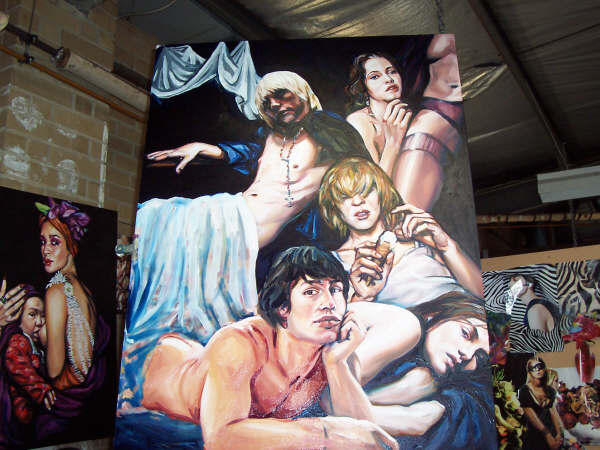
Pansexual artist Gavin Brown

Gavin Brown a New York Artist creates
according to the blogger `The Art Pimp' http://diaryofanartpimp.blogspot.com/
"semi-nudelicious paintings from one of the great pansexual art hos of our time"

Friday, March 17, 2006

Face it :: No more bombs


Protesting the War in Iraq, this protester chose his face for his canvas and produced a memorable image.

Monday, March 13, 2006

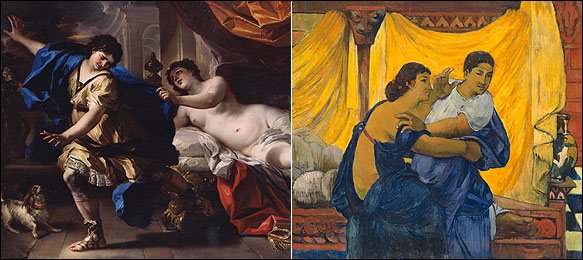
On the theme Joseph and Potiphar's Wife

Interpetation of a theme:
Paul Grant (Follower of Basho)


Left, Simon C. Dickinson, London; right, Wildenstein & Company


Solimena's "Joseph and Potiphar's Wife" (1689-90), left, is being offered for $2 million at the European Fine Art Fair in the Netherlands, while a version of that theme by Gauguin from 1896 is going for $25 million.


I found this interesting comparison of the two pictures on the same theme in an artical in The New York Times entitled : Modern Art Steps Up at Fair of Old Masters.

The artical was about an Old Masters Fair celebrating it's 27th anniversary, suddennly shpwong more modern works including prime examples of works by Picasso, Magritte, Mondrian, Jasper Johns, Robert Rauschenberg and Claes Oldenburg, and these modern masters selling well.

Modern is a clumbsy word to choose for a period, since it indicates a continuation of contemporay that actually does not exist. Choosing a better word for this time period will make for easier comprehension by students of art history in the future.

I will put a link for the New York Times artical at the bottom.

I wanted to add a little more information for our comparison of the two pictures.

First what is the scene being depicted by Joseph and Potiphar's Wife?

(see Genesis 39:1).

Joseph was a righteous young man who had been sold into Egypt. He served Potiphar, captain of Pharaoh's guard. Potiphar trusted Joseph and gave him an important position in his house. Potiphar's wife liked Joseph and kept trying to get Joseph to do wrong. Joseph refused to give in to her. Then one day Potiphar's wife caught hold of Joseph's cloak and tried to tempt him to sin. Again he refused, and he ran from the room, leaving his cloak in her hand. Potiphar's wife called to the men of the house and claimed that Joseph had come to try to do wrong with her. She told the same untrue story to Potiphar, who had Joseph put into prison. But the Lord was with Joseph and blessed him.:
"But the Lord was with Joseph" (Genesis 39:21). He loved Joseph and helped the keeper of the prison to think well of him. Soon the keeper of the prison put Joseph in charge of the other prisoners and all that went on in the prison. Joseph was successful, even in prison, because he was obedient and the Lord was with him. (See Genesis 39:2123.)

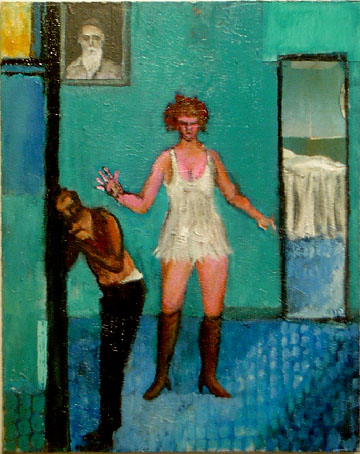
What other examples do we have of work on this theam?

(If you have others we should look at please let us know. This shows a pretty wide varriety of interpetations of the theam.)


Properzia De Rossi (1490- 1553) believed painted in 1520
(Properzia was a woman)


CIGNANI, Carlo
Italian painter, Bolognese school (b. 1628, Bologna, d. 1719, Forli)
Joseph and Potiphar's Wife
1678-80
Oil on canvas, 99 x 99 cm
Gemäldegalerie, Dresden


Marc Chagall (1887-1985)

"Joseph and Potiphar's Wife" oil on canvas (16 x 20) by Richard McBee

***
Link to the NYT artical

Friday, March 10, 2006

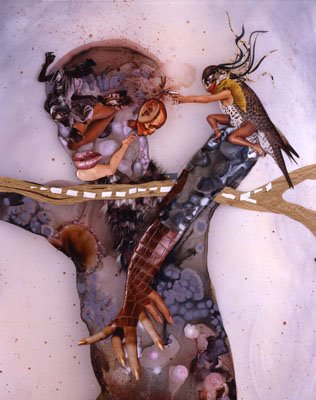
Thoughts on picture by Wangechi Mutu


Artist Wangechi Mutu
Bloody Old Head Games (detail), 2005.

at: SAN FRANCISCO MUSEUM OF MODERN ART
151 Third Street

December 16–April 02

Paul's Critique :

Learning to look is part of being an artist. An artist looks at something, either internal or external, either knowingly or subconsciously and produces a reaction to that sensation. As a viewer of art we are an extra step away from the original conception. And by original conception I am not talking about an absolute by rather a synchronic moment. That moment will have had a history of many combined concepts to arrive at a solidarity of form.

When walking a person through looking at a piece of art, I will first gather their first impressions and then ask them to notice specific parts of the picture – until it is apparent that a complete picture a grouping of distinct features. Sometimes a viewer because of their past histories may see and feel emotive energies that I do not. The key I always emphasis is that a solid work of art is a communication between the artist and the art viewer. The physical work stands as a code. It is a code that there is no decided meaning. If the artist feels ill, they might be better to write down `words’ rather than attempt to communicate with images. By abandoning language, they allow `the unspeakable’ to enter into the dialogue. By unspeakable, I refer to sensations that have no clear words that define them.

Knowing nothing about the artist, or the painting, and viewing it `freshly I can only express my personal feelings. First impressions: – it seems peaceful, it is figurative, it is not about depicting beauty, and there are two characters represented and a tree branch.

On closer inspection we see that this is not a peaceful scene. The smaller character seems to be shooting the larger. The larger character has feminine lips. The feminine hand has six oddly joined fingers coming out of a reptilian fore arm. The head of the larger picture is made up of other images. Reminiscent of Giuseppe Arcimboldo [1527-93] ( who long after his death had a strong influence on Dali)

The branch is in the upper two third of the picture and has white dashes along it, it reads to me as a code for crossing the line. Or for the larger figure the possibility of escape.

The second character, much smaller is a human morphed bird creature. It takes a dramatic pose. To me, in my perception, the pose is authoritarian. This is a David killing a Goliath depiction. Yet, the Goliath, possibly because of her feminine attributes does not come across to me as being criminal, so much as being distorted, possibly sick. There is a sense that we are to feel sympathetic for the larger figure.

As a total composition, after closer viewing has a surreal nightmarish quality. The soft tonality goes against the brutality of the story. The composition feels balanced even though it is made up of incongruous parts. It is technically well done picture. It has a recognizable storyline (though not explicit). It has interesting textural effects from the dotted background to the one figure being created out of unusual coloring while the second is done more representational realistic.

That said this is not a picture I would own. It has an unpleasant Edvard Munch “Anxiety” feeling, for me. Lingering on other people’s nightmares is fun for some, but not for me.

INSIDERS VIEWS:

"
Abuse of power comes as no surprise, as Jenny Holzer so lucidly put it some twenty-five years ago, and it remains a fitting slogan for the current geopolitical climate. Wangechi Mutu's skin-toned collages and body-referencing installation addresses the same subject—misused authority—with a range of heated corporeal references. Her site-specific installation, titled The Chief's Lair Is a Bloody Mess, includes two substantial collages, a series of sculptures, and wall works, and manages to address the dour tenor of the times by including wine bottles that drip their contents to the floor in blood-like splatters, infusing the gallery with earthy odors and Catholic subtexts. The bottles are suspended above a series of early American chairs with grafted-on leg extensions that make them seem like rickety thronelike spawn of a Louise Bourgeois spider. They face a truly dazzling constellation of red-tinted "wounds" that are gouged right out of a looming gallery wall. It's difficult not to think of violence in Iraq, though unlike our regulated media, Mutu pictures it with passion, color, and difficult truth.

—Glen Helfand"

Sunday, February 26, 2006

Villagers claim church fresco is lost Michelangelo


Parishioner's confession leads to discovery of monogram behind altar


John Hooper in Rome
Thursday February 23, 2006


No one else knows what the pensioner told the priest about what he got up to when he was a naughty altar boy. But his confession holds out the tantalising possibility that there could be a lost Michelangelo on the wall of a village church in Chianti.

For centuries the inhabitants of Marcialla have handed down the legend that a fresco above the altar was painted by the great Florentine artist in his youth. And the claim has sometimes been referred to in scholarly texts.

But it has recently been learned that, at the end of last year, a stone slab forming part of the altar was heaved aside to reveal the first visible evidence for the claim: a monogram with the letters M, B and F intertwined. MBF is thought to stand for Michelangelo Buonarroti (his name) and fecit (did (it) in Latin), a common way of asserting authorship, or fiorentino (the Florentine).

Elsa Masi, a retired chemist and the head of a local cultural association who is leading a campaign to have the fresco examined by experts, told the Guardian yesterday that the M and B were "exactly the same" as in the lettering above a crucifix attributed to Michelangelo in the church of Santo Spirito in Florence.

She said the decision to find out what lay behind the altar had been taken by the parish priest, Father Rosario Palumbo, after hearing the confession of an elderly parishioner who said that, during a prank as an altar boy, he had glimpsed the initials. Father Palumbo was not available for comment.

Asked about the identity of the parishioner, Ms Masi said: "The priest didn't want to tell me."

Stylistic verification of the claim will be difficult because the central part of the fresco was damaged by damp and painted over. But at least one scholar has said there is something of Michelangelo in the muscularity of the thief who stands on the right of the painting

Mr Masi said it was plausible that the artist had stayed in or around Marcialla in the tumultuous period after the fall of the Medicis in January 1494. It is known that Michelangelo, a Medici protege, went into hiding at one point and that he had enjoyed the hospitality of the Augustinian order.

The church of Santa Maria in Marcialla belonged to the Augustinians until 1570, coming under the authority of the prior of Santo Spirito, who had helped Michelangelo to study anatomy.

A succession of diocesan surveys between the late 17th and late 18th centuries stated that the fresco was by Michelangelo, and a scholar of the time, Marco Lastri, noted that it was "said to be by the celebrated Michelangelo".

But no one seems to have bothered with the painting again until the 1940s, when two more Italians mentioned the claims. One of them, Roberto Weiss, even ventured an attribution.

In a book published in 1942 Weiss quoted an elderly sacristan who said he had been present when a frame around the picture was removed in the previous century. He said the operation had uncovered the letters MBF. A notice was put up in the church recording Weiss's attribution.

"Yet no one ever again took an interest in this fresco," said Ms Masi.

In part, this may have been because no living person had seen the initials - until last year.

Ms Masi said: "If this is attributed to Michelangelo, then all the books that describe his early life are going to have to be rewritten."

Contest for Book Cover: Life of Pi

Karen Schneider, selected by The Age, Australia


Drawn to the power of Pi

Many people have recomended the novel Life of Pi. I have it on a stack of books to be read.
(I added Amazon Links at the bottom - you can get this book now under $3.00)

I did not know about this cover contest, but found the short list results impressive. You can view these submissions at The Time on Line Web Site at

http://www.timesonline.co.uk/article/0,,923-2044284,00.html


Details
"In October, The Times and Canongate Books launched a competition to find an illustrator for a new edition of Yann Martel’s Man Booker-prizewinning novel Life of Pi. Today we feature the five shortlisted images, chosen by our judging panel out of some 600 entries. Five more artists have been selected from those who entered via The Globe and Mail newspaper in Canada, and another five from those who submitted their illustrations to The Age in Australia. All 15 shortlisted artists will submit three more illustrations each before an overall winner is chosen in April."

The artical also had several interviews with some of the shortlisted artist. This one was my favorite artist repsonse:


LUIS LORENZANA

(Manila, Philippines)

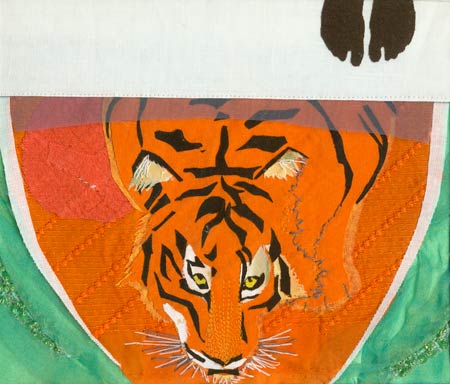
I never bought the book. When the competition came to my knowledge, I didn’t have any cents in my pocket but I wanted to enter so I went to the bookstore four days in a row to read it. I’m happy to be shortlisted. I put a lot of work in: it’s a long walk to the bookstore! My illustration is entitled The Greatest Show on Earth — it shows the scene where Pi is taming Richard Parker. It is full of emotion, conflict and excitement. Pi could die at that moment. I wanted to emphasise the space between them; to capture the intensity of the tiger and the mix of coolness and terror in Pi.

I use all sorts of media, but this was done by layering acrylic paint on paper. I wanted to make it look old and blurred, to fit the magical, mysterious effect of Pi’s story. I plan a completely different style to illustrate the alternative story that Pi tells at the end.


Thursday, February 23, 2006

Goya, Unflinching, Defied Old Age - New York Times

Goya, Unflinching, Defied Old Age

IN 1824, Ferdinand VII, lately freed from prison with French help and returned to the Spanish throne, was a vengeful despot. The Inquisition was restored, liberals were rounded up.

When a temporary amnesty was announced, Francisco José de Goya y Lucientes, court painter, friend to too many free thinkers, applied to take the waters at Plombières, in France.

He headed for Bordeaux, not even bothering to stop at Plombières, then went on to Paris, where he spent the summer. He was stone deaf and didn't speak a word of French. If he saw Delacroix and Constable in the great Salon of 1824, he never mentioned it. Delacroix belonged to another generation. In September, Goya returned to Bordeaux and settled into the expatriate community.

And there he died, at 82, in 1828, attended by his companion, Locadia, a distant relative, with whom he reportedly fought all the time, and by her two children. The younger one, Rosario, is sometimes thought to have been Goya's daughter because he said nice things about her art. Goya didn't say many nice things about other artists.

There have been many Goya shows lately. He's a man for our day, the great, unflinching satirist of everything irrational and violent and absurd in life and politics. "Goya's Last Works," at the Frick, differs from the large, rather loveless survey that veteran aficionados may remember that the Metropolitan Museum did some years ago. That exhibition tried to pigeonhole the artist as a symbol of Enlightenment values, draining the guts out of Goya. Look at the late work and you'll see, as Robert Hughes once nicely put it, that there's no less of the Marquis de Sade in him than there is of Rousseau.

The compact Frick show is sublime. An early French biographer, Laurent Matheron, writing about Goya during his twilight in exile, blew off the late work as "feeble and slack." Matheron must have been blind, or saw pictures now lost. They're certainly not here. I can't recall too many exhibitions on this scale more revelatory.

The inspiration for it was one of the Frick's own Goyas, a deceptively fine portrait of a young woman, from 1824, the sort of painting you might miss if you weren't looking closely. The curators, Jonathan Brown and Susan Grace Galassi, decided to spotlight it, and the show naturally grew, but not too much, to include other late works.

It has sometimes been said that the sitter for the Frick portrait is Rosario, which isn't too likely since she was 36, and the young woman, flushed, expectant, childishly calm, doesn't look a day over 26. Prim in white gloves and a black dress trimmed in lace, she is swiftly painted in dashing, creamy strokes that pay homage to Goya's hero, Velázquez, at the same time that they bring to mind Manet. He's the automatic association today, Manet having passed on to posterity the look of "modern" painting inherited straight from Goya.

For comparison's sake, the curators borrowed other late portraits. Goya could be a perfunctory artist, and two clunky portraits of Spaniards in Paris, Joaquín María de Ferrer and his wife, seem lifeless: diffident commissions. But then Goya also painted Don Tiburcio Pérez y Cuervo, an architect, shirt sleeves rolled up, arms folded, smiling slightly, resembling Goya as a young man. The best portraits have an intimate bond with the sitters.

The strongest bond comes across in the one of his old pal Leandro Fernández de Moratín. A poet and playwright, Moratín sat for Goya in the 1790's, when he was lean and suave. Now he's puffy and middle aged, his face built up with thick, puttylike slabs of pigment. He has the tense expression of someone who knows his portraitist will be brutally honest but who is himself a believer in truth and in the artist, and whose forbearance therefore makes him look heroic and humane. Only the savviest, most mature painter could manage to convey all that.

But then, more than 30 years earlier, Goya had already sketched a portrait of himself after a bout with death that cost him his hearing; in it he's Beethoven with Medusa's hair, all wary introspection and defiance. That drawing is in the show, as a kind of prelude for the self-portrait from 1820, painted after another illness during which Goya was attended by a friend, a doctor named Eugenio García Arrieta. In gratitude Goya portrayed them both, as an ex-voto, inscribed with elaborate thanks. Arrieta supports his ailing patient and holds up a glass of medicine. Eyes glazed, head lolling, Goya clutches his bedsheets (the gesture speaks volumes) while behind him, as if straight from his fevered brain, a noisome coven of figures, like the Fates, lurks in the shadows.

By that point, decades of violence and political calamity along with his own physical suffering had reinforced in Goya a hermetic, almost hallucinatory despair — an outlook on the world that, the portraits of his friends aside, pervaded the late work. Mankind was not inherently good, rational and free, manacled and corrupted only by tyranny and circumstance. Society was a surging mob of lost souls, hysterics and murderers. The most shocking picture in the show may be a little keepsake that Goya dashed off before quitting Madrid. It's of his son, Javier, a wastrel, whom Goya loved anyway. He is drawn as fat and dissolute, a lost soul staring vacantly. With Goya, truth trumped love. But life was still worth living to the very last minute, if only for the reason that Goya scrawled across a sketch of a hunchbacked Methuselah: "I Am Still Learning."

He was. Nearly 80, he took up lithography in Bordeaux, making prints of bullfights in the workshop of Cyprien Gaulon — Goya's portrait of whom, all velvety touch and measured nobility, turns him, like Moratín, into a romantic hero.

Bullfight scenes didn't appeal to the French, but lithography inspired Goya to draw with black crayon, another new medium for him. His Bordeaux drawings bring to mind diary entries. He spotted a roller skater, head tossed, on the verge of toppling backward, alongside a bicyclist. He saw a woman crammed into a shoulder carriage, like a giant backpack with a little window, being lugged by a stooped porter. And he noticed an amputated beggar, wide-eyed and slack-jawed, in a huge contraption of a wheelchair that, like a chariot, enclosed him between its two great front wheels, making a triangle of the composition.

He also visited a madhouse in Bordeaux and drew a lunatic, a monstrous figure, wearing a loose sack, twisting like a Michelangelo slave, his arms behind him, his legs buckling, his head a gnarled mass of thatched hair and knotty bone. A single, haunted eye swivels into the man's skull. As Mr. Hughes put it in his Goya biography, the eye was a stroke of genius by "an old man who had suffered immensely and known every last terror of black melancholy."

And then there is the imploring penitent on his knees, maybe another of the madhouse inmates, although his pose, arms raised, is like the famous patriot's before the firing squad in "The Third of May."

It's hard not to see him and all the other old men in these late works as implicit self-portraits. They're fools, donning bat wings, moving herky-jerky before women invariably more graceful and powerful than they are. A dwarfish constable clutching a set of keys beseeches a young beauty wearing a giant padlock. He's a thwarted Romeo. A groaning, half-naked old man, pinioned by a woman, has the devil on his back. Even a flying beast, part Icarus, part Cerberus, with webbed feet, crashing to earth — one of Goya's classic nightmare inventions — seems to symbolize man's hubris and impotence.

I don't mean artistic impotence, of course, not with Goya, who tried his hand at yet one more new medium in Bordeaux. He painted on palm-size slivers of ivory — "original miniatures, which I have never seen the like of before," he boasted, rightly. On a dark, wet ground, he let fall a drop or two of water, whose blots and granulates suggested shapes, like the ones that Leonardo imagined in stains on old walls.

Goya conjured up a screaming monk and a goggle-eyed woman. A man picking fleas. Judith hacking off the head of Holofernes. A nude reclining, paint wiped from the ivory to connote flesh. And Susannah ogled by the elders, the standard fable of chaste youth and pathetic, dirty old men.

Broad fields of light and dark make these ivories like flashbulb snapshots. Immediate and exquisite, they're nearly monumental. Like the late works of Titian or Rembrandt, Goya's late works achieve a whole new level of freedom and depth, haunted by death but exalted. The Frick has picked for the show's poster the perfect image: one of the creepier Bordeaux drawings of a thick and stumpy old man on a swing, leering as he vaults skyward.

You can almost hear Goya cackle.

"Goya's Last Works" continues through May 14 at the Frick Collection, 1 East 70th Street, Manhattan; (212) 288-0700, or www.frick.org.


Sunday, February 19, 2006

Forget a thousand words. This picture's worth $2.9 million -

Forget a thousand words. This picture's worth $2.9 million

NEW YORK (AP) -- A photograph of a pond taken by Edward Steichen sold for more than $2.9 million, easily setting a world record for the highest-priced photograph ever auctioned, Sotheby's said.

"The Pond-Moonlight," taken in 1904 at Mamaroneck, New York, sold Tuesday for $2,928,000, including the buyer's premium, Sotheby's spokesman Matthew Weigman said. The buyer's identity was not immediately disclosed.

The photograph shows a pond in a wooded area with light coming through the trees and reflected in the water. Pre-sale estimates priced the photo, which is slightly bigger than 16 inches by 19 inches, at up to $1 million. The only other two prints are in museum collections.

The previous record for highest price for a photograph at auction, $1,248,000, was set in November by Richard Prince's "Untitled (Cowboy)." (ABOVE)

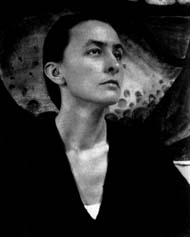
Also surpassing that record on Tuesday were two photographs of the artist Georgia O'Keeffe taken by Alfred Stieglitz, her husband. A photograph of her hands sold for $1,472,000, and a portrait of her nude sold for $1,360,000, Weigman said.

All three photographs were among a group of close to 140 scheduled to be auctioned by Sotheby's on Tuesday night and Wednesday morning.

The photographs have been put up for sale by the Metropolitan Museum of Art from its

acquisition last year of the more than 8,500 photographs in the renowned Gilman Paper Co. collection.
Some of the Gilman works duplicated material already in the museum's holdings so they were put up for auction, as were some photographs in the Met's collection that were in better condition in the Gilman collection.

Stephen Perloff, the editor of The Photograph Collector, a newsletter about the photography art market, said before the Steichen auction that it would be a "moment of history."

The entire sale is estimated to bring in between $4 million and $6 million, said Denise Bethel, director of the Sotheby's photography department. The proceeds will go toward defraying the costs of acquiring the collection.

Copyright 2006 The Associated Press. All rights reserved.This material may not be published, broadcast, rewritten, or redistributed.


Find this article at:
http://www.cnn.com/2006/US/02/14/photo.auction.ap/index.html

Thursday, February 16, 2006

There's More to Life Than Screaming - New York Times

There's More to Life Than Screaming - New York Times: "February 17, 2006
Art Review | Edvard Munch
There's More to Life Than Screaming
By GRACE GLUECK

EDVARD MUNCH'S vision of modern angst, 'The Scream,' has been much in the news lately. The trial of six suspects in the theft of one version from an Oslo museum began this week; the painting has not been recovered. The image of 'The Scream' has been so widely embraced and reproduced that if you hear the name Munch 'The Scream' comes instantly to mind, and vice versa. Yet Munch (1863-1944) regarded 'The Scream' as an aberration, one that cast the shadow of insanity on a body of art that he intended to address more universal aspects of human experience.

'Edvard Munch: The Modern Life of the Soul,' an affecting full-scale retrospective that opens Sunday at the Museum of Modern Art, presents this broader view. The first survey of the Norwegian painter in an American museum in almost 30 years, it was organized by Kynaston McShine, chief curator at large of the Modern. Its more than 130 oils and works on paper cover Munch's entire career, from 1880 to 1944. It also includes a large selection of the prints — many of them ingeniously adapted from his oils — that played an important role in his art."

Tuesday, February 14, 2006

New Orlean benefit photographic exhibition.


New Orleans Our Hometown, Inc. (NOOHT) a non-profit corporation, will host an international benefit photographic exhibition. Donated entries will be accepted now through March 3, 2006.


All entries to "New Orleans Our Hometown: Photographs from a World of Admirers" will be reproduced and made available for purchase with 100% of net profits donated to A Studio in the Woods, New Orleans, Louisiana to fund artist in residency programs for artists displaced by Hurricane Katrina.


All submitted entries will be displayed at LeMieux Galleries, New Orleans, Louisiana throughout 2006.


"New Orleans Our Hometown: Photographs from a World of Admirers," has been created as the exhibition theme in the aftermath of Hurricane Katrina to serve as a memorial and a testimonial to what has been lost and forever altered. The exhibition seeks to create a dialogue focusing on the city of New Orleans, a city of unique qualities and character that holds a place of honor in the hearts and minds of the world

For information on how to submitt work- please go to thier website at: http://www.nooht.org/web/

Monday, February 13, 2006

ARTISTS REFLECT ON THE DEATH PENALTY.

Justice For All?

The death penalty has come under intense criticism of late. Innocent people have been released from death row after years of wrongful incarceration. Other innocents, such as Ruben Cantu in Texas, may have been wrongfully executed. Calls have been made to stop all executions and investigate the system or to abolish it once and for all.

We are organizing this international, all-media, juried art show to foster the creation of new artwork on the death penalty, to celebrate artwork that may already have been created and to encourage and enhance civic engagement and dialogue about the death penalty.

Democracy is animated when an informed public is engaged in the issues of the day. We hope this art show will reach new and diverse participants and audiences and will stimulate public dialogue about this contemporary social issue and inspire action to make change. Art is a wonderful medium for the transformation and awareness of the world.

We welcome submissions from artists who engage the issue from all sides.
Deadline for Submissions: March 20, 2006. Exhibition: May 6-22, 2006 in Austin, Texas


THE DEATH PENALTY ART SHOW IS SPONSORED BY AND COPYRIGHT © 2006 TEXAS MORATORIUM NETWORK.
More info at:
http://www.deathpenaltyartshow.org/index.html

Sunday, February 12, 2006

Scott Covert - More than just rubbing grave stones


Scott Covert started exhibiting his artwork in 1979 at Club 57 in New York at a show curated by the now deceased famous New York artist Keith Haring. I find this element of Scotts Bibliography curiously apropos with the work he’s involved with now being his “Grave Rubbings”. Working on large canvas sheets Scott starts out doing single rubbings, but the work quickly evolved into what he thinks of as cocktail parties for the dead (more or less), in which he puts together the guest list. As with any good party, the original list often gets blurred, with names added and deleted on the spur of the moment. In Scott’s work, one person sometimes gets layered over another, reflecting not only the randomness of life and death, but of memory and history. Lives get covered over, perhaps forgotten.


They are portraits, in a sense, and they reveal the intensely personal connection Scott makes with his “subjects” while on his knees, on their graves, rubbing away and meditating on their lives. Certainly, there is a Dr. Frankenstein element here as well, almost a sense of re-animation through the hand of the artist, and in the combinations of different elements with the various personalities.

Scott Covert is being shown right now in Illinoios at at Plan B Gallery, 7453 W. Madison; Forest park Illinois.

His web site is at:
http://www.enthrive.com/covert/pages/info.html
 
*/ /* Use this with templates/template-twocol.html */